Up next in 10



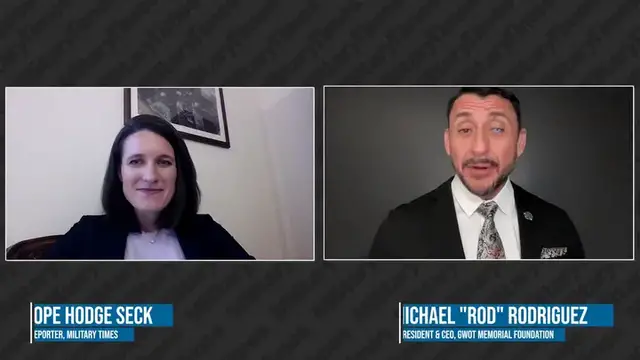
Head of the group behind the forthcoming Global War on Terrorism memorial says first public renderings are not the "final concept," and changes are expected.
Show More Show Less View Video Transcript
0:00
Rudd, thank you so much for joining us today
0:09
No, thank you for taking the time to talk with us. So really, really excited to have the chat
0:14
So a lot has happened in these last few days and weeks here
0:19
The memorial design that we've been waiting on for a very long time was just unveiled
0:24
And the response has been decidedly mixed. So some specific criticism I've heard has had to do with the ambiguity of the design and the lack of the names of the fallen worked into it
0:37
So I would love your thoughts on any of that. But first, can you bring us up to speed on what has happened since that design was unveiled
0:46
Sure, of course. Well, first and foremost, I'm excited for the spirited conversation that sparked, you know, us unveiling the design
0:53
I think it's important to note that this is our initial design concept. never before has this step been taken to where the American people are shown a design before it
1:03
goes through the incredibly arduous and rightfully so approval process. So we showed it to everybody
1:10
so they could get an idea of where we're at, but then also continue on a trend that we started in
1:16
2018 was to listen. Even with my levels of service and experience and my families and the fact my son
1:23
is four years old when the towers fell and he's deployed several times in this in the G-WAT
1:29
We need to start listening. I'm not an expert. I don't think any individual really is. So
1:34
you know, we were excited to be able to unveil the initial design concept with the world on
1:40
how kind of how we got here. You know, it's been an eight year process, listening and taking into
1:45
consideration the individuals that served and sacrificed as well as embodying the American
1:50
people pretty much along for the ride. And can we, before we talk about that listening process
1:55
and everything that went into it, let's talk about the design itself. Can you walk us through
2:02
the basics, the different zones it contains and what the intent is for what should be felt as
2:08
veterans of this war walk through it? Sure, of course. So one of the most common themes that we
2:15
gleaned or the with the whether it was the 20,000 individuals that contributed
2:20
design data and our design advisory council they wanted a place to gather
2:24
they wanted people a space where they could come together tell stories celebrate
2:28
life and in addition to that one of the other very probably I think the most the
2:34
strongest thing that people wanted or design element was water so that that those are some of the things that were kind of in part of the design process that really informed the design itself So it
2:46
if someone were to just take a step back and look at it, it really is, it's, if you were to look at
2:51
it as a hemispherical amphitheater, that is really kind of what the design is based off of
2:57
you know, a place that come together and particularly a Greek amphitheater, because
3:02
those are hemispherical in nature, as well as several of the design elements that are incorporated into it as well
3:10
One of the most impactful design elements really are the footsteps. Now, we faced an incredible challenge
3:18
One of the first things that we started addressing in 2018 was, okay, the names, the names of the fallen
3:22
But it was really important for us to tell the entire story on how we fought this war
3:27
You know, we were there are several people that have lost their lives that weren't in a uniform capacity
3:34
As a matter of fact, our first KIA was a gentleman by the name of Johnny Michael Spann
3:38
He was killed November 25th, 2001. He was in the CIA at that point
3:42
And so we wanted to capture those stories, but also tell the stories of the family
3:46
So the footsteps incorporate that element and also recognizing the fact that the war comes home
3:51
So we have footsteps to recognize that when I mean the war comes home more often than not
3:56
more often, but oftentimes, you know, we talk about veteran suicide quite a bit. Well, let's
4:02
talk about that. Let's actually recognize whether it be a veteran suicide or some mysterious illness
4:08
they got through their service. We wanted to capture everything in there. So those are a few
4:12
of the design elements. So kind of, you know, summing it up, that's really kind of how we got
4:17
to this space. And you mentioned this quantitative data that you brought to the designers to work
4:23
with. Can you talk about how you gathered that and specifically how veterans have had opportunities
4:29
to have their input into this process? Absolutely. So it began in 2018 and it was
4:36
when I say qualitative quantitative data, you know, we had some designers help write that. That's not
4:41
a survey I would know how to create. So we had our, some designers with us put that together
4:46
And then we started asking questions from Gold Star family members, veterans, activity service
4:50
members, veterans of families, and also those that weren't a veteran family
4:56
We wanted to capture how America felt about this. And then we launched it digitally for a period of about five months, a few years ago, to
5:05
kind of grow on the data that we had started collecting in 2018. And, you know, the goals were really to get input from all 50 states, as opposed to, you
5:14
know me running around with a clipboard and the team running around trying to gather the data to all 50 states and every military service branch Over a period of about five months we got 20 respondents from all 50 states in every veteran
5:26
demographic from World War II to today, because the only thing differentiates veterans or those
5:32
that serve is their time period. So, you know, this motivation is to raise our right hands and
5:37
say all the words that we all share is the same. You go back to 250 years we've existed, it's still
5:43
the same. So we were able to capture that and that was put in a report. And some of the data
5:47
we got from that, like I referenced earlier, was the water. People wanted water there
5:51
They wanted, people wanted green space, you know, overwhelmingly. People wanted an opportunity to
5:58
come together and do more than, you know, just sit for a moment. They wanted to have opportunities
6:05
to engage. So all of that was handed to the designers after we completed our design engagements
6:11
with our design advisory council as not only the 23 members of our design advisory council's input
6:17
the direct input they provided, but then some supplemental information to really capture the voice of America
6:21
So we've always been listening and even we're still listening. You know, when we unveiled the design on the 10th, then that's when we launched another survey
6:30
Hey, tell us what you think. Because, again, I think I said it earlier was we wanted to bring everyone along for the ride
6:36
But really, me and the whole team, we really felt it's our duty to show everybody, hey, this is what we have
6:43
We're still listening. Never did we think this was the final concept
6:47
We all expected changes for a number of different reasons. But that kind of sums up where we got
6:57
How much leeway is there when you talk about things can be changed, we're going to refine the design
7:04
how much flexibility is there to do a variation on this design that's been unveiled
7:12
What's set in stone and what can be changed? What are the limits to what you can do
7:18
Yeah, well, I don't know if I can really answer that question because we're taking the feedback seriously
7:22
We're getting, you know, a lot of feedback. So it's a matter, we got to be sure that we look at the feedback we receive
7:31
balance that with the design data, as well as, you know, the approval authorities, and then work
7:37
forward. So I would struggle. I don't know. I'll be honest to tell you, you know, it would be
7:42
difficult and overreaching for me to say. What would have been the most instructive
7:49
or even surprising pieces of criticism, or feedback, I would say that you've gotten so far
7:54
I would probably have to say The Shape of it People don recognize it as an amphitheater They don see that And that probably one
8:06
I wouldn't say it's a criticism. It's a very strong observation. They're like, oh, what is that
8:11
I think that's one of the items. But in addition to that, I think there's some key factors that when people look at something to get a face value, we'll look at all the other elements incorporated into it
8:23
And I do believe that there's a lot of people that are missing some of the elements
8:27
They're going to look at a photo. And that's fine. That's absolutely fine. Tell us what you think
8:31
But I invite everyone to dig deeper into it, see some of the structural elements, look at the footprints, look at the interactive components, look at the fact that the steel that we are incorporating is actually some of the weapons and vehicles we used in global war on terrorism
8:47
Do you feel there's a pathway to maybe for a veteran who saw the design, felt very critically about it or did not immediately like it and to build trust with them over time and to help them experience it in different ways
9:04
What would that pathway look like? Well, doing exactly what we're doing right now is listening
9:09
You know, their voices matter. I value it highly, right? Whether they served, whether they're a family member, or our most cherished stakeholders are those that lost a loved one
9:20
You know, there is a pathway to it. But this is, again, we took so many additional steps that have never been taken before that we wanted to incorporate that
9:29
This has been a pattern of listening since 2018. And, you know, some people may have never heard of this effort until now
9:37
And it's really important that I hope people understand or at least accept that we're still listening
9:43
We still have to take it to the process to get it approved. But typically what will occur is it'll be approved before anyone else sees it
9:50
So we've taken additional steps to make sure their voices are heard
9:54
And the pathway forward is each of us have our own individual journeys
9:59
Each of us have our own things that we have to, whether it be memories or whether it be things that we still need to address
10:07
as individuals. And I think people, it would be great if people to look at some of the
10:12
I won't say controversy, some of the contention with the Vietnam Veterans Memorial, you know
10:17
and look at what occurred then, right? We're taking some additional steps. We want to tell
10:23
the entire story and we welcome it. We're not, there's no defensive posture on our side whatsoever
10:28
is we want to be sure that people understand we've been listening for eight years at this point
10:32
and we're still listening. you
news