Up next in 10


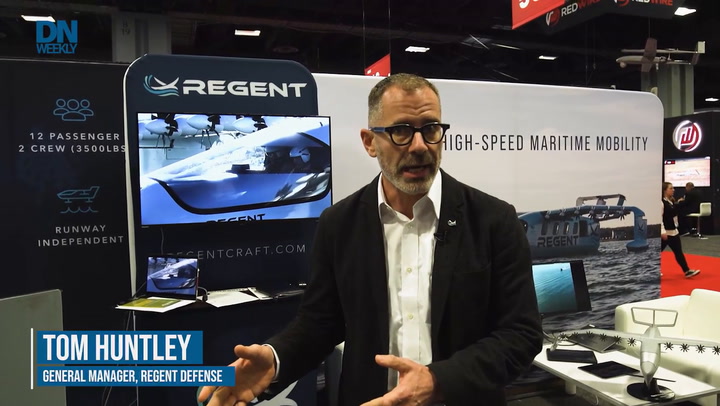
Regent Defense shows off its new hydrofoil drone that can loiter in the water, take off and fly at low altitude, then land again on the surface after a mission.
Show More Show Less View Video Transcript
0:00
At Regent, we build sea gliders
0:04
Sea gliders are a new form of maritime transportation. They float, foil, and fly
0:10
So it's a hydrofoiling wing and ground craft. Operates on its hull just like a boat off of existing dock infrastructure
0:16
Comes up on hydrofoil. It's up to 50 knots or, you know, 45 miles an hour or so
0:22
And then takes off actually low over the water, flying in an aerodynamic regime called ground effect
0:26
that gives it incredible range and low signature properties in the defense market
0:31
There's an incredible need for infrastructure independent maritime capability, whether that's Contest Logistics, Kinetic Strike, ISR
0:40
And so the Department of War have actually been looking towards a number of different solutions in that space
0:46
And that's exactly where we thrive. We can operate in the littorals, in the open ocean, at speed
0:52
So it's high speed, long range, low signature capability for the warfighter
0:57
When we were building out the design and vehicle systems for the sea glider
1:02
we built a quarter scale tech demonstrator called Squire. There's incredible demand signal for an unmanned maritime asset
1:11
that can perform in all weather conditions and all sea states. And so we've actually built out the, not just the tech demonstration
1:19
but now the capability of that asset as a drone platform for ISR critical medical delivery supplies and even kinetic delivery From a mission standpoint Squire enables an asset to fly low over the water
1:37
incredibly fast, but also land on the surface in Loiter, staying for even days, picking up intelligence
1:46
keeping track from video and audible signals, sonar below, radar on the surface
1:52
and even tracking aerial assets, and then can either be brought home or repositioned
1:57
And multiple Squires can work in concert to do search and rescue
2:02
to do protective mesh net sort of operations. So it gives a new capability into the warfighters
2:10
One of the key aspects of Squire is its speed. So it can be loitering on the surface
2:15
but if it needs to move to another location or track a target, it can come up from its hull, actually flying low over the water
2:22
It speeds nearly 100 knots. well over 100 miles an hour and has incredible range
2:28
So it gives us versatility in the maritime space. So at Regent, we are testing sea gliders all the time
2:36
Every day we're floating and foiling and flying. In fact, Squire was out doing operational testing
2:42
just yesterday and we are entering into the high-speed hydrofoil and soon-to-be flight phase of our full-scale
2:49
15,000-pound vehicle, human-controlled, human safety triple redundant flight control and vehicle control systems all built out for the safety and efficiency and effectiveness of our missions So Viceroy our full sea glider has a payload capacity of 3 pounds
3:11
That's up to 14 Marines in the craft and has a range of 1,400 nautical miles. That's 1,600
3:19
statute miles. That's enough to get from Guam's second island chain to Okinawa first island chain
3:24
and into Taiwan in a matter of hours, not days. Squire, on the other hand, a small platform, still has incredible capability
3:33
It can carry 50, we're actually expanding that, hopefully into 70 pounds of payload
3:39
and range well over 100 nautical miles at speeds of up to 70 knots
3:43
So, again, high speed, long range. And importantly, because they're flying low over the water
3:48
it's this low signature where they're below line-of-sight radar. They're not disturbing the water column
3:54
So incredibly clandestine, even at those speeds. So operating in ground effect, which is defined as within a wingspan of the surface
4:01
So we operate in the full-scale Viceroy at around 30 feet over the water
4:08
That does a number of things. One is it's below line-of-sight radar, so it keeps that low signature
4:14
but also gives an incredible aerodynamic benefit. So we're actually reducing the thrust and increasing range, and therefore our payload
4:24
for the platform. So that again where we get this high capability in a platform that doesn require you know years in flight school or anything In fact it could even be operated by crews with a few months of training
4:41
One of the key benefits of sea gliders is all-weather capability, and that's really the
4:46
hydrofoils come in. Hydrofoils extend down below the water and actually provide an underwater wing
4:51
that lifts the vessel up out of the water. And that gives incredible sea state capability
4:57
actually up to sea state four, waves as tall as I am, nearly six foot tall
5:02
And that gives also the ability to take off and land in other than favorable weather conditions
5:09
And that's really what we need in the operational environment is that condition flexibility across
5:15
whether it's high sea state, high winds or storms, because that's when we really need that capability
5:22
So one of the most exciting things at Region is we're building our manufacturing facility
5:26
a quarter million square foot factory, and we're going to start producing sea gliders
5:32
both for commercial passenger transportation and, importantly, for our warfighters. So that factory actually opens up later on this summer, and we're going to take possession in summer 2026
5:44
and we'll start manufacturing and deliveries as early as 2027. So this technology is not just a render or not just a prototype
5:54
This is real-life technology that we're building out and ready to manufacture at scale
#news