Up next in 10



When you think of an American Girl doll, you probably think of wholesome history lessons, inspiring role models, and childhood nostalgia.
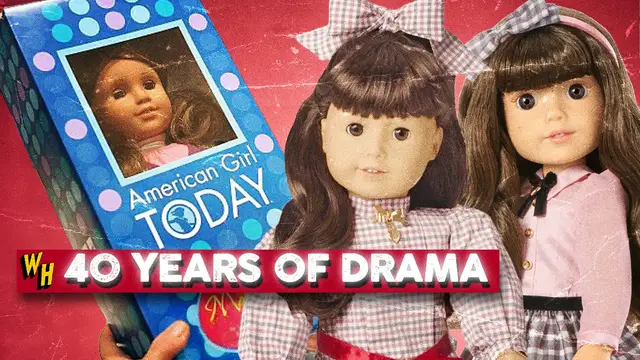
But despite their educational mission, American Girl has found itself at the center of controversy again and again. From surprising historical inaccuracies to culture wars and collector backlash, the beloved doll brand has repeatedly sparked debates no toy company ever expected.
Show More Show Less View Video Transcript
0:00
Since 1986, American Girl dolls have taught millions of kids about history, empathy, and resilience
0:07
They've represented groups not typically seen in the toy aisle, and taken on subjects most other toys wouldn't touch with a 50-foot slip and slide
0:15
At the same time, they can't seem to go more than a few years without stepping into some controversy
0:21
And that's why, today we're taking a look at American Girl, the doll that can't seem to stay out of trouble
0:30
The story of American Girl begins with a woman named Pleasant Roland
0:36
Yes, that is her real name, and yes, it is perfect. Roland was the oldest of five children and grew up in the suburbs of Chicago
0:44
After graduating from Wells College in 1962, she spent several years as an elementary school teacher
0:49
before becoming a news anchor and reporter for KGO-TV in San Francisco
0:54
She eventually moved into educational publishing, where she developed reading programs for children
0:59
By the mid-80s, Pleasant had built a career around one central belief
1:04
Children learn best when the material captures their imagination. The idea for American Girl came to her during a 1984 vacation to Colonial Williamsburg in Virginia
1:15
Roland was struck by how powerfully the living history experience brought the past to life
1:20
She would later recall sitting on a bench in the shade, thinking about what a poor job schools do of teaching history
1:26
and wondering if there was a way to bring that history alive for kids the way Williamsburg had for her
1:32
Using $1.2 million she saved from textbook royalties, she founded Pleasant Company in 1986 and got to work making dolls
1:41
The first three American girls launched were Kirsten Larson, a Swedish immigrant settling in 1850s Minnesota
1:48
Samantha Parkington, a well-to-do orphan living in the Edwardian era of 1904
1:53
and Molly McIntyre, a girl navigating life on the American home front during World War II
1:59
Each one came with a six-book series written at a third-grade level, which included surprisingly difficult subjects like poverty, child labor, and war
2:07
albeit handled in ways appropriate for young readers. The company made $1.7 million in its first year and $7.6 million in its second
2:17
Given that success, over the following years, They expanded the family with characters including Felicity Merriman, a spirited girl during the
2:25
American Revolution, Addie Walker, a formerly enslaved girl escaping to freedom during the
2:31
Civil War, Josefina Montoya, living on a rancho in New Mexico in 1824, Kit Kittridge, navigating
2:38
the Great Depression, and Rebecca Rubin, a Russian-Jewish girl growing up in New York in 1914
2:44
Referring to American girls' ability to wrap history lessons in a fun package
2:48
Roland called the dolls chocolate cake with vitamins, and in 1998, she sold that vitamin cake to toy giant Mattel for $700 million
2:58
Since then, Mattel has sold over 36 million American Girl dolls. Before we get to the controversies it worth taking a moment to appreciate what American Girl actually got right because they did get a lot right At a time when the dominant doll options in the toy aisle were baby dolls and Barbie American Girl offered something different characters with inner lives historical context and real struggles
3:27
They introduced young readers to immigration, racial injustice, wartime sacrifice and economic hardship through the eyes of girls their own age
3:35
For many children, these were their first brushes with those parts of American history
3:39
The dolls also made a deliberate effort to represent groups that were largely absent from the toy market
3:45
Addie Walker, for example, was the first black American Girl doll and was introduced in 1993
3:51
This was also the first doll in the line with a different face mold, hair texture, and skin color
3:56
Josefina brought Latina heritage to the line. Kaya Atonmai represented the Nez Perce people
4:02
with American Girl working directly with the Nez Perce Advisory Board in her creation
4:06
In fact, the company consulted historians and cultural advisors extensively for each character
4:12
As a result, the Addy Books Alone, vetted by black historians and written by author Connie Rose Porter
4:18
sold over a million copies within a year of publication, an impressive figure for book sales by any standard
4:24
Beyond the historical line, American Girl expanded to offer dolls with hearing aids, wheelchairs, crutches, and hair loss options
4:31
The Truly Me line introduced over 100 different doll variations to allow kids to find a doll that genuinely looked like them
4:39
And these variations weren't afterthoughts. They were built right into the brand's stated mission from the beginning
4:45
And then there are the fans. American Girl has cultivated one of the most devoted fan communities in toy history
4:52
There are adult collectors, historians. I'm responsible for ensuring the historical accuracy of all our characters' products and stories
4:59
and even a podcast called Dolls of Our Lives, hosted by two actual historians
5:04
It explores the books chapter by chapter and received coverage in The New York Times
5:09
Not surprisingly, the brand was inducted into the National Toy Hall of Fame in 2021
5:14
There's even an unofficial stage musical. What we're saying is the American Girl doll love is real and it runs very, very deep
5:22
So here's the thing about trying to represent all of American history
5:31
It is very, very hard to get it right every time. And unfortunately, American Girl, for all its genuinely good intentions, has stumbled more than once
5:43
Addie Walker is one of the most meaningful and most debated dolls in the line's history
5:49
Introduced in 1993, she was American Girl's first black character, and American Girl's
5:55
deliberate choice was to make her story one of escape from slavery during the Civil War
6:00
The books, written by Connie Rose Porter and vetted by black historians, were even praised
6:05
for their authenticity and earned widespread acclaim. The question that has followed Addie
6:10
ever since, however, is a real one. Namely, why was the first black American Girl doll
6:15
an enslaved person. Many in the African-American community didn't particularly love the idea that
6:21
the first doll to look like them was defined by bondage, even if her story was ultimately one of
6:26
courage and liberation As writers and scholars have noted there a meaningful difference between a story that includes slavery and a story whose very premise positions a black girl as someone escaping rather than living freely
6:39
In other words, the concern wasn't that Addie's story wasn't important or beautifully told. It
6:44
was about what it means to make slavery the entry point. American Girl's second black historical
6:49
character, Cecile Ray, was notably different. Cecile was a well-to-do free black girl in New
6:55
Orleans, and the contrast was not lost on anyone. In 2005, American Girl's Girl of the Year was
7:05
Marisol Luna, a dancer and the first Girl of the Year of color. She was meant to represent the
7:10
Chicano-Mexican community of Pilsen in Chicago. Her book described the neighborhood as dangerous
7:16
and it featured a story about her leaving Pilsen for the suburbs. However, the residents of Pilsen
7:21
which was actually a vibrant community, weren't all that thrilled by the depiction
7:26
As a result, they protested outside the American Girl store in Chicago
7:30
American Girl responded by saying the passage had been taken out of context
7:35
The book's author, Gary Soto, however, retired from children's literature following the controversy
7:40
You can draw your own conclusions as to why. In 2009, a friend doll named Gwen Thompson was introduced as a companion to that year's
7:51
Girl of the Year. Gwen's story involved homelessness. She had lived in a shelter
7:56
and at one point in her mother's car. The intention was to acknowledge a real and often
8:01
invisible part of American life. The problem that critics immediately pointed out, however
8:06
was that the doll cost $95. In other words, the communities most directly affected by homelessness
8:12
were unlikely to ever be able to afford the doll meant to represent them
8:16
It was a bad look, and American Girl stepped back from tackling heavier social issues in
8:21
their storylines for several years afterward. In 2014, American Girl announced it was discontinuing four characters
8:31
including Cecile Ray and Ivy Ling, the only Asian American historical doll in the collection
8:37
The company described it as a business decision to move away from the character friend strategy
8:42
but fans didn't seem to want to move in that direction. The public, particularly Asian American
8:48
and African American advocates, pushed back hard. American Girl, however, discontinued the dolls anyway
8:55
Since then, five more black American Girl characters and two more Asian American characters
9:00
have been added to the line. However, both of the new Asian American characters
9:05
Corinne, who is of Chinese descent, and Kavi, who is of Indian descent
9:09
are contemporary dolls, not historical ones. As of today, there has been no Asian American historical character released since Ivy was discontinued
9:20
The 2021 Girl of the Year, Kira Bailey, was an animal lover who visits her aunt's wildlife
9:27
sanctuary in Australia, and those aunts, Mamie and Lynette, were a married same-sex couple
9:32
Conservative groups, most notably One Million Moms, petitioned to have the doll and its
9:38
books discontinued, viewing it as attempting to normalize same-sex marriage. American Girl however stood by Kira and refused to pull the doll It was one of four times the brand had been the target of anti plus boycott campaigns but the only one tied to a specific character
9:58
Throughout all of this runs a tension that American Girl has never fully resolved. Namely
10:04
the dolls were created to represent communities that were underrepresented and underserved
10:09
but their pricing has put them largely out of reach for many members of those very same
10:13
communities. A standard 18-inch American Girl doll today, for example, starts at $135, and that's
10:21
not including accessories. A beach car accessory for the doll costs $275, and the flagship store
10:28
experience in New York City, with a doll salon, cafe, and photo studio, can easily run $600 for
10:34
a single visit. In other words, across most of the brand's history, the high price and limited
10:39
retail locations have meant that the dolls are often completely inaccessible to the very
10:44
communities they're designed to honor. A doll that represents a homeless girl costs nearly $100
10:50
and a doll representing immigrant communities requires a trip to a flagship store in a major
10:54
city or an online order that isn't in the budget for many families. Again, it's not such a great look
11:01
American Girl turns 40 in 2026, and the brand is at an interesting crossroads
11:12
At its mid-2010s peak, the line generated over $600 million in annual sales. By 2023
11:18
that number had fallen to roughly $200 million. The brand has since posted five consecutive quarters
11:23
of sales growth, but ysts seem to see that as stabilization rather than a full recovery
11:29
Meanwhile, the dolls continued to create new and interesting controversies. For example, in early 2026, to mark the toy's 40th anniversary
11:38
American Girl announced a new Modern Era line. The new line features updated versions of the classic characters in contemporary clothing
11:46
but the new versions are notably slimmer, a detail that has not gone unnoticed by their fanbase
11:53
And the response from that devoted fan community was swift. social media filled with reactions like
11:58
what in the Bratz doll is this? And did they snatch their waists
12:03
And perhaps most pointedly, Kirsten didn't endure six weeks on a boat across the Atlantic
12:07
and lose her best friend to cholera for you to give her the Ozempic treatment and space buns
12:12
The historical dolls were always about honoring the past. In that spirit, the fans now seem to feel
12:19
that should include honoring the pasts of the dolls themselves. American Girl was built on a belief that history matters
12:26
that representation matters, and that children deserve stories that take them seriously
12:31
That belief is still evident in everything the brand does. Now, after 40 years, the question is whether a company can keep getting better at living up to
12:40
its own ideals, and the fans are clearly watching. From a bench in Colonial Williamsburg to $36
12:46
million sold, American Girl has spent four decades trying to do something genuinely hard
12:52
make history interesting for kids, and make them feel like they belong in it
12:56
They haven't always gotten it right, but those who ignore history are doomed to repeat it
13:01
And if there's one thing we can say about American Girl dolls, it's that they rarely ignore history