Up next in 10



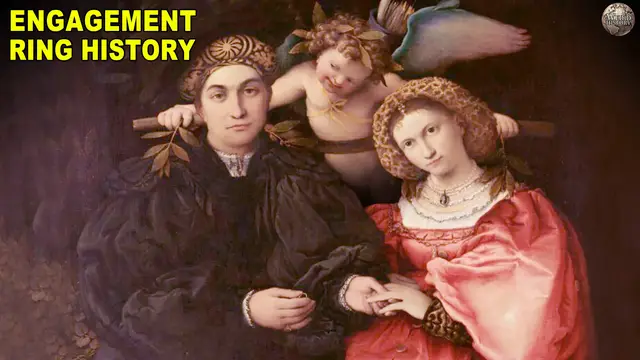
Why do engagement rings exist? And why do engagement rings have diamonds? It turns out, betrothal rings are much older than diamond engagement rings. Before the late 19th century, diamond engagement rings were uncommon, even though royals sometimes exchanged diamond rings.
Show More Show Less View Video Transcript
0:00
Ever wonder why people get married by proposing to each other with engagement rings
0:05
Or why the vast majority of engagement rings are topped by diamonds? Well, like so many things, the answers to those questions begin in ancient Rome
0:14
and end in a 20th century advertising campaign. So, today we're going to take a look at how proposing marriage with an engagement ring
0:22
became a worldwide tradition. Okay, sit back, relax, and try to look surprised as we get on bended knees
0:29
to propose some weird history. While some historians have suggested that the engagement
0:41
ring tradition was started by the ancient Egyptians and later adopted by the ancient Greeks
0:46
nothing can be definitively proven. What we do know, however, is that engagement rings date at
0:51
least as far back as the Roman Empire. In ancient Rome, the ring had a definite practical purpose
0:56
It was a public symbol of a couple's legal contract, because nothing says romance like
1:02
contractual legal obligations. That's like a married couple wearing matching, we signed an agreement t-shirts
1:08
Incidentally, the legal implications is why only women wore engagement rings. It symbolized a woman moving from her father's legal ownership to her husband's
1:17
Basically, it's like a tiny collar, maybe a little too much like a collar
1:21
Roman marriage contracts linked two families, and the ring showed which women were off the
1:26
market. Roman men often gave women two engagement rings, one made of iron and the other made of gold
1:31
Women wore the iron ring at home because it represented strength. And home is where the
1:36
strength is. Or maybe it's where a Roman family just kept their weight bench. We'll never know
1:41
But when engaged women went outside, they put on their gold ring to show off their wealth
1:46
As long ago as the classical era, women wore engagement rings on their fourth finger
1:51
which is still called the ring finger today. The reason for this was that Romans believed a vein
1:55
ran from the ring finger to the heart, which is scientifically inaccurate, but still much more
2:00
romantic than the idea of wearing an iron bill of sale on your hand. After the fall of Rome
2:05
the tradition of betrothal rings continued in Europe, even as it began to take on a slightly
2:09
different significance. For example, the 7th century Visigothic Code declared that ballot
2:14
engagement should include a ring, which represented a pledge that shall under no circumstances be
2:19
broken. Here, the ring was more representative of the promise to marry, rather than the betrothed's
2:25
current property status. Meanwhile, in the 9th century, Pope Nicholas I explained how wedding traditions differed
2:32
in the Roman Catholic Church compared to the Greek Orthodox Church. The pope specifically pointed two engagement rings, explaining
2:39
The betrothed man joins the bride to himself with vows through the finger marked by him with the ring of faith In this case the ring represented the couple bond of faith In either case however just like today the engagement ring kicked off a period of planning and waiting
2:54
that would end with two people getting married. In 1477, an engagement brought together
3:07
the powerful Habsburg heir, Archduke Maximilian I of Austria, and Mary, the daughter of the Duke of Burgundy
3:14
The union would make peace between neighboring powers and expand the Holy Roman Empire, which
3:19
is a lot of pressure to put on a marriage. Even more stressful than finding a plus one
3:23
for an all-you-can-eat Valentine's Day brunch. This betrothal was also the first time in recorded history
3:28
that a man gave his fiance a diamond engagement ring, wrecking the curve forever
3:33
But according to one legend, Archduke Maximilian almost didn't give Mary of Burgundy that diamond
3:39
The story goes that after Mary's father signed off on the betrothal, Maximilian and Mary still
3:44
had yet to meet. So Maximilian traveled from Austria to Burgundy to formally introduce himself
3:49
to his future wife. After all, they were going to have to meet eventually, so they might as well
3:54
get it out of the way to avoid any surprises on the big day. Along the way, celebrating villagers
3:59
showered the archduke with gold and silver, which he used to buy the diamond engagement ring
4:04
Basically, he stopped at a jewelry store on the way to her house to pick up a ring using money he
4:07
hustled on the road. Might want to keep that story to yourself, Max. When Archduke Maximilian
4:12
presented Mary of Burgundy with a diamond ring, it started a new trend. Europeans began to
4:17
experiment with ways to make diamond rings even more impressive by developing new tools to cut
4:22
the stones. Jewelers, in turn, came up with inventive new ways to set those cut stones
4:27
Wealthy couples did their part to invigorate the burgeoning trend by snapping up these flashy new
4:31
rings. That is, when they could find them. Prior to the 18th century, the only source for diamonds
4:36
was India. That meant they were still fairly rare in Europe, and therefore extremely expensive. In
4:42
fact, it wouldn't be until the discovery of diamonds in Brazil in 1726, and later in South
4:47
Africa, that diamond prices would finally begin to drop. Sometimes, as is common today, men gave
4:57
women betrothal rings, and then the couple would exchange rings at the wedding. But that changed
5:02
during the Protestant Reformation. Some thriftier or otherwise less showy couples would skip the engagement ring altogether
5:09
and simply exchange wedding rings. In other cases, the style of engagement rings changed
5:14
Unlike the expensive diamond ring Maximilian gave Mary of Burgundy in the 15th century, some couples began
5:20
opting for simpler engagement rings and more elaborate wedding bands. An unadorned gold band might serve as the betrothal ring
5:27
with a more expensive ring presented during the actual ceremony to represent matrimony Meanwhile some people objected to the entire idea of engagement rings English Puritans argued against their use in the 16th and 17th centuries because English Puritans famously do not like anything
5:44
As 17th century poet Samuel Butler wrote in the satirical poem, Hudibras, others were for abolishing that tool of matrimony, a ring
5:53
with which the unsanctified bridegroom is married only to a thumb. The poem was poking fun at the Puritans' objection to engagement rings
6:01
and also refers to the common custom of placing an engagement ring on the thumb rather than the
6:06
ring finger. Apparently, back then, people accessorized like characters from the 1995
6:10
film Hackers. Speaking of which, as anyone with a working knowledge of fashion will tell you
6:15
trends are cyclical. While engagement rings fell out of favor from around the 16th century to the
6:20
19th century, they eventually came roaring back during the Victorian era. In fact, it was Queen
6:25
Victoria herself who helped make engagement rings fashionable again when Prince Albert proposed to
6:30
her in 1839. Prince Albert gave Victoria a custom ring, which was a little different than engagement
6:35
rings as we think of them today. How so? Well, for starters, this one was shaped like a serpent
6:41
The serpent had rubies for eyes and a diamond mouth, while the center of the ring displayed
6:46
an emerald, Victoria's birthstone. Now, that's a bling ring. Made from 18 karat gold, the ring
6:51
shaped borrowed from a classical Roman symbol of love and looked overwhelmingly like something
6:56
you'd find in a He-Man cosplayer's rummage drawer. Thanks to Albert and Victoria, birthstone engagement rings
7:01
became popular during the Victorian period, a trend that lasted until relatively inexpensive
7:06
South African diamonds flooded the market. As for Victoria, that dazzling snake ring
7:11
must have really charmed her, because she stayed married to Albert for 21 years, right up until his death in 1861
7:18
In 1867, a 15-year-old boy named Erasmus Stephanus Jacobs was playing on his father's
7:31
farm near Hoketown in the northern Cape province of South Africa when he discovered a strange
7:36
shiny rock on the banks of the Orange River. A knowledgeable neighbor soon identified that rock
7:41
as a diamond, an assessment that was quickly corroborated by a mineralogist from Grahamstown
7:46
The discovery of that 21 and a quarter carat diamond, today known as the Eureka diamond
7:52
kicked off a diamond rush, which is similar to a gold rush, but pointier
7:56
Soon, diamonds flooded the world, and even middle-class couples could afford a diamond
8:01
engagement ring. In fact, diamond prices dropped so much that a conglomerate stepped in to create a monopoly
8:07
to artificially increase their value. In 1889, the De Beers Consolidated Mines took over South Africa's diamond industry
8:14
By the 20th century De Beers controlled the world diamonds and inflated prices by limiting supply Good old conglomerates always looking out for the little guy Interestingly in 1967 De Beers would purchase the Eureka diamond and gift it to the people of South Africa
8:31
Today, it could be seen on display at the Mine Museum in Kimberley. The impact of the First World War, followed by the Great Depression
8:42
created a market crash in diamond engagement rings. Rather than pay for an expensive diamond ring
8:47
cash-strapped couples chose less expensive stones or went for simpler bands, like the Protestants
8:52
of yore. De Beers, which controlled most of the diamond market, found themselves struggling to
8:57
convince people to buy expensive rings during a worldwide economic contraction. To stop the
9:01
financial bleeding, in the 1930s, the diamond conglomerate turned to aggressive advertising
9:06
to convince couples to invest in diamonds. As part of their strategy, De Beers even pressured
9:11
actresses to wear diamond rings on the red carpet, kind of like sponsored Instagram posts
9:16
only decades before any of the Kardashians were invented. I'm not just a TV show
9:21
The De Beers marketing campaign worked like magic. And from 1938 to 1941, diamond sales increased a whopping 55%
9:30
Even more impressive, between 1939 and 1979, the total sales of diamonds in the United States
9:36
rose from $23 million to $2.1 billion. Yeah, that's billion with a b-b-b-b-b-b-b
9:43
B, the ad campaign aimed to convince Americans to buy bigger, more expensive stones
9:48
positioning diamonds as a critical part of getting engaged. As part of the campaign, a copywriter named Mary Frances Garrity came up with a slogan
9:56
that would sell a million diamond engagement rings. A diamond is forever
10:01
The slogan was so popular, it would become a lasting part of pop culture
10:05
And it even inspired the title of one of the most forgettable James Bond movies
10:08
By the 1960s, 80% of engaged or married women in the US owned a diamond engagement ring
10:14
Another critical element of De Beers' advertising strategy promoted the idea of a diamond engagement
10:19
ring costing only one month's salary, rather than assigning it a specific wallet-curdling
10:24
dollar amount. In the 1980s, the company, ever concerned about their customers' best interests, upped
10:30
that vague amount to two months' salary. Although De Beers still declares a diamond is forever, the dominance of diamond engagement
10:37
rings may be fading. In the 21st century, negative perceptions of blood diamonds and a move toward conflict-free diamonds
10:44
along with the exorbitant cost of the stones, have convinced a growing number of couples to
10:48
choose rings with emeralds, sapphires, rubies, and other gems. While diamonds still remain the
10:53
most popular gemstone for engagement rings, even De Beers acknowledges a declining interest in
10:58
diamonds. In its 2018 Diamond Insight report, De Beers concluded, most of these youngest
11:04
consumers have yet to reach the level of affluence that will allow them to increase their active
11:08
interest in diamonds. In other words, we may have made these rocks too damn expensive