Up next in 10



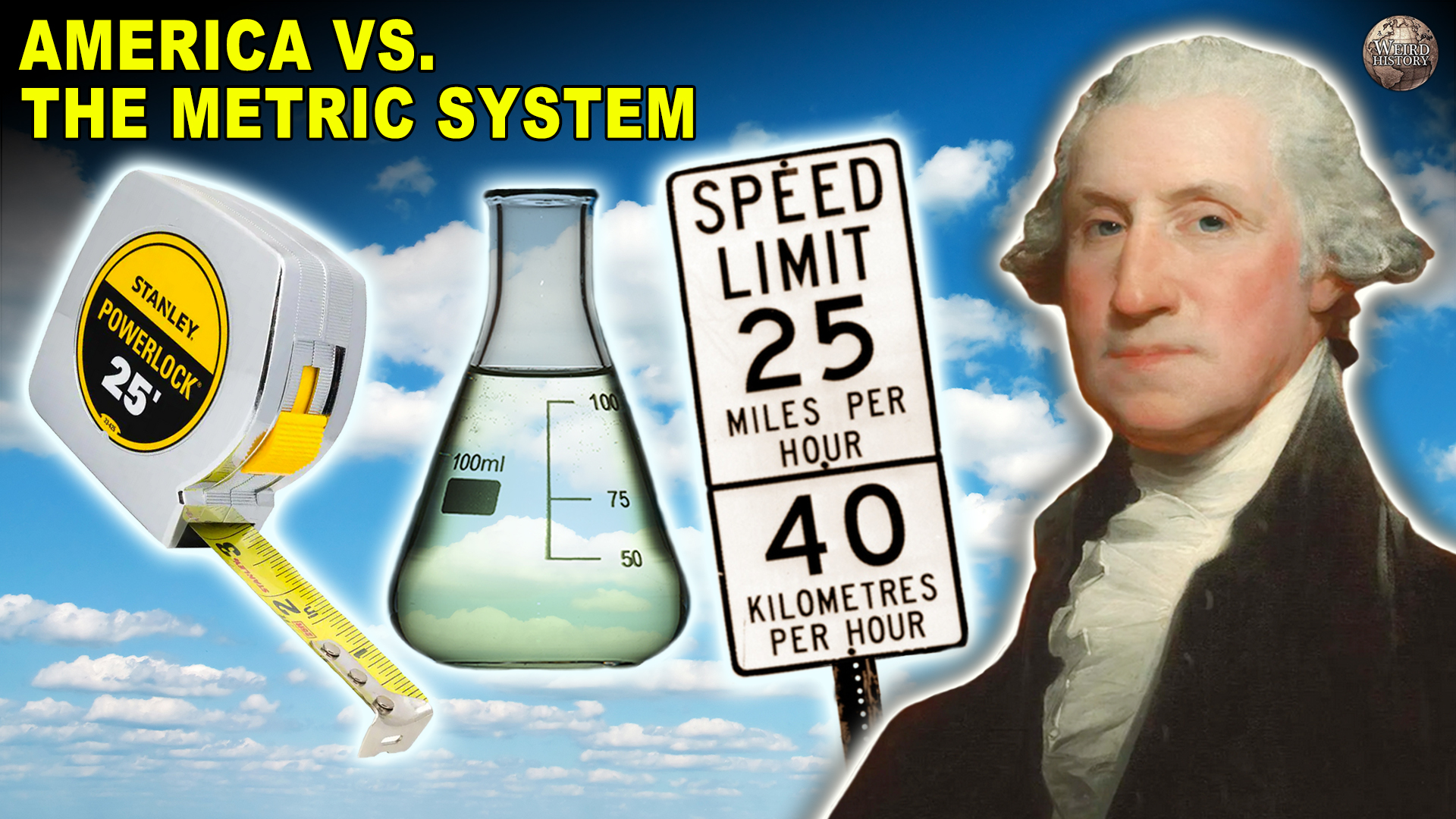
If you grew up in the United States, you probably learned the United States Customary System (USCS) for weights and measures. USCS terms like inches, feet, pounds, and miles are derived from the British Imperial System, steeped in a long history of application and use. Any introduction to the metric system may have muddied the measurement waters, adding unfamiliar words and awkward conversions to your school day.
Show More Show Less View Video Transcript
0:00
If you grew up in the United States, you probably learned hot dogs are for barbecues
0:05
and the United States Customary System, or USCS, is for weights and measures
0:10
Terms like inches, feet, pounds, and miles are derived from the British imperial system
0:14
steeped in a long history of application and use. While Americans continue to use the USCS, it seems most of the world has shifted to the metric system
0:24
So if it appears that most of the globe favors one system, Why does the U.S. muddy the measurement waters, sticking by its beloved U.S.C.S.
0:34
Today, we're going to examine why Americans don't use the metric system
0:38
Now, grab your rulers and scales, and let's get to measuring. Like many people, Thomas Jefferson was obsessed with money
0:49
As early as the 1770s, Jefferson expressed the need for the United States to establish coinage based on the decimal system
0:56
part of his overall belief in the importance of a uniform system of weights and measures
1:00
So if you've ever been annoyed that something costs $3.99 and not an even $4
1:05
you've got T.J. and his decimals to thank. When Jefferson was in France during the 1780s
1:10
he had long conversations about standardized systems with statesman and cleric Charles
1:15
Maurice de Talleyrand-Périgord, often referred to simply as Talleyrand. The French bishop
1:21
apparently the Madonna of 18th century France, was the force behind the adoption of a standardized system
1:27
of measurement by the French assembly in 1790. Talleyrand's system eschewed the traditional second pendulum
1:33
technique, a unit of measure favored by the Royal Society of London for Improving Natural Knowledge in 1660
1:39
probably because of how spooky that name sounds. Instead, he calculated his met, coming from the Greek metron
1:45
for measure, at one ten millionth of the length of a meridian line from the equator to the North Pole
1:51
a meridian line that coincidentally ran right through Paris. Très chic, n'est-ce pas
1:57
While Jefferson loved the idea of standard measurements and loved chopping it up with his French ami
2:02
more than your friend who studied abroad, this francophiliac unit was a metre too far
2:08
But TJ started corresponding with another French thinker, physician and naturalist Joseph Dombay
2:14
who did not have a cool pop star mononym. Dombay told Jefferson of the mutual benefits available
2:19
if Dombe were to visit North America. Jefferson would get Dombe's sweet European measurement intel
2:25
while Dombe would get some of North America's sweet, plant-hungry land. Dombe set sail for America in April 1794
2:33
His ship was dubbed Soon. But in an Alanis Morissette-esque twist of irony
2:39
a storm detoured the vessel to the Caribbean, and the vessel was bombarded and raided by British privateers
2:45
Dombe was taken captive and held on the small island of Montserrat, where he perished soon after
2:50
Dombay's metric prototypes, one demonstrative of the length of a meter and the other kilogram approximating
2:56
unit called, double ironically, a grave, were sold off by the pirates, never reaching
3:02
the awaiting Jefferson, quite the jagged little pill to swallow. Jefferson continued to favor the second pendulum As first American President George Washington told Congress uniformity in the currency weights and measures of the United States
3:20
is an object of great importance and will, I am persuaded, be duly attended to
3:26
He then chopped down 19 cherry trees to prove his point. Jefferson, America's Secretary of State, kept at it
3:32
heading a task force and submitting a report to Congress the summer of 1790
3:37
Jefferson's report contained two possible solutions, and Congress considered neither of them
3:42
So Washington gave another measurement-focused speech that December, prompting the Senate to take another look at Jefferson's report
3:49
and do nothing about it. In October 1791, Washington gave another uniformity in the weights and measures of the country speech
3:57
and Congress rolled their eyes and twiddled their thumbs all the way through 1796, when a designated committee
4:02
recommended the president employ such persons of sufficient mathematic skill to finally carry out Jefferson's plan
4:09
Through all of this, the deceased Dombay's findings on measurements were delivered to the French minister in the United States
4:15
Joseph Fauché, who passed them along to Secretary of State Edmund Randolph in 1795
4:21
But as historian Andrew Linklater wrote in Measuring America, both parties failed to appreciate the significance of the two standards
4:29
Indeed, the prototypes of the meter and the kilogram were never shown to Congress at all
4:33
This guy gets slaughtered by pirates and you won't even consider his plans
4:38
Jeez. So, ultimately, official movements to make any of these plans a national measurement system
4:43
were deferred and deferred again. Later, in 1821, Secretary of State John Quincy Adams publicly copped to the fact that the
4:51
French uniform measurement system might have some merit. But Adams also stated that
4:55
The final prevalence of this system beyond the boundaries of France's power must await
4:59
the time when the examples of its benefits, long and practically enjoyed, shall acquire the
5:04
ascendancy over the opinions of other nations, which gives motion to the spring and direction
5:09
to the wheels of power. Therefore, measurements across the states were deregulated at best and
5:14
chaotic at worst. Manufacturers fitted factories with the machines and equipment based on British
5:20
precedents, but they often varied by state and resulted in widespread inconsistency
5:25
And you thought your office was disorganized. By 1832, the government finally adopted some official measurement
5:31
based on British units, specifically the yard, gallon, and bushel, a gesture toward consistency we'd measure at 0.7 bushels
5:39
And while Congress did eventually pass the Metric Act of 1866, which legalized the use of metric weights and measures
5:45
the US customary units became so ingrained in practices and processes that major industrialists argued formally switching to the metric system
5:53
would be too costly, inconvenient, and unrealistic. As late as 1921, the International Institute
5:59
for Preserving and Perfecting Anglo-Saxon Weights and Measures, another not-at-all spooky-sounding name
6:04
estimated an $81.2 million cost for a countrywide change, which is around $13 billion in today's money
6:11
Or 13 bushels of cash? Does anyone actually know how bushels work
6:16
while the United States struggled mightily and stubbornly to find uniformity across its states several countries around the world enthusiastically accepted the metric system
6:31
Metrication, as the process was known, took place around the world starting in the mid-1800s
6:36
often as a resulting process around decolonization. 11 of the first 20 countries to adopt the metric system after France were located in Latin America
6:44
Mexico, Colombia, and Venezuela nabbed the system through the 1850s, while Chile, a country that had previously made the metric system optional in 1848
6:53
fully adopted the standards in 1865. Elsewhere across the globe, countries throughout Western Europe
6:59
like Portugal, Belgium, and the Netherlands, adopted their continental buddy system, while Eastern European countries like Romania, Austria, Serbia, and Hungary
7:06
all began to use metric standards by 1874. By switching to the metric system, these nations placed themselves on common ground
7:14
with political counterparts and potential economic partners, but often at the expense of popular opinion
7:20
People just really hate the French. But the US, the OG of no metric system for us, please
7:27
signed the 1875 Treaty of the Meter alongside 17 other countries. This treaty set up a permanent body called the Bureau
7:34
Internationale des Poids et Measure, or International Bureau of Weights and Measures
7:40
As you might have guessed, it was based in France. The Bureau was tasked with assessing metric standards, prototypes, and instruments around
7:48
the world. And by the time it was amended in 1921, 44 total countries participated
7:53
So you might ask, was it time for the United States to put on their flippies and make the
7:58
official plunge? Good question. In the early 1900s, American scientists and medical professionals were vocal in calls
8:10
for complete metric conversion. The head of the newly established National Bureau of Standards, Samuel W. Stratton
8:17
supported the metric system, especially in scientific cases. Representatives from engineering firms, wholesale grocers, and academic and professional
8:25
associations came together before Congress to push for standardization. These folks included lightbulb inventor Thomas Edison, Dewey Decimal System inventor Melville
8:34
Dewey, and telephone inventor Alexander Graham Bell. Bell especially led the charge, showcasing arguments as to why an American metric system
8:42
was beneficial for the workforce, scientific investigation, trade, and commerce. Then again, he wanted people to say ahoy when they answered the phone
8:51
So what did he know? But despite this call for uniformity, the political system couldn't deny that public opinion
8:57
wanted America to be the land of change, of difference, of exceptionalism
9:02
The American people did not want to kowtow to a bunch of elitist, expensive European nonsense
9:08
They wanted to measure stuff their own way. Oddly enough, Great Britain, perhaps the European country most perceived as being elitist and
9:15
expensive, was also wary of shifting the metrics. Heck, they even had it in for decimal-based currency in the early 19th century and was
9:23
one of three countries that didn't sign the Treaty of the Meter in 1875. So politicians in one of the broadest acts of we just someone you want to have a with kept the American metric system away from official ratification Arguments against the metric system continued well into the 20th century
9:42
Labor unions voiced concerns that it would be too costly and difficult, and companies
9:46
would simply outsource jobs outside the country rather than put in the time and money to retrain employees
9:52
In 1974, the International Brotherhood of Electric Workers, a name that's 50-50 on
9:57
the spooky name-o-meter, testified to Congress that a full-scale conversion would cost hundreds
10:02
of thousands of jobs. Undeterred, President Gerald Ford signed the Metric Conversion
10:07
Act of 1975. This act officially designated the metric system of measurement
10:12
as the preferred system of weights and measures for United States trade and commerce
10:17
The act also established the United States Metric Board, which publicized, encouraged, and facilitated understanding
10:23
and use of the metric system. And it all gave federal agencies until 1992 to use the metric system of measurement in
10:30
its procurements, grants, and other business-related activities. Finally, vive la France! Well, outside of these business contexts, none of this was mandatory
10:40
The language of the act even allowed for the continued use of traditional systems of weights
10:45
and measures in non-business activities. And while the United States Metric Board represented a change for businesses, educational programs
10:52
and even public television PSAs, none of it was compulsory. In fact, just seven years after the metric board was established, President Ronald Reagan
11:00
discontinued its funding and shut it down. While that may have assuaged domestic concerns of confusion, industries were still concerned
11:08
about America's ability to stay globally competitive. So Congress passed the 1988 Omnibus Trade Competitiveness Act, which made it even more
11:16
beneficial and easier for US businesses to use the metric system. But it was still voluntary for private entities
11:23
You give them a centimeter, they still take an inch. So where does that leave the US
11:28
It's a popular but erroneous claim that the US, Liberia, and Myanmar
11:32
are the only countries who haven't adopted the metric system. That's a disingenuous claim
11:38
The truth is, the use of the metric system is mandatory in some countries, voluntary in others, but all countries have recognized and adopted the metric system
11:46
including the US. The switch to a different system is a process that happens over time
11:51
and every country is somewhere on the spectrum of increasing use. There are still countries changing laws to adopt a mandatory metric policy
11:58
while others pursue voluntary metrication. And in practice, more American institutions use the metric system than you might think
12:05
For one, remember that our decimal-based currency system is technically metric. Additionally, industries like electronics, beverages, and pharmacies have made the switch
12:13
and it has stuck. and Great Britain, America's OG baby daddy, formally adopted the metric system in 1965
12:20
with British officials publicly stating the need to keep up with their European counterparts. But their transition has not always been smooth
12:26
In 1971, a new type of decimal currency was introduced, necessitating the country to join the European economic community
12:32
two years later. Everything from postage to packaging began to shift, resulting in so much confusion that even in 2004
12:39
the UK Metric Association issued a report about the inconsistent and incomplete process
12:44
entitled, A Very British Mess