Up next in 10



We all know that once every four years, Americans go to the polls to vote for a new President. But this technically isn’t true. Americans don’t actually vote directly for a commander in chief; they elect representatives who then decide the next president. Complicated? Sure, and maybe even a little misleading. But this system wasn’t designed on a whim.
Show More Show Less View Video Transcript
0:00
We all know that once every four years, Americans go to the polls to vote for a new president
0:07
But this technically isn't true. Americans don't actually vote directly for a commander-in-chief
0:13
They elect representatives who then decide the next president. Complicated? Sure. And maybe even a little misleading
0:20
But this system wasn't designed on a whim. The founding fathers and their fancy Whigs had very specific intentions in mind when structuring elections this way
0:29
So, today, we're heading to the ballot box to figure out why the Electoral College exists
0:36
All right, everyone, make sure your states are swinging and your chads are hanging
0:44
The Electoral College gets laid out in Article 2, Section 1, Clause 2 of the U.S. Constitution
0:51
This clause directs states to help choose the next president by appointing a group of electors
0:56
Each state appoints the same number of electors as congressional delegates, equal to two senators plus their total number of House representatives
1:04
which in turn is based on the state's population size. So everyone has a certain number of electors that varies from state to state
1:13
Everybody got that so far? Good. After the public votes in the presidential election
1:18
states use their own processes to choose electors, who meet and decide their choice for president
1:24
Today's electors, who are forbidden from holding federal office, are traditionally selected by the state's political party aligning with either candidate
1:32
Republican votes help select Republican electors, who presumably then choose the Republican presidential candidate and vice versa
1:40
Since 1964, U.S. presidential elections have had a total of 538 electors
1:46
Before then, it was just 535 from all 50 states. Washington, D.C. got three of its own after the ratification of the 23rd Amendment in 1961
1:56
48 of the 50 U.S. states have laws on the books requiring the electors to base their selections
2:02
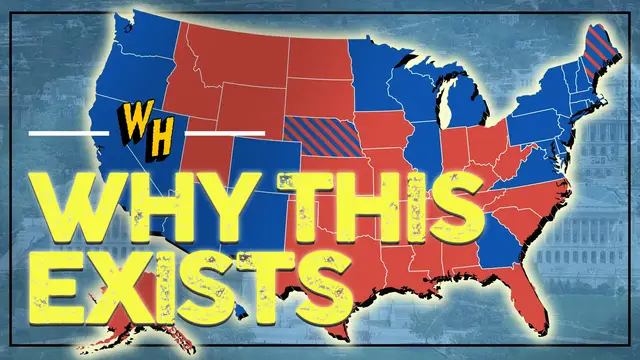
on whoever won a plurality of the popular vote. But Maine and Nebraska base only two of their electoral votes on winner-takes-all
2:10
then allocating the remainder by congressional district, allowing candidates to functionally split up the electors between them
2:17
The District of Columbia gets three electoral votes, and they all go to whichever candidate got the most votes from the public
2:24
Winner takes all. Most states require electors to promise that they will vote for whichever candidates won the most votes from the citizenry
2:32
Those who don't live up to this pledge are known as faithless electors, which is a strong team name for trivia night
2:39
In practice, all of this means that the winner of the U.S. presidency doesn't always align with the candidate who got the overall most votes
2:46
In a number of elections including George W Bush 2000 victory over Al Gore and Donald Trump 2016 win over Hillary Clinton the popular vote went one way while the other candidate took a majority of 270 electoral votes out of the 538 possible
3:04
That's why we have all the red state versus blue state versus swing state math
3:08
and color-coded maps and explainers by math experts and khakis around election season
3:13
rather than a more straight-ahead chart showing who's in the lead. So why aren't American presidential elections decided by a simple majority vote
3:26
Because the Founding Fathers didn't trust a majority of the population to make smart decisions
3:31
In his contributions to the Federalist Papers, James Madison laid out an ideological case for indirect democracy or republicanism
3:39
Like many of his colleagues, Madison feared the factionalism, despotism, and short-term
3:45
passion-based thinking that can arise from direct democracy. A like-minded majority, particularly one under the sway of a charismatic demagogue, could
3:55
become tyrannical against the minority, leading to a variation of mob rule inconsistent with
4:00
true democracy. In Federalist No. 10, Madison wrote, quote, A common passion or interest will, in almost every case, be felt by a majority of the whole
4:11
a communication and concert result from the form of government itself, and there is nothing to check the inducements to sacrifice the weaker party or an obnoxious individual
4:22
In Federalist No. 39, he adds that the ideal president would not be directly elected
4:27
but indirectly derived from the choice of the people. In other words, the decision of whom to elect will be related to who everyone voted for
4:36
but not necessarily who everyone voted for. But the idea of creating a group of people who could check the power of the majority
4:43
was not purely philosophical. The members of the Constitutional Convention were attempting to create a single, powerful
4:49
central government that could rule over a group of diverse, independent states
4:54
They faced a significant obstacle that required a delicate compromise. what to do about states where slavery was going to remain legal and practiced
5:04
The convention's infamous three-fifths compromise meant that slaves counted toward a state's total population
5:10
when choosing representatives and thus presidential electors, but only as three-fifths of a full person
5:17
Free black people and indentured servants were not included in this compromise
5:20
and were each counted as one person. But this quote-unquote compromise raised concerns among slave states
5:27
that they'd be underrepresented when choosing a president. So these concerns were addressed
5:32
In the Virginia Plan, the original outline for what became the Constitution
5:36
citizens voted for their state representatives and then Congress chose the president themselves independent of a second public vote This was ultimately rejected for threatening a separation of powers with the legislative branch exerting a worrying amount of control over the executive
5:52
A number of similar proposals, most of which involved a small group of already powerful individuals getting together to pick the president
6:00
were also dismissed over fears of corruption. By guaranteeing each state a minimum of three electors
6:06
the Electoral College gives lesser populated states more of a say in picking the president
6:11
than they would otherwise have in direct voting. Still, a number of these states favored proposals that would give each state equal power in choosing a president
6:20
regardless of their populations. These suggestions were shot down by the more populated states
6:26
which argued that it was fundamentally undemocratic. Ultimately, the Electoral College was formed not as a favorite or even particularly popular proposal
6:35
but the only way to satisfy both slaveholding and free states. It's kind of like a runner-up prize that we just never bothered to trade in
6:46
The Constitution doesn't specifically lay out how electors are chosen by states
6:51
or how they should be divided up. Because the 10th Amendment leaves all powers not specifically designated in the Constitution to the states, this process varies widely, adding a lot of confusion and complexity
7:05
In the first few U.S. presidential elections, some states actually ignored the results of the popular vote, allowing their legislatures to pick electors who then picked whoever they wanted for president
7:15
Andrew Jackson lost the 1824 presidential election despite winning the popular vote
7:21
because electors from six states opted to ignore the results of the actual elections
7:26
John Quincy Adams was declared the victor with less votes and fewer electors, but more delegates
7:32
This way of organizing elections fell out of favor soon after, and by 1828, only Delaware and South Carolina continued to pick the president via legislature rather than popular vote
7:43
Setting aside how electors are chosen, there were also questions and disagreements about how to divide up the electoral votes
7:51
While many states went with the winner-take-all system, in which all electoral votes go to the candidate that won the plurality among voters
7:59
it's also constitutionally permissible to divide up the electoral votes based on congressional districts
8:05
This led to a major controversy during the election of 1800. Candidate Thomas Jefferson's party, the Democratic Republicans
8:13
held a majority in the legislature of his home state, Virginia, but it was a tentative one
8:18
Eight of the state's 19 districts were controlled by Jefferson's opposition, the Federalists, and their incumbent president, John Adams
8:26
In order to prevent Adams from taking nearly half the state's electoral votes
8:30
Democratic Republicans voted to change their system to winner guaranteeing their candidate all 21 of the state electors States that had federalist majority legislatures responded by making their own systemic changes
8:44
but Jefferson nonetheless prevailed. Following this contentious election, Alexander Hamilton hoped to fix these issues
8:51
by drafting a new constitutional amendment, which would adopt the congressional district method of allocating electors nationwide
8:58
But before he could finalize his work and present it to Congress, he died
9:03
Can you believe it? In a duel with Aaron Burr, no less
9:07
What a story. Someone should write a musical about that. The 12th Amendment to the Constitution, ratified in 1804 and enacted during that year's presidential election
9:18
streamlined the presidential election process, including the Electoral College. Specifically, it changed rules around the vice presidency
9:26
Initially, the Constitution said the vice president would be the runner-up in any presidential election
9:32
which resulted in John Adams taking the presidency and Thomas Jefferson, a member of his opposing party, becoming his VP
9:38
The Twelfth Amendment instead split the presidency and vice presidency into two distinct votes
9:44
and mandated that electors would pick one candidate for each office. Additionally, at least one of the two candidates had to come from outside of an elector's home state
9:54
in an effort to prevent factionalism. The Electoral College remains a contentious topic in U.S. politics
10:05
Voters who live in states where one political party has a strong majority
10:08
can feel disenfranchised or disincentivized to vote. The current system also gives residents of swing states
10:15
particularly those with larger populations, more power in presidential elections and encourages campaigning politicians to focus their efforts
10:24
The winner-takes-all aspect of the Electoral College also suppresses third-party candidates. On a state-by-state basis, an independent or third-party candidate might be able to attract a significant chunk of the electorate to their side
10:37
but this wouldn't be as possible with each state voting for the lone candidate with the plurality of votes
10:43
The Electoral College also disenfranchises citizens living in U.S. territories that don't currently have electors
10:50
which includes the nearly 4 million residents of Puerto Rico, the Northern Mariana Island
10:55
the U.S. Virgin Islands, American Samoa, and Guam. Efforts to eliminate the system, however, are consistently met with opposition from smaller and less populated states
11:06
And because any changes to the Constitution require the approval of two-thirds of Congress and three-fourths of state legislatures
11:13
there isn't enough support to get any alternate proposals passed. so for now the electoral college is what we've got but if we hold out and save up a few more
11:23
tickets we may be able to swap it for the light up yo-yo