Up next in 10



The Prestige may not always be viewed as Christopher Nolan’s crowning achievement, but it might be his most personal and revealing film. Often overshadowed by The Dark Knight, Interstellar, and now Oppenheimer, The Prestige quietly explores themes that define Nolan’s entire career.
Show More Show Less View Video Transcript
0:00
It was the greatest magic trick I've ever seen
0:04
This is The Prestige, a period piece about dueling magicians, the artistry of illusion, and the price of greatness
0:11
It's also, secretly, Christopher Nolan's most personal film. It's the skeleton key to understanding his entire body of work
0:18
and yet, it rarely gets brought up when dissecting his career. The answers to everything that made him tick were right in front of our faces this whole time
0:26
I apologize. There simply is too much magic for my stage at the Pantages across the street
0:36
Christopher Nolan might be the most important filmmaker of his generation. He's achieved meteoric financial success, critical acclaim, and charted his own course
0:46
making projects that almost no other filmmaker could get made. He also is notoriously private
0:51
He's not someone who openly talks about his personal history, the meaning of his films
0:55
or why he is the way he is. However, this scene from the finale of The Prestige
1:00
holds all of the secrets to his illustrious career. In case you don't remember
1:04
The Prestige is a historical epic based on a novel by Christopher Priest
1:08
that follows two rival magicians as they attempt to push the boundaries of their chosen practice
1:13
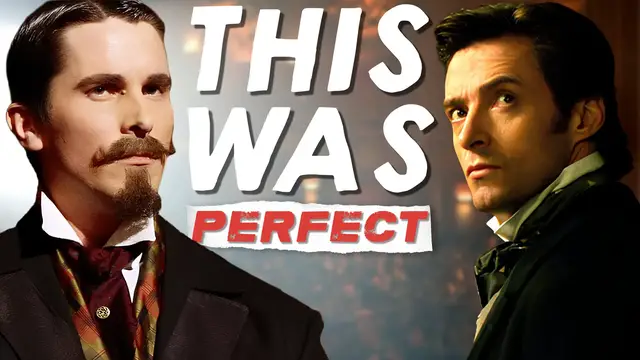
and take very different routes to their eventual destinations. On one hand, we have Christian Bales Borden
1:18
from Humble Beginnings. He pioneers a trick that's so simple and decepting
1:22
it almost doesn't impress anyone because of how effortless it is. He disappears and reappears
1:28
moving about 10 feet in what seems like mere seconds. No one initially knows how it's accomplished
1:33
Conversely, Hugh Jackman's Angier uses a trick called the teleported man. Again, no one knows how it's done
1:38
and the result is utterly inexplicable. Angier disappears and reappears instantly over distances that aren't humanly possible
1:46
In both tricks, the key point is how it climaxes. This part of the trick structure is called the prestige
1:51
You have to bring back what you've taken away in a surprising manner. You have to restore the status quo
1:56
The scene in question comes at the very end of the film. Angier is sitting on the floor having just been shot Borden scoffs Takes nothing to steal another man work It takes everything Is the film about dueling magicians literally
2:11
Yes, it is. But it's actually about the two halves of Christopher Nolan's soul
2:15
battling for which one of them will win out on how they will run their career
2:19
This idea of absolute dedication to a craft runs through the entirety of the movie
2:24
And it's obvious that's the thing Nolan is preoccupied with here. He started making movies as an independent filmmaker with a low-budget indie following
2:31
then quickly leveled up to Memento, which received widespread critical acclaim, and from there, he had a choice to make
2:37
Which direction was he going to take his career? Was he going to be an uncompromising arthouse auteur
2:42
or was he going to try and make large-scale Hollywood films? Well, he opted to direct Insomnia, a remake he didn't write
2:49
that starred Al Pacino and Robin Williams. You can say he was making deliberate decisions about his career
2:55
He was attempting to get to the next level. He wasn't making choices that were necessarily his absolute primal urge as an artist
3:01
In this final scene, Angier and Borden are obviously discussing the core theme of the movie
3:06
How far would you go for your work? That's the thesis of the entire story
3:10
What are you willing to sacrifice to get to the next level? Well, Borden represents the side of Nolan's personality that doesn't want to compromise
3:17
that is unwavering and is completely dedicated to his craft, even in the face of capsizing artistic projects
3:23
where Angier represents the necessity to be flexible within the studio system
3:27
to play the game, and how sometimes that perspective can spiral out of control
3:31
and you can lose yourself in a continual pursuit of more. Borden represents what happens when an artist refuses to have any flexibility
3:39
the torture they put themselves through when they refuse to compromise to get to the next level
3:43
and Angier represents when that necessary flexibility metastasizes and eats away at everything that makes you, you
3:50
We see this idea represented metaphorically in the visualization of Angir's initial test of the
3:56
teleporting man. Angir turns on the machine, another version of himself materializes across
4:01
the room and he instinctively picks up a nearby weapon and ends his former self He killing a previous version of himself in pursuit of greatness After Insomnia box office success Nolan found himself at another crossroads He had had a bona fide hit under his belt
4:15
Insomnia was produced on a budget of 46 million and pulled in $114 million at the box office
4:21
He had a little capital to spend, but was this the moment? Should he make an indie movie that he could write
4:27
and direct and control everything on? Or should he push deeper into the studio system
4:31
Well, we all know the answer to this question. Warner selected him to take over the reboot of the long-dormant Batman franchise
4:38
His first entry, Batman Begins, was co-written with David Goyer and his brother Jonathan Nolan
4:43
The film was heralded as a huge step forward for the emerging superhero genre
4:47
Obviously, we all know that Begins was a cultural juggernaut, and its sequel, Dark Knight, is arguably still Nolan's defining work
4:54
But these studio successes allow Nolan to return to making original films
4:59
like Interstellar and Inception, as well as high-profile adaptations like Oppenheimer and The Odyssey
5:04
At the end of the day, the key reason why The Prestige is such a fantastic film
5:08
is because Nolan isn't impunging either of these characters. He's both of them, or all three of them
5:14
if you're familiar with one of the movie's key revelations. You go live your life in full now, right
5:20
You live for both of us. Borden's way of sacrificing his art is that he and his twin brother
5:25
decide to share a single life. They're pretending to be a single person in order to have the ability
5:30
to literally be in two places at once. They inherently have lived a compromised life
5:34
to make this trick work. Nolan obviously loves the idea that making things is a no-win scenario
5:41
To a certain extent, everyone has to compromise. Film is a collaborative art form
5:45
so whether it's incorporating some bad notes from the studio exec or making a film
5:49
you're not exactly thrilled to spend two years creating, every artist working in the medium has to compromise
5:55
In a less skilled filmmaker's hands, Borden would be the hero and Angier would be the villain
6:00
and that's not the case. They're both well-rounded characters who are completely realized and evolved
6:05
over the course of the film. The fact that Nolan chose to use his cultural momentum from Batman Begins to get this movie made is really impressive He obviously highly adept at playing the Hollywood game but the maturity and texture on display in this film
6:19
show just what an amazing craftsman he is as well. Christopher Nolan wants to shoot movies on film
6:24
for the theatrical experience. He wants to make stories that are both crowd-pleasing and have
6:29
probing intellectual themes. He wants to shoot practical stunts and actual explosions. He wants
6:34
to make large-scale epics and big swing high-concept pictures. He's literally trying to do it all
6:40
Usually, directors have to pick a lane. Do you want to make small, intimate character dramas
6:44
or do you want to be sanded down in a studio system as a journeyman director for hire
6:48
But it's very apparent that Nolan spent the first decade and a half of his career
6:52
very deliberately crafting a career to allow himself as much freedom as possible. And in many
6:58
ways, The Prestige is his most autobiographical work in that respect. It's a film about the
7:03
sacrifices it takes to become an artist and how difficult it can be to will something as expensive
7:08
as a film into existence and then have to do it over and over and over again. Angier and Borden
7:13
are the dual symbols of the existential poles of being an artist. Compromise and rigidity
7:19
stubbornness and malleability. It's obvious that the structural, symbolic, and narrative lessons
7:24
that Nolan learned on this movie deeply influenced his work on The Dark Knight. He ported over the
7:29
political, ideological, and competitive struggle of Borden and Angier onto the Joker and Batman
7:34
More people have seen that film, obviously, but the prestige is more important to understanding
7:39
Nolan, to really unpacking and understanding what makes him tick. He's a formalist, someone who's
7:44
obsessed with craft. He's compelled to make films that utilize the endemic structures of film to
7:49
their maximum potential. And naturally, as a cerebral filmmaker, he approached crafting his
7:54
career the same way. Much like Angier, Nolan's dedication to this mission of making movies
7:59
is both admirable and frightening. The way he depicts the manic dedication of Angier to his
8:04
task of cloning himself, even though he wouldn't know if he was the man on the stage or in the box
8:10
feels deeply personal. You can tell Nolan has sacrificed to get where he's gotten
8:13
and even if those stories aren't public, they're carved into the work