Up next in 10



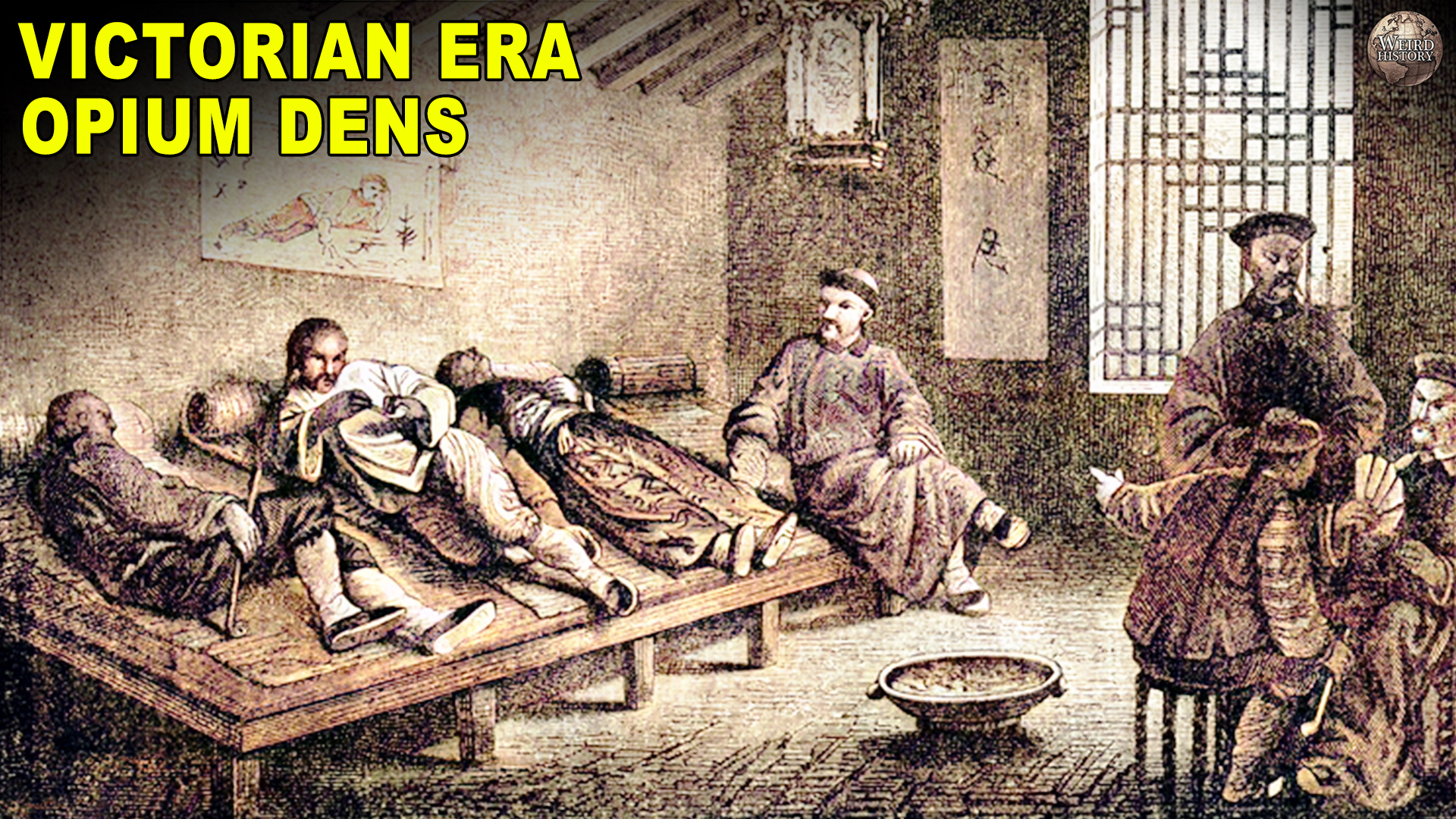
When we think of opium dens of the 19th century, the conjured image is usually a hazy, smoke-filled room full of questionable characters, right? Well, at one point in the early 19th century, everyone and their mother was taking opium (quite literally - mothers were specifically targeted by opium marketers). Over the decades, however, and through sensationalized media and literature, the Victorian era opium dens took on a life of their own.
Show More Show Less View Video Transcript
0:00
When we think of opium dens of the 19th century, most of us picture a hazy, smoke-filled room
0:06
full of questionable characters, right? But that image was largely created by sensationalized
0:12
and occasionally racist, media and literature, through which the Victorian-era opium dens took
0:18
on a life of their own. So, today we're going to take a look at what Victorian-era Chinese
0:24
opium dens were really like. OK, time to spark up some weird history
0:35
In the modern world, we all know that if you need medication
0:39
there's a certain process that you have to go through. You go to a doctor, get a prescription
0:44
and then get that prescription filled by a pharmacist. Or you go to the ATM and text a line cook named Eddie
0:51
But before 1850 in Great Britain, there were basically no regulations on medications, drugs, or poisons. You could pick up some opium
1:00
from your local barber, confectioner, or wine merchant. This changed in 1851 when the Arsenic
1:06
Act was passed. The public had become concerned about a spate of accidental arsenic poisonings
1:12
and intentional ones. Hey, it was Victorian England. The legislature responded by passing
1:18
a new law. This act required that the seller had to keep track of all sales, the seller had to know
1:25
the buyer's identity, and the arsenic sold had to be colored, typically with soot or indigo
1:30
This act paved the way for the 1868 Pharmacy Act, which regulated the use of 15 poisons
1:36
including morphine and opium. After that, only people who were graduates of the Royal
1:41
Pharmaceutical Society's school were allowed to sell these substances. You don't want just
1:46
any old Yahoo's slinging morphine. You need to graduate from drug school first
1:51
However, as good as the intentions were with this act, there was still no limit on how much pharmacists could sell
1:57
This made the law not nearly as restrictive as it could have been. But hey, you got to start somewhere, right
2:07
The rise in popularity of opium can be attributed mainly to the opium war between Britain and China
2:14
British merchants were going to China to acquire highly desired items like tea and silk to sell
2:18
back in Europe. A great many wars are fought over who gets to sell a thing. However, while the
2:23
British were buying up all these Chinese goods, the Chinese did not want to buy any of what Britain
2:28
was selling. This made for an uneven trading balance that the Brits didn't care for. In an
2:34
attempt to even things up, economically speaking, the Brits went in search of a product the Chinese
2:39
would buy. That product turned out to be Indian opium, which was illegally transported into China
2:45
to sell. The opium trade proved to be highly lucrative, which was good, but it also created
2:51
one of the worst mass addictions the world has ever seen which was bad but less bad if you the one selling the opium By 1840 there were millions of people addicted to opium in China
3:02
Just 65 years later, an estimated 13.5 million Chinese citizens were addicted to opium, with 27% of the adult males
3:10
suffering from opium dependency. Attempts by the Chinese to clamp down on the opium trade
3:16
led to two conflicts, which resulted in some unfavorable treaties for China. Doctors in the 1800s were doing their best
3:29
but they just didn't understand the dangers of addiction yet. So they prescribed opium for just
3:34
about anything. The long list of elements that opium was used to treat included toothaches
3:40
whooping cough, inflamed intestines, fever, insomnia, diarrhea, and hiccups. There's a non-zero chance you would have been prescribed opium to help boost your algebra grades
3:52
For many of these, laudanum, which was 10% opium dissolved in alcohol, was the specific
3:57
formula that was prescribed. Opium was touted as a miracle drug that could help everyone
4:03
including women, children, and even infants. Advertised as women's friends, opium was often
4:09
heralded as a great treatment option for women's problems, including anything from menstruation
4:15
childbirth, hysteria, depression, and fainting. Maybe they were fainting because of all the opium
4:22
And for women who had troublesome children, well, hey, they could take opium too
4:27
Oftentimes, kids and babies would be spoon-fed what's called Godfrey's Cordial. Also known as mother's friend
4:34
this was a mixture of opium, water, and treacle, given to children for anything from colic
4:39
coughs, and hiccups. And in fairness, a spoonful of watered-down morphine probably did chase those hiccups away
4:45
Because opium was so widely distributed, people from all walks of life took it for medicinal
4:55
purposes or, you know, for hanging out. This included many famous authors like Charles Dickens
5:01
Walter Scott, Elizabeth Barrett Browning, and Lord Byron. In fact, one of Samuel Taylor Coleridge's
5:07
most well-known poems, Kublai Khan, was inspired by an opium-induced dream. The point is, opium
5:14
was fairly common in the early 19th century. However, as the decades wore on, opium started
5:20
to become associated with the lower class, and then with criminals. Despite taking opium
5:26
Dickens painted a grim picture of opium dens in his unfinished novel, The Mystery of Edwin Drood
5:33
describing them as the meanest and closest of small rooms. Oh, okay, like those private karaoke bars
5:40
The author Thomas De Quincey openly spoke about the pleasurable sensations that accompanied taking opium
5:46
which he had started taking as a student at Oxford to treat a toothache However De Quincey became addicted to the substance for the rest of his life He detailed the awful withdrawals he experienced after he tried to stop his opium usage
5:59
in a nightmarish montage filled with racist remarks about the Orient and some wild visions
6:05
including being stared at, hooted at, grinned at, chatted at by monkeys, by parakeets, by cockatoos
6:11
That last part may have been a drug-induced hallucination, or De Quincey may have simply gotten so high
6:17
he wandered into a zoo. In any case, his gritty account of his opium habit became highly influential
6:22
and greatly shaped the way subsequent authors depicted opium. Later in the 19th century
6:28
opium dens became a darker and more crime-centric setting. This can be seen in many of the stories
6:33
that came out in this time period. In the Sherlock Holmes mystery, The Man with the Twisted Lip
6:38
by Arthur Conan Doyle, the case starts with Dr. Watson going to find a man who had a horrible
6:44
opium affliction, he was found in an opium den, which Conan Doyle described like a one-star Yelp
6:50
review of a haunted house. Watson immediately sees little red circles of light glimmering at him from
6:56
out of the dark shadows, which he knows to be burning opium. The den is full of motionless
7:01
muttering addicts, talking, as Doyle puts it, in a strange, low, monotonous voice
7:07
the conversation coming in gushes, and then suddenly tailing off into silence
7:11
each mumbling out his own thoughts and paying little heed to the words of his neighbor
7:16
Oscar Wilde also painted opium dens in a negative light in his famous work
7:21
The Picture of Dorian Gray. According to Wilde, there were opium dens where one could buy oblivion
7:27
dens of horror, where the memory of old sins could be destroyed by the madness of sins
7:31
that were new. That sounds like a night out at Buffalo Wild Wings. Despite what some of the literature of the era would have you think
7:44
London was not riddled with opium dens. But there were a few opium dens outside London's ports
7:50
specifically in a slum area called Limehouse. The dens originated here because they mostly catered to the sailors and dock workers
7:57
who had become addicted to opium on their travels. And even Limehouse wasn't as bad as it was made out to be in fiction and media reports
8:05
Writers portrayed Limehouse as a dark, dangerous, and mysterious place that had an opium den
8:10
on every corner. But they were just playing it up for maximum hysteria, the Victorian equivalent of clickbait
8:16
With so many alarming stories about opium dens swirling around in pop culture at the
8:20
time, it was hard to separate fact from fiction. However, we do have some first-hand accounts of what opium dens were actually like
8:27
Walter Besant, a novelist known for describing the social evils of London, made his first
8:33
visit to an opium den expecting to see the refuge of human misery he had heard about in fiction
8:39
but it didn't go the way he expected. According to Besant, when one goes to an opium den for the first time one expects a creeping of the flesh at least The place was neither dreadful nor horrible He was genuinely bummed out that the dens were not nearly
8:55
the wretched hives of scum and villainy he'd been led to believe. That being said, the experience
9:00
wasn't exactly pleasant either. Besant commented on the smell of the place, which he described as
9:06
overwhelming, like Comic-Con times a thousand. He didn't say that last bit, but what if he had
9:13
Besant also called out a man who was playing an unidentified musical instrument that Besant
9:18
described as sounding like a thousand fingernails scratching the window or ten thousand slate
9:23
pencils scratching a schoolboy's slate. According to Besant, the musical instrument was the only horror of the opium den
9:30
In other words, he was so unimpressed with the den itself that he wound up roasting some
9:35
dude trying to play Wonderwall instead. Classism also played a part in creating the myths around opium dens
9:47
If the upper or middle class used opium, it was seen as merely a leisurely activity
9:52
And if a rich person became addicted to opium, as many were, it was viewed simply as a habit
9:58
like biting your fingernails or getting drunk at breakfast. However, that same generous view wasn't extended to the lower class
10:04
who were misusing the substance and should be shamed and stopped at all costs
10:09
That may sound a little familiar, and so will this next bit. By the end of the 19th century, doctors were becoming aware of the dangerous and addictive
10:17
nature of opium. Armed with a new form of pain relief, namely aspirin, the upper class no longer
10:24
needed to go to opium to cure their ailments. So a movement began to educate people about the
10:29
dangers of opium, which is understandable. It had been overprescribed for decades and had become a
10:35
genuine health crisis. However, the movement also included some racism, for good measure
10:41
Part of the anti-opium messaging focused on the idea that smoking opium was a uniquely
10:45
Oriental trait that degraded Europeans and thus shouldn't be replicated. This narrative was
10:51
furthered by negative portrayals in literature, such as the villain Dr. Fu Manchu, a villain who
10:56
tried to take over the West in a series of crime novels by Sax Romer
11:00
The evil doctor did have a pretty rad mustache, though. The final nail in the coffin of legal opium sales came in 1888
11:13
with the founding of the profusely named Christian Union for the Severance of the British Empire with the Opium Traffic
11:19
That's just too many words, fellas. Tighten it up. Clunkily named though they were, the organization proved to be very effective
11:25
After much criticism throughout the end of the 19th century and early 20th century
11:30
the United States banned opium in 1905. Five years later, Britain followed suit by dismantling the India-China opium trade once
11:39
and for all. However, many of the stereotypes built around opium dens persist to this day
#Substance Abuse
#People & Society
#Recreational Drugs