Up next in 10



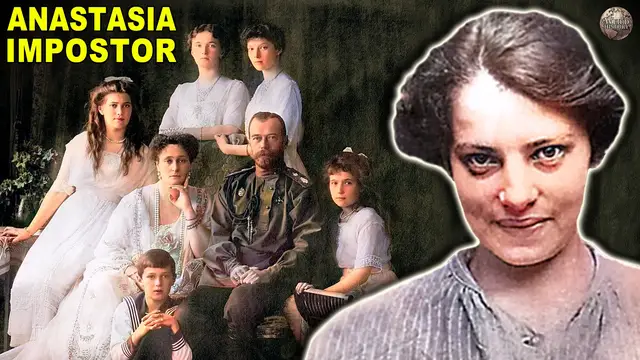
Grand Duchess Anastasia Nikolaevna of Russia was Czar Nicholas II's youngest daughter and a member of the Russian Imperial Romanov family. The family was placed under house arrest during the Bolshevik Revolution, and Anastasia was brutally murdered alongside her family by the secret police in 1918. But Anastasia lived on after death in a very bizarre way: a few years later, a woman named Anna Anderson convinced many people that she was Anastasia, and had somehow survived the massacre.
Show More Show Less View Video Transcript
0:00
Die-hard fans of 90s animation and or John Cusack
0:03
may remember the animated film Anastasia. You know, the one with the talking bat
0:08
While it wasn't exactly a true story, for example, Grigori Rasputin has yet to return
0:13
from the dead as a zombie wizard, it is true that a woman once came very close
0:18
to convincing the world she was the long-lost Grand Duchess Anastasia. So today, we're going to take a look
0:25
at the woman who almost fooled everyone into believing she was Anastasia
0:30
Okay, time for a true story about a tall tale. Grand Duchess Anastasia Nikolaevna of Russia was Tsar Nicholas II's youngest daughter
0:44
and a member of the imperial Romanov family. During the Bolshevik Revolution in 1918, the family was placed under house arrest
0:53
and a 17-year-old Anastasia was murdered alongside her family by the secret police
0:57
But many people believe that some of the Romanovs may have survived. It was not a totally outlandish
1:03
theory. The bodies of the imperial family had vanished without a trace, so no one could say
1:08
for certain what had happened to them. It certainly seemed possible that one or more of them could
1:12
have escaped. Flash forward to two years later, when on February 17, 1920, a young woman attempted
1:18
to take her own life by jumping off a bridge in Berlin, Germany. She survived the fall and was
1:23
fished out of the Landwehr C by police officers. She didn't have any identification
1:28
on her, and either wouldn't or couldn't tell authorities who she was. Remember, this was
1:33
still decades before anything resembling the internet existed, so a person could completely
1:38
erase their identity by simply wandering into a new city and refusing to speak to anyone
1:43
Try pulling that at a Panera in 2022. Twitter will have your second grade teacher tracked down by
1:47
the time your panini is off the grill. The woman was transported to a medical facility to receive
1:52
treatment, then promptly admitted to a mental hospital, the Daldorf Asylum. During the first
1:57
six months of her stay, the anonymous woman would not speak. The only clues to her identity were a
2:03
series of odd-looking scars on her body and her preference for isolation over the company of
2:08
others. She stayed at the institution for a couple of years and was given the name Anna Anderson
2:13
When Anna eventually did talk, she had a very noticeable accent, which some believed was Russian
2:18
Today, we call that specific brand of indeterminate accent the generic Bond villain
2:28
Anna's strange, detached behavior caught the attention of another patient at the Daldorf asylum
2:34
named Clara Pudert. When Pudert was released from the hospital, she reached out to former high-ranking officials from Russia
2:41
and various people who knew the Romanov family, including some of their servants, and took them to meet Anna
2:46
Incredibly, some of them agreed she was the czar's daughter. However, who there told them she thought
2:52
Anna was Tatiana one of Anastasia older sisters At first Anna refused to confirm whether she was a member of the royal family She would hide under the bed when prodded for answers which if we being honest is a mood we all recognize and respect However when she was shown photographs of the Romanovs
3:09
she eventually claimed to remember some of them. Captain Nicholas von Schwabe, who worked for the
3:13
Dowager Empress, came to visit Anna and brought some pictures with him. After showing them to Anna
3:18
she became visibly upset. Once he left, Anna reportedly told her nurses
3:22
the gentleman has a photo of my grandmother. Baroness Sophie Boksoveden, who was a lady in
3:28
waiting for the Russian Empress, took one look at Anna and conceded there was a Romanov resemblance
3:34
However, the Baroness said Anna was much too short to be Tatiana because the Baroness was
3:38
apparently a savage dinner guest. You know, the kind who never fails to notice how much weight
3:42
you've gained since last summer. Anna reportedly countered by saying, I never said I was Tatiana
3:47
When Nicholas II's sister, the Grand Duchess Olga, came to see her, word was beginning to spread that Anna was actually Anastasia
3:56
However, the Duchess instantly rejected that notion and called Anna a stranger
4:01
For one, Anna's mouth and facial features were different from Anastasia's. In addition, she didn't appear to understand Russian
4:08
Traditionally, one of the biggest indicators a person isn't a secret Russian princess
4:13
However, there were rumors that Anna spoke the language in her sleep
4:17
Anna was an attractive young woman, which added credibility to her story for people who assumed a princess would be beautiful
4:29
Her dazzling good looks aside, there was still the small matter of explaining how Anna had managed to survive a Bolshevik hit squad
4:37
According to her, she and her sisters hid jewels inside their corsets, making them partially bulletproof
4:42
That is some fancy body armor, like if Iron Man had a suit designed by Adam Sandler and uncut gems
4:48
She claimed the knife scars on her body were the result of Bolshevik bayonets
4:52
which weren't quite sharp enough to do the job. After surviving the massacre and faking her death by hiding underneath the slain bodies of her family
4:59
Anna said one Bolshevik soldier took pity on her and helped her get out of the country
5:03
She traveled to Berlin to find her relatives, but feared no one would recognize her
5:07
and decided to put an end to her misery by throwing herself off a bridge
5:11
While she had initially refused to confirm or deny her identity, in the months leading up to her
5:16
release from the asylum, Anna had begun insisting she was the lost Grand Duchess. Once she got out
5:22
of the hospital, she was surrounded by supporters who believed her story. One notable person was a
5:27
man named Yeb Botkin, whose father had been the Romanov family physician before his death. Botkin
5:33
was friendly with the Romanovs when he was a child and had intimate knowledge of the family
5:37
So his endorsement boosted Anna's credibility. There were other family members and acquaintances
5:42
including an aunt and a princess, who got to know Anna and became convinced she was who she said
5:48
she was. They saw the physical similarities she shared with the Romanovs and were drawn in by tiny details
5:54
Anna knew about the imperial family. Nicholas II mistress a ballerina thought Anna had the same eyes as the Tsar And both Anna and Anastasia reportedly had nearly identical foot deformities Nothing like getting the endorsement of
6:07
she has the same weird feet from your dead dad's side piece. But there were others who believed Anna was lying
6:13
For one, she struggled to accurately recall significant milestones in Anastasia's life
6:19
Furthermore, Anastasia had been well-schooled in English, French, and Russian, where Anna did not have a good grasp
6:25
on any of these languages. And while it seems like those inconsistencies would stitch together to form the biggest, reddest flag imaginable, Anna's supporters had a way of overlooking them
6:35
They pointed out that she was mentally ill, and while PTSD wasn't a term medical science recognized back then, she'd undeniably been through some trauma, which could account for her gaps in memory
6:45
It's important to note that many of the people who backed Anna's stories were czarists
6:55
people looking to return Russia to imperialist rule. These supporters took care of her and gave
7:00
her a place to stay while she was under the watchful eye of Soviet counterintelligence
7:04
and began the process of legally proving she was Anastasia. If Anna was indeed the czar's heir
7:10
she would inherit whatever fortune the family had amassed outside of Russia, which, putting it lightly, was more than a few nickels
7:17
In addition, she would be a symbol for Tsarist exiles, who did not want their country to be communist
7:22
In other words, she was potentially a major political threat. If you've been keeping track, that was not a good thing
7:28
to be in the early 20th century Russia, or maybe even now
7:37
Anastasia's uncle, the Grand Duke of Hesse, was not convinced that Anna was Anastasia
7:42
and did everything he could to discredit her. With the help of a private investigator
7:47
he finally discovered the truth. Anna was actually a woman named Franziska Shanskowska
7:53
Shanskowska was a Polish-German factory worker from Pomerania who had vanished in 1920
7:58
She was known to have mental health problems and had been scarred during a factory explosion in 1916
8:04
rather than the bayonets of bloodthirsty Bolsheviks. German newspapers published articles about the findings
8:09
prompting a man named Felix Shanskowska to come forward and claim that Anna was his missing sister
8:15
Franziska. Despite being outed as a fraud, many continued to believe that Anna was Anastasia
8:21
including her husband, J.E. Manahan, a history professor from the United States whom she married
8:26
in 1968. But in 1970, she lost a lawsuit to prove her royal identity. With that legal decision
8:33
any remaining funds belonging to the Romanovs were transferred to the Duchess of Mecklenburg
8:38
Anna and her husband settled in Charlottesville, Virginia, where they reportedly lived in a particularly memorable episode
8:45
of Hoarders. According to one person who visited their home, the stench of half-empty dog bowls, open tins of food
8:52
and dried up dog dirt is enough to make you vomit. Suddenly, zombie Rasputin doesn't seem so gnarly
8:57
In 1984 Anna was sent to a mental health facility Her husband who never stopped believing Anna story broke her out of the institution They were chased and held at gunpoint until they surrendered Anna succumbed to pneumonia two months later
9:16
Weird history viewers who saw our video about the Romanov mystery know that in 1991
9:21
Russian investigators unearthed what they believed was the site of the royal family's
9:25
final resting place. The investigators sought help from scientists in Britain to determine
9:29
whether DNA testing could shed some light on the macabre discovery. The experts determined the
9:34
remains belonged to five females and four males, a mother and father, three daughters, and four
9:40
unrelated persons, presumably servants. Using DNA from Prince Philip, the scientists were able to
9:46
prove that the remains belonged to the Romanovs and that Tsar Nicholas II was among the dead
9:51
The findings indicated that two bodies were missing, Romanov's son Alexei and one of their daughters, who just might have been Anastasia
9:59
However, the discovery of the remains poked a final grave-sized hole in Anna's story
10:04
In 1994, a German team of scientists took a tiny sample of Anna's blood and compared it with the DNA found at the site
10:11
They determined that it was impossible for Anna to have been related to the imperial family
10:15
That same year, Russian officials declared that Anastasia had indeed died in 1918
10:21
along with her family, and that her remains were among the bones that were discovered in 1991
10:26
Turns out, she had been there all along. Anna Anderson was far from the only person who claimed to be one of the Tsar's children
10:37
As many as 10 different women claimed to be Anastasia over the years
10:42
while seven men purported to be her brother, Alexei. A prisoner in Kazan, Russia, named Nadyezhda Ivanovna Vasilyeva, wrote a letter to King George V in the 1930s, claiming to be his long-lost cousin, Anastasia, and asking for his aid
10:58
And in 1963, an imposter named Eugenia Smith wrote the boldly titled book, The Autobiography of H.I.H., The Grand Duchess Anastasia Nikolaevna of Russia
11:09
Life magazine staged a public execution of Smith's story by featuring it in an issue alongside expert testimony that torpedoed her many flimsy claims
11:19
But still, you have to admire Smith's unique strategy. Nobody wove a tale as convincing as Anna's
11:25
Even today, there exists a Facebook page titled Anna Anderson Was Anastasia Romanoff that still supports the claim that Anna Anderson was Anastasia Romanoff
11:35
Just like the title says, the group purports to have picture comparisons, documents, testimonies
11:40
et cetera, to prove the truth. For example, they point to evidence supplied by a forensic expert in which Anna and Anastasia
11:47
had nearly identical right ears. Sounds a little less ironclad than DNA evidence, but it's hard to deny the allure of a good mystery
11:56
And while science has had its say on the matter, there will always be people willing to believe
12:00
in the story of the lost Russian princess, Grand Duchess Anastasia