Up next in 10



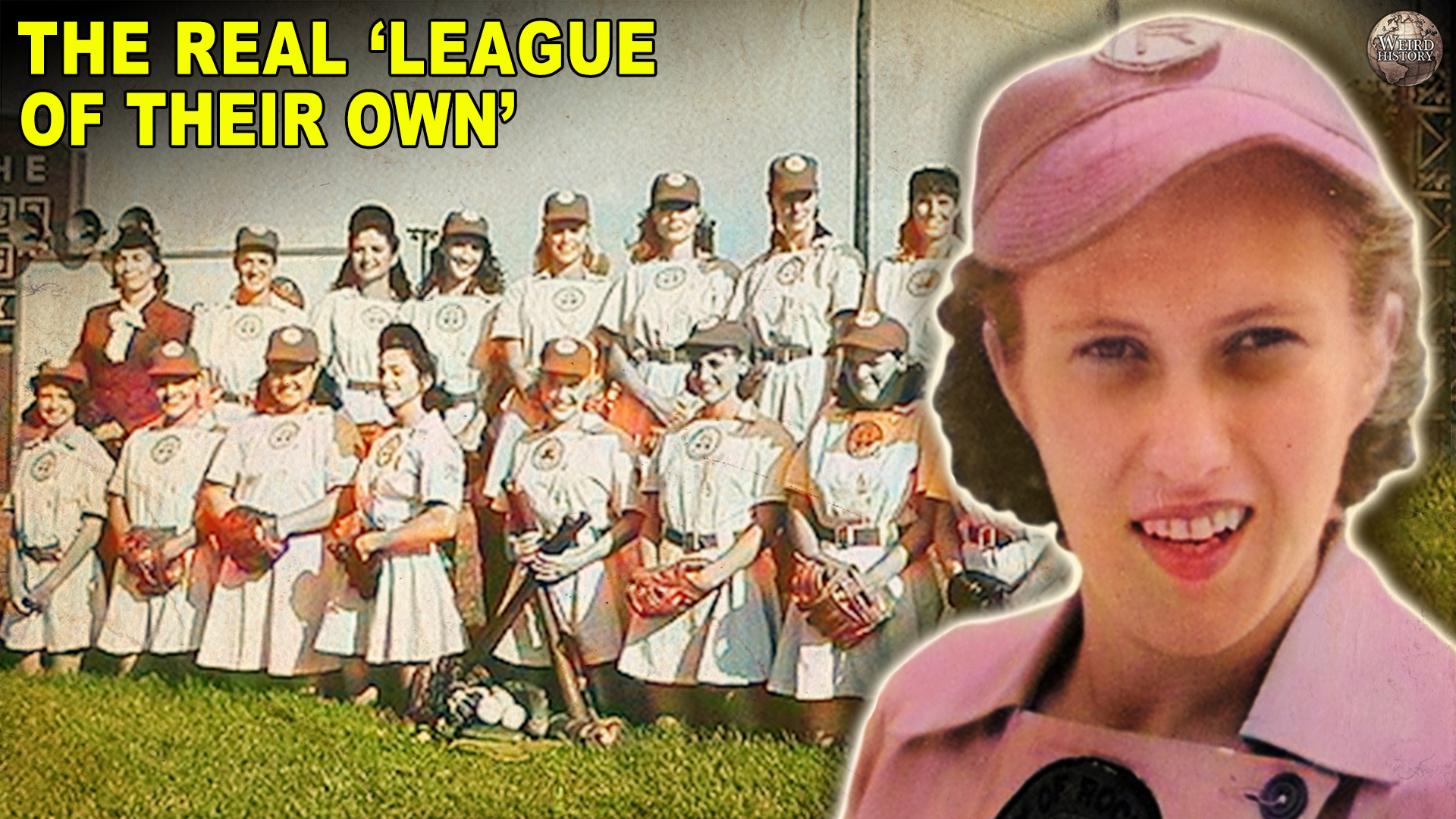
When A League of Their Own was released in 1992, it brought attention to a women's professional baseball league that had disbanded nearly 40 years earlier. Based on the true story of the All-American Girls Professional Baseball League, which existed from 1943-1954, the film attempts to put the AAGPBL - which went from being a gimmick to save baseball from going extinct during WWII to a respected league that drew sizable crowds for years - in some sort of context.
Show More Show Less View Video Transcript
0:00
A League of Their Own, apart from being the only Madonna movie
0:03
anyone might enjoy, is based on the true story of the All-American Girls Professional Baseball League
0:09
which existed from 1943 to 1954. But how much of the movie's story is actually true
0:16
Well, some details are accurate, while others, not so much. So today, we're looking at the true story
0:23
behind A League of Their Own. OK, grab your bat and glove, because it's
0:27
time to hit the field for some weird history. In the fall of 1942, Chicago Cubs owner Philip K. Wrigley
0:38
asked Ken Sells, the assistant to the Cubs' general manager, to head up a committee to come up with ideas
0:44
to compensate for the loss of revenue if Major League Baseball got shut down by World War II
0:50
Several minor league clubs had already disbanded due to players being drafted or volunteering to serve
0:55
and Wrigley and other MLB owners feared the same thing would happen with major league players
1:00
They came up with the idea of forming a women's softball league, whose teams would be prepared
1:05
to go into MLB parks if the attendance started to drop significantly. Sells was named as the
1:10
league's president. The newly minted All-American Girls Professional Baseball League, or the AAGPBL
1:17
scheduled its first tryouts in Chicago in the spring of 1943, and drew almost 300 women from
1:22
across the United States and Canada. Wrigley said of the new endeavor
1:26
the need for additional recreation in towns busy with war defense work prompted the idea
1:32
Also, maybe women wanted to fill their day up with something other than anxiety
1:36
about their men fighting overseas in the most significant global war in history. And baseball is pretty good at helping you forget about stuff
1:43
That's why the games are so long and why every stadium sells beer. In the movie, Rockford manager Jimmy Dugan, played by Tom Hanks, is a former Major League
1:57
star whose career was cut short by a combination of injuries and heavy drinking
2:01
Well, that sounds like every Major League star from the early to mid-20th century. While Jimmy Dugan wasn't a real person, he was based on two real Major League players
2:11
each with their own tragic stories, Jimmy Fox and Hack Wilson. Fox was a phenomenon who made his MLB debut when he was just 17 years old and spent the
2:20
next two decades cleaning up in the game. Unfortunately, he began experiencing recurring double vision and facial pain in 1936, but
2:29
that issue may actually be traced to a concussion he suffered after being hit in the head by
2:33
a pitch in 1934 He sought treatment multiple times but doctors couldn find a remedy Teammates said that while Fox had previously only been a social drinker by 1941 he
2:43
was using alcohol to cope with health issues. There's a story about one cross-country flight
2:48
during which Fox drank about a dozen miniature bottles of scotch to numb the pain
2:53
And once you've hit your dozenth bottle, that miniature distinction no longer applies
2:58
And Hack Wilson? One sports writer who covered Wilson's career said, for a brief span of a few years, this hammered down little strongman actually rivaled
3:07
the mighty Babe Ruth. But unfortunately, his love of alcohol got in the way of possible
3:12
superstardom. When asked if he ever played a game while drunk, Wilson replied, hungover? Yes
3:18
many times. Drunk? No. Watching the movie, you can really tell that the primary inspiration for
3:24
Jimmy Dugan were two formidable alcoholics. Maybe there should be a Hall of Fame for that
3:29
In the movie, Dottie Hinson, played by Gina Davis, is a catcher, but the character was based in large part on first baseman Dorothy Dottie Kamencheck
3:38
Kamencheck played in the AAGBPL for 10 years, winning two batting titles and earning seven all-star nods
3:45
Her undeniable talent even drew attention from outside the AAGBPL. In 1947, she received an offer from a men's minor league team in Fort Lauderdale, Florida, to buy her contract, but she turned them down
3:59
That's a pretty big deal for 1947. Wait, that would be a pretty big deal today
4:03
Kamen Cech was also later named one of the top 100 female athletes of the 20th century by Sports Illustrated
4:10
So you could say the filmmakers really took some liberties by having her character retire after a single season
4:16
Also, her position was changed to catch her to create more dramatic tension between Dottie and her pitcher sister, Kit, played by Lori Petty
4:23
In the movie, a league scout, played by John Lovitz, tells Dottie she will get paid $75 a week if she made the league
4:34
Kit points out that it would be a lot more than their $30 per week salary at the Oregon dairy farm where they worked
4:40
Plus, you know, playing baseball is generally more fun than milking cows
4:44
And people don't buy tickets to get drunk at a farm. In fact, many players in the AAGPBL were paid better than most Americans in the 1940s
4:52
While the average worker made around $25 per week, the players earned between $50 and $125 per week
4:59
during their three-month season. The league upended many gender roles of the day
5:04
The players even had their own groupies. The players called their especially devoted male fans
5:09
Clubhouse Clydes or Locker Room Leonard In 1992 former player Helen Callahan St Avin recalled wherever we were guys used to hang outside our hotel yelling up to us We throw our bras down to them
5:23
And while that's not exactly like catching a home run ball, you'd probably still want to get those autographed
5:28
In the movie, the players are seen attending charm school, doing things like walking downstairs with books on their heads
5:34
to improve their posture, learning how to drink tea without slurping, and being taught to cross their ankles
5:40
and not their legs when sitting. It seems a little silly, but it's also completely accurate
5:46
The real-life AAGPBL players did have to go to charm school during spring training
5:52
After all, it was the 1940s. Former player Lil Jackson said in an interview
5:57
Every day after practice, Mr. Wrigley sent us to Helena Rubenstein's charm school
6:02
to learn how to put on makeup, how to put on a coat, and how to get in and out of a car or chair
6:07
Back at the hotel, he made us wear skirts. If you dressed in slacks, you had to use the servant's elevator
6:14
Ugh, the servant's elevator. Might as well take the stairs. In the documentary Baseball Girls, former AAGPBL player Faye Dancer explained
6:24
P.K. Wrigley, he wanted women to look like women. So we had the hair below the ears
6:29
We had blouses, skirts, dresses. We could not wear shorts. We could not wear slacks or anything like that
6:36
At all times, we had to look like women. When we played ball, we could play like a man, but we still had to look like a woman
6:42
The players also had to follow a strict set of rules. Lipstick had to be worn at all times
6:47
The players could not smoke or drink in public, or use obscene language of any kind, or drive
6:53
their cars past the city limits without permission from the team's manager. Curfew was two hours after the game, and the team's chaperones had to approve all social engagements
7:02
And today, while conduct guidelines aren't unusual for actors or athletes with million
7:07
dollar sponsorship deals, these unusually strict rules made the AAGPBL sound less like a professional
7:12
organization of adults and more like a summer camp for teens. But these ladies were rebels
7:18
Dancer went on to say, rules are only made to be broken. If they said we'd have to be in two hours
7:23
after the ball game, which would ordinarily be midnight, well, we'd be lucky if we'd got in at
7:28
two, four o'clock in the morning. Several former players and some historians believe the AAGPBL
7:34
strict rules were a matter of not wanting the players to be seen as lesbians, even though some of them were gay
7:39
Pat Henschel, who had been in a relationship with a fellow AAGPBL player in the 1940s, recalled
7:46
I don't think it was really even talked about, frankly. The AAGPBL was a segregated league Women of color were not allowed to participate In 1951 Mamie Peanut Johnson and her friend Rita
8:01
traveled to Alexandria, Virginia for a tryout, where they were the only non-whites there
8:06
Johnson said as they stood there with their gloves, the others looked at her and Rita, but said nothing
8:11
They wouldn't give us the opportunity to try out, she told the National Visionary Leadership Project
8:16
A league of their own acknowledges this in a brief scene in which a woman, who is possibly meant to represent the real-life Johnson
8:23
fires a stray baseball bat to the players so hard that the catch hurts Dottie's hand
8:28
But Johnson did eventually get to play professional ball. After the AAGPBL refused to let her to try out
8:35
she continued to pursue her dream of being a pitcher and was signed by the Indianapolis Clowns of the Negro League in 1953
8:43
Promoters believed a woman playing men's baseball would help with attendance, and Johnson wound up being one of three women to play in the league
8:54
Sex sells has been the rule of the game pretty much since people began exchanging money for
8:59
things, and it was no different in the 1940s. So the short skirt uniforms the characters wore
9:05
in a league of their own are historically accurate. AAGPBL players were required to
9:10
wear these uniforms, which were designed by the wife of league founder Philip K. Wrigley
9:15
And just like you saw in the movie, the skirts were less than practical for a game of baseball
9:19
Former player Faye Dancer recalled, you had no protection for your leg or anything like that
9:24
So when you would slide, you would get a strawberry. A strawberry being that huge bruise
9:28
the one player gets on her leg in the film. We all had nightmares about that, right
9:38
A 27-minute documentary short about the AAGPBL produced in 1987 by Kim Wilson and Kelly Kandale
9:46
led to the story about the all-women baseball league being developed into a feature film
9:50
Wilson and Kandale wrote the initial script treatment for what would become a league of their own
9:55
Kandale was the son of Helen Callahan, who was an outfielder in the league
9:59
His aunt also played in the AAGPBL as a second baseman. And according to Wilson
10:05
a big screen movie was always the goal. She later told ESPNW
10:10
We used the documentary to write the story, then to sell the idea for a feature
10:14
We were completely obsessed with the idea. It took close to five years to sell it, to do the research on it, to film it, and to write the story for the film
10:23
The work paid off. The film was a huge success and was recently adapted into a streaming series by Amazon
10:30
Now, if only someone would tell us whether Dottie dropped the ball on purpose
#Documentary Films
#Drama Films