Up next in 10



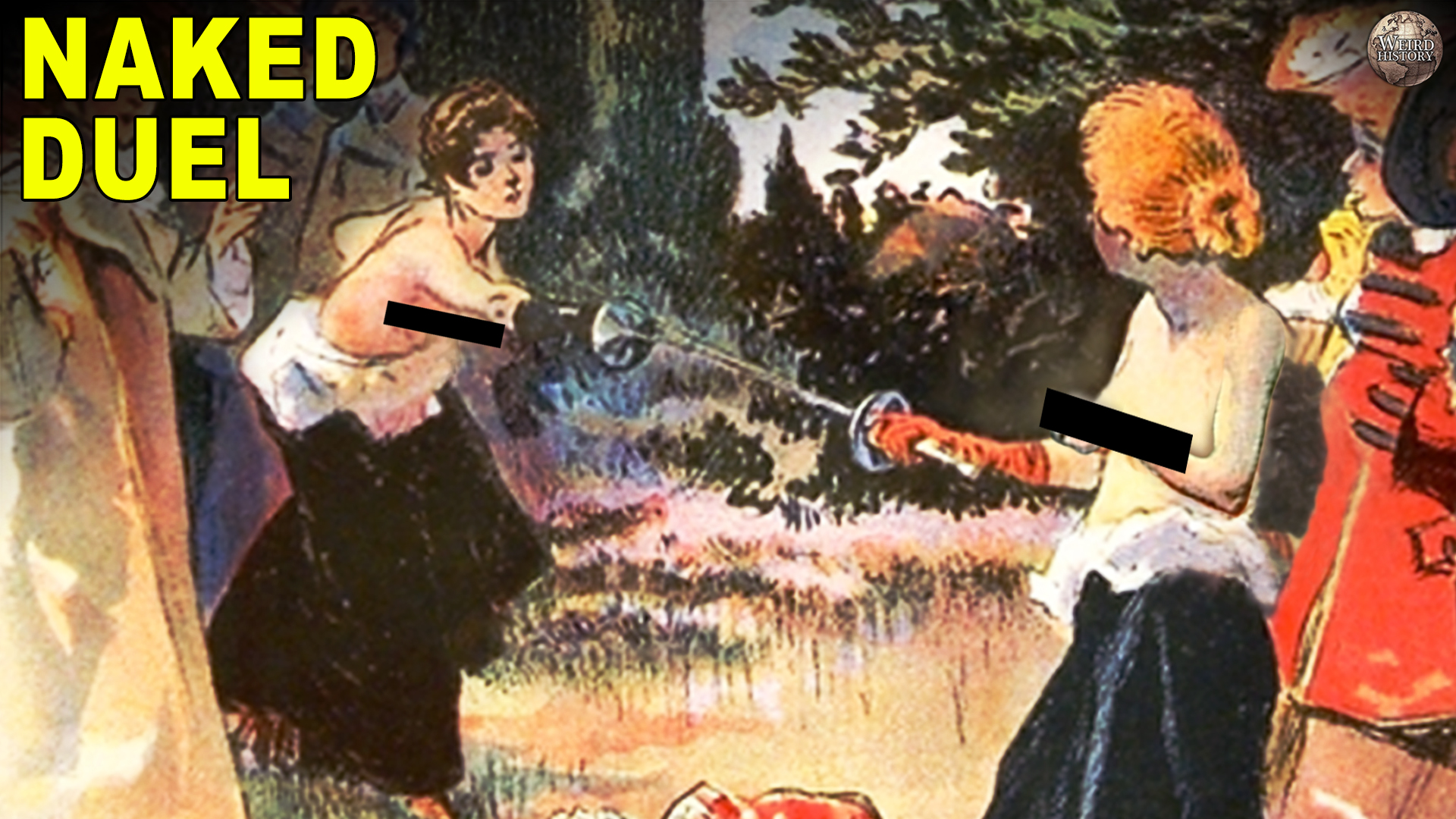
The history of dueling is full of shocking moments, like the time the vice president shot and killed the Secretary of the Treasury - that was, of course, the duel between Alexander Hamilton and Aaron Burr. But no duel was more shocking than the topless duel between fought a princess and a countess. It was called the first emancipated duel because not only were both duelers women, their seconds and the doctor on hand to tend their wounds were also women.
Show More Show Less View Video Transcript
0:00
History's most famous duel was arguably the one between Alexander Hamilton and Aaron Burr
0:05
that got its own musical. But have you heard of the duel between Princess Paulina von Metternich
0:11
and Countess Anastasia Kielmansegg, the two aristocrats who faced off with their clothes off
0:17
Today on Weird History, we're examining the topless duel between a princess and a countess
0:23
Okay, get ready to face off with pistols at dawn. Austrian socialite Paulina von Metternich was born Countess Pauline Shandor de Slavnica
0:38
in Vienna to a noble family from Hungary in 1836. At age 26, she married her uncle
0:45
Prince Richard von Metternich, who worked as a diplomat and, in case you missed it
0:49
was her uncle. We can't stress that enough. They're said to have had a relatively happy
0:54
marriage despite being closely related and despite Prince Richard's frequent public love
0:59
affairs with several actresses and opera singers. Details, details. After marriage, Paulina, now a princess
1:07
accompanied her husband on trips to both the Royal Saxon Court in Dresden and the Imperial French Court in Paris
1:13
During the Franco-Prussian War of the 1870s, they lived in France for several years
1:18
This made her something of a cross-cultural ambassador, bringing new ideas and trends she had picked up
1:23
in one corner of Europe along with her on her international travels. Ultimately, Paulina became known as a fashion icon and trendsetter, who helped to popularize
1:33
activities among the women aristocrats of her era that were previously male-only, such
1:37
as skating and smoking cigars, which is difficult to do at the same time
1:42
She also became an important evangelist for the works of famous composers Richard Wagner
1:46
and Franz Liszt, whose career she backed at crucial moments. Which brings us to the summer of 1892 and the annual Vienna Musical and Theater Exposition
1:56
a key event in the elite social calendar. Princess Paulina was overseeing preparations for the event alongside another noblewoman
2:04
the Countess Anastasia von Kielmansegg. Though the specific nature of their dispute remains lost to history
2:11
for whatever reason, these two women became deeply upset with one another
2:14
regarding the decision of some floral arrangements. And if there's one thing that'll get fancy ladies at a musical theater exposition to throw hands
2:22
it's gaudy bouquets. A British woman's magazine at the time noted that Anastasia was an ambitious court rival
2:28
to Princess Paulina, while also being young enough to be her daughter. By the 1890s, Princess Paulina was already in her 50s
2:36
while Countess Anastasia was an up-and-comer in the Viennese social scene. The Countess's attempt to step up at the musical and theater
2:43
exposition and maybe take control of some of the responsibilities that had previously belonged to the princess may have been viewed as a threat to the princess position or an attempt to push her aside As proper etiquette and decorum forbade clobbering each other
2:58
with high-backed ornamental chairs right there on the spot, the women opted to settle their dispute in a more formal setting
3:09
Duels were seen as more proper and respectable because unlike street fights or brawls
3:13
they were conducted according to a set of strict rules. These were designed to keep things fair
3:19
to exhaust all nonviolent forms of negotiation, to ensure that immediate medical attention
3:23
was available for anyone injured during the fighting, and to minimize harm and death
3:28
That's minimize, not eliminate. In a traditional 19th century duel, one party would publicly challenge another
3:36
while identifying the insult or grievance that had caused their initial offense
3:40
The challenged party would then have the option to offer a public apology or restitution to avoid the duel
3:46
also known as the knee-knocking chicken heart maneuver, or to simply accept the challenge
3:50
and choose the weapons to be employed. If the challenged person opted to move forward with the duel
3:56
the challenger would get to propose the field of honor where they'd meet. Eh, wonder how many times the parking lot behind Dave and Buster's
4:03
was a field of honor. The challenged person would get a chance
4:06
to propose an alternate site. These locations were often chosen because of their privacy
4:10
and to avoid potential arrests. Each duelist would typically bring a doctor of their choosing
4:16
along with at least one witness, known as their second. Just prior to the start of the duel
4:21
seconds would meet up and act as go-betweens, trying anything they could think of to settle the dispute
4:26
before guns or swords or bricks or whatever were drawn and things got real
4:31
Should either party bail on the duel altogether, their opponent would be considered the victor
4:36
and they were publicly branded a coward, a distinction that carried very real consequences
4:43
By the mid-19th century, the popularity of these kinds of duels between officers or aristocrats
4:52
was already in decline, even among men. The last known fatal duel in England actually took place
4:58
in 1845, almost 50 years before the countess and the princess faced off. To have two women taking
5:05
part was an even more rare occurrence. More often, when women aristocrats felt slighted or took
5:10
offense, they'd ask male friends, relatives, or colleagues to fight duels on their behalf
5:15
As proto-feminist movements spread across Europe in the late 19th century, these ideas started to
5:20
change, and there was growing sentiment that women should be able to settle social exchanges for
5:25
themselves, including through duels. A duel between two women was known as an emancipated duel
5:32
and notably all parties involved in the affair, including the medics and seconds, would also have been women Countess Anastasia and Princess Paulina opted to fight outside the city of Faduts
5:47
the capital city of Liechtenstein. The location was key because of Liechtenstein's status as an independent principality
5:54
Prior to the Napoleonic Wars of the early 19th century, Liechtenstein had been a sovereign member of the state of the Holy Roman Empire
6:01
When the empire was dissolved in 1806 by Francis II, the state ceased to owe any obligation to any feudal lord beyond its borders for the first time
6:09
in nearly 1,000 years. Ultimately, it joined the German Confederation, presided over by the Emperor
6:15
of Austria, though it continued to enjoy a reasonable level of autonomy and self-governance
6:21
This made Liechtenstein an ideal spot for an extra-legal activity like a duel. Notably
6:26
the Principality was also a favored refuge for the Pope on occasions when he had to flee the Vatican
6:32
Although, as far as we can tell, the Pope never dueled anyone in Liechtenstein, unless they tried to steal his big hat
6:37
Princess Schwarzenberg served as the second for Paulina, while Countess Kinski aided the other countess
6:43
Baroness Lubinska, a Polish noblewoman who actually had a degree in medicine
6:48
served as the presiding doctor for both parties. As weapons, the two combatants went with rapiers
6:54
As they're designed for making quick stabs with their pointy end, the sides of the blades are nearly edgeless
7:00
like the lyrics to a Will Smith song. The swords actually rose to prominence as dueling weapons
7:06
and were frequently carried around by courtiers in earlier eras, when the need to defend one's honor at the end of the blade
7:11
was more common. It wasn't the first of its kind, but duels between women
7:16
were rare enough that the story got picked up by newspapers and spread around the courts of Europe
7:21
London's Paul Mall Gazette reported at the time of a duel between two ladies of the high Austrian nobility
7:27
Even the Los Angeles Times, which, yes, actually existed in 1892, ran a brief blurb about the events, commenting that
7:34
it was a real fight without hair pulling or plain scratching. Apparently, the LA Times really wanted to make it clear this wasn't a foxy boxing match
7:43
Much of our knowledge of what transpired on that fateful August day is directly based on these newspaper reports
7:49
In sword duels, the opponents start on opposite sides of a square that was 20 paces wide
7:55
leaving the square at any point before the conclusion of the fight was considered forfeiting
7:58
and would also result in being labeled a coward, especially if you left the square while shrieking
8:04
and flailing your arms. Specific victory conditions changed depending on the duel
8:09
and we have no way of knowing what the countess and princess agreed upon in the moments before they crossed swords in Faduts. Most accounts hold that the match lasted a total of three rounds
8:18
In rounds one and two, neither woman managed to wound the other, resulting in a draw
8:23
In round three Paulina received a tiny cut to the nose while Anastasia was slashed or stabbed in the arm It unknown which party actually won but neither was labeled a coward for their behavior so both would have retained their honor
8:37
One report claims that the women embraced, kissed, and settled their differences in the
8:42
moments after the duel completed. You know, just like the end of Rocky
8:46
OK, so you probably noticed when you clicked on this video
8:55
that both Princess Paulina and Countess Anastasia entered the square circle for their duel completely topless
9:02
That may have even been why you clicked on this video. No judgment here
9:06
The combatants agreed to this at the suggestion of their presiding doctor, Baroness Lubinska
9:10
who had firsthand experience dealing with infected wounds and was an early proponent of germ theory
9:16
Lubinska knew that should either of the duelists actually break the skin, it was possible their
9:21
rapiers could have forced dirty pieces of clothing or other surrounding material into
9:25
the wound, causing it to become infected. That is bad in any century, but especially bad in the olden days, when the nearest urgent
9:33
care was often just a guy who had stitched up a horse one time. A blade slashing against bare skin, on the other hand, would have produced a cleaner
9:41
cut that's easier and quicker to heal. As the goal of the duel was not to leave anyone permanently injured, this just made good common
9:48
sense. Plus, there weren't any dude witnesses around anyway. Speaking of witnesses, it's worth
9:54
pointing out here that we can't be 100% absolutely certain that all of these events actually took
9:58
place the way they were described in newspapers, or if the duel even took place at all. Though the
10:04
story scandalized Victorian England and became a subject for public fascination around the world
10:09
none of the newspaper items from the time are based on actual eyewitness accounts
10:13
and no photographs of the event have survived. Rats. The duel wasn't reported in any Austrian or Liechtenstein newspapers
10:22
In fact, not long after the first accounts began to pop up, Princess Paulina issued a total denial
10:28
calling the story a ridiculous invention by Italian journalists. If it did happen, it was one of the last major duels of the era
10:39
made famous by so many Westerns had started falling out of favor by the close of the 19th
10:43
century. You could do those topless too, but with bullets, it doesn't make much of a difference
10:49
Many historians cite the devastating wars of the 1800s and early 1900s and the advent of
10:54
frightening weapons like machine guns and chemical warfare as prompting duels to fall out of favor
11:00
It was also the beginning of a major decline for the European aristocracy
11:04
as social position became more closely intertwined with wealth as opposed to concepts like reputation, legacy, and honor
11:12
With people less concerned about protecting their family name, they likely had less motivation to challenge one another to duels
11:18
Nowadays, people just flame each other on Twitter