Up next in 10



The Nobel Prize is one of the most prestigious awards a person can earn. Among its many recipients, it is an honor won by chemists, physicists, and authors who have contributed vast amounts of tireless work to shaping the world we live in, and for their efforts in paving the way for humanity to move forward. The prize is named after its benefactor, Alfred Nobel, who, among a great many other things, was noted for his revolutionary invention that oftentimes literally helps to shape our world: dynamite.
Show More Show Less View Video Transcript
0:00
On November 12, 1970, an Oregon businessman and military veteran by the name of Walter
0:07
Eumenhofer called his insurance company to file a most unusual claim. As Mr. Eumenhofer told it, his brand new Buick sedan had been flattened by a three-by-five-foot
0:18
chunk of rotten whale flesh that came hailing down from the sky
0:22
Sure enough, a quarter mile from Mr. Eumenhofer's parked Buick, the Oregon Highway Division
0:27
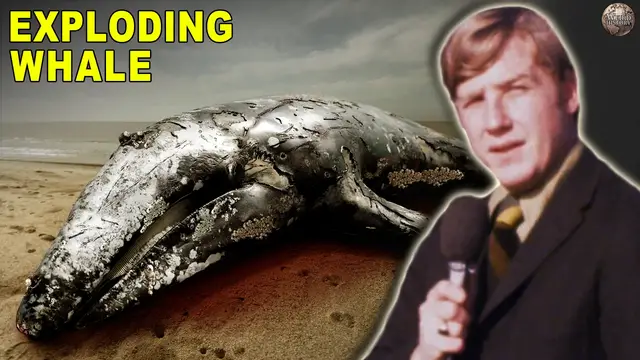
in consultation with the United States Navy, had decided to deal with an eight-ton, 45-foot-long beached whale carcass
0:34
by loading it up with dynamite and blasting it to kingdom come
0:40
Today, we're going to take a look back at the time they blew up a whale in Oregon
0:48
Three days earlier, the giant sperm whale carcass had washed ashore near Florence, Oregon
0:53
The whale was already starting to decompose, And according to locals, the stench was unbearable
0:59
and could be smelled from up to a mile away. Locals were also concerned that the carcass may burst
1:04
resulting in an even bigger mess, or that some teenager would try to climb on top of the carcass and end up falling in
1:11
In 1970s Oregon, if you could drive on the beach, it was considered a highway
1:15
And so the job of whale carcass disposal fell on the Oregon State Highway Division
1:20
In consultation with the United States Navy and munitions experts, Assistant District Highway Engineer George Thornton
1:26
made the call to treat the whale as one would an unwanted boulder and blow it to smithereens
1:32
Nowadays, virtually everyone has a video camera in their pocket. But back in 1970, if you wanted a video camera in your pocket
1:40
you would need some pretty deep pockets, literally and figuratively. A video camera back then weighed about 100 pounds
1:46
and, adjusted for inflation, cost around $70,000. Lucky for us, the authorities at Oregon's Department of Transportation
1:53
had the foresight to realize blowing up a whale could make for some serious must-see TV
1:59
Cameraman Doug Brazil and news reporter Paul Linman of Portland's KATU-TV were invited to
2:05
come document the entire spectacle. Little did they know just how much this story would blow up
2:15
Controlled explosions are never an exact science. Even today, as an example, in June of 2021
2:22
17 people were injured in downtown Los Angeles as the bomb squad attempted to
2:28
safely detonate a truck full of illegal fireworks But the whale wasn going anywhere and it needed to be dealt with somehow And so a half ton of dynamite or 450 kilograms was thought to be enough to do the trick
2:41
Walter Eumenhofer, the man whose Buick would soon be flattened, claimed to have warned Thornton that he was using way too much dynamite
2:48
and that a mere 3.8 kilograms would suffice. But despite Mr. Eumenhofer's military expertise
2:54
his advice went unheeded. The assumption was that a large explosion would disintegrate the whale carcass
3:01
and any small pieces that remained on the beach would be taken care of by seagulls and crabs and whatnot
3:06
It was a bold prediction by Thornton, one that would inevitably blow up in his face
3:11
At Thornton's signal, state highway division workers detonated the half-ton brick of dynamite
3:17
The beach erupted in a 100-foot-high column of sand and whale, said reporter Larry Bacon with the register guard
3:24
The crowds that had gathered to watch with morbid curiosity and glee from what was assumed to be a safe distance of a quarter mile away
3:32
soon began to scream and run for cover as large pieces of Moby Dick blubber came raining down
3:37
Luckily, no one was seriously injured. But as Paul Lindman infamously joked, the Land Lubber Newsman had become the Land Blubber Newsman
3:46
With a blast blasted blubber beyond all believable bounds. Back in 1970, with no Facebook, YouTube, Instagram, Snap, TikTok, or cable news
3:59
stories just didn't go viral. So if you didn't live in Florence, Oregon, and have an eyewitness account of, say
4:05
the detonation of a giant aquatic mammal, you may have had to rely on word of mouth
4:10
Unfortunately, people often embellish stories, or even outright make them up. We're looking at you, Mr. and Mrs. Balloon Boy
4:17
So it's understandable when reasonable people were told the story of organ officials blowing up a beached whale
4:23
many assumed they were being fed a tall tale. The incident became nothing more than an urban legend
4:29
And for 20 years, that's how it remained. In his nationally syndicated humor column for the Miami Herald
4:36
writer Dave Barry recounted the whale exploding incident in a column titled Moby Yuck
4:41
Oh, Dave, you yuckster. As part of the story, Barry claimed to have actual footage of the event
4:46
Joking that, here at the Exploding Animal Research Institute, we watch it often, especially at parties
4:52
But when an unattributed version of the article began circulating on the electronic bulletin boards
4:57
under the title, The Far Side Comes to Life in Oregon, the anonymous poster had left out crucial information
5:03
like the tiny fact that the incident in question happened 20 years prior Soon the Oregon Department of Transportation was inundated with calls from outraged readers who believed that the exploding whale incident
5:15
had just happened. They thought the whale had washed ashore recently and were hot on the trail of a governmental blubber flubup
5:22
said public affairs coordinator for the Oregon Department of Transportation, Ed Shokes
5:26
They were disappointed that the story has 25 years of dust on it
5:30
Ed's phone became a de facto blubber hotline for the ODOT. He was regularly receiving calls from outlets like The Wall Street Journal and Washington
5:39
D.C.-based Governing magazine. The exploding whale story went from actual event to urban legend to current news to presumed
5:47
hoax over the 30 years from 1970 to 2000. Then Shopes got a call from Snopes
5:53
The Snopes staff was investigating the urban legend and was surprised when Ed Shopes confirmed
5:57
the entire story, along with corroborating evidence and recorded eyewitness accounts. Snopes published their findings on March 19, 2000
6:06
And the internet went nuts. The original 1970 news clip made its way to the interwebs in 2003
6:12
And by 2006, it had garnered 350 million views and was ranked the fifth most watched viral video of all time
6:19
coming in right behind Star Wars Kid, Numa Numa, One Night in Paris
6:24
and Kylie Minogue for Agent Provocateur. But unlike some of those other videos
6:28
the Oregon Exploding Whale is timeless. For the 50th anniversary of the event, KATU pulled the original 16mm footage from the archives and re-released a remastered edition of the news report in 4K definition
6:47
There is an entire website devoted to the exploding whale story, with origins dating back to the early 1990s
6:53
It is aptly named TheExplodingWhale.com. End of 2019, the site is completely ad-free
7:01
The exploding whale has even reached Hollywood stardom, having been parodied in the 2007 movie Reno 911 Miami
7:07
and more recently in the 2018 Australian comedy Swingin' Safari. And in 2020, residents of Florence, Oregon
7:14
voted to name a new recreational area, Exploding Whale Memorial Park, in honor of the infamous incident
7:21
One could even visit the park while wearing one of the many I Survived the Exploding Whale t-shirts sold on eBay
7:26
and Etsy. Unfortunately, beached dolphins, porpoises, and whales are not uncommon. Sometimes
7:33
these cetaceans die naturally of disease or old age out at sea and are washed ashore. Other times
7:39
human activity like boat collisions bycatch or environmental degradation lead to these animals deaths When 41 dead whales washed up on a beach right near Florence Oregon in 1979
7:50
explosives were not considered. Instead, like a Roman soldier, the animals were burned and buried
7:57
Sometimes cetaceans wind up accidentally stuck on the beach. This whale's beached himself. He needs to get back in the water or he'll die
8:04
Step aside. I'll handle this. Give me some room. In these cases, trained responders will attempt to refloat the animal, carefully sending it
8:11
back to sea. But in cases where that isn't possible, the beached creatures are typically euthanized
8:17
With smaller mammals like dolphins, chemical euthanasia is possible. But for larger whales, explosives are still used
8:25
But nowadays, they know to haul the animal out to sea before blowing it up
8:29
This may seem cruel, but sometimes it's the most humane option. If you were ever to encounter a beached cetacean, do not try to rescue it yourself
8:39
Moving it can cause the animal a great deal of pain and is extremely dangerous
8:43
Best to leave it to experts like George Costanza. Pulled out the obstruction
8:56
Another whale explosion occurred on January 29, 2004 in Tainan City, Taiwan
9:02
This unfortunate sperm whale had washed ashore in southwest Taiwan and was close to death by the time help arrived
9:10
Rescue efforts soon proved futile. So instead of letting the carcass go to waste, authorities ordered the whale to be transported via truck to a university where the carcass could be studied for educational purposes
9:22
It took three large cranes and 50 workers more than 13 hours to shift the whale onto the back of a truck
9:28
The whale was successfully moved to the National Chenggung University, but apparently nobody had bothered to inform the university
9:36
When Professor Wang Qianping was denied permission to perform a necropsy, he ordered the mammal to be moved to the Suzhou Wildlife Reservation Area
9:45
But the whale never made it to its destination, at least not in one piece
9:50
Unlike the Oregon whale, nobody had expected this one to blow. Scientists would later confirm that the combustion
9:57
was the result of trapped gases expanding inside the decomposing carcass. But this natural explanation was likely little comfort
10:05
to the scores of pedestrians and shopkeepers sprayed with buckets of blood and blubber
10:10
in the center of Taiwan's oldest city. There was one silver lining, however
10:14
Just like with the Oregon explosion, there were no reported injuries