Up next in 10


When The Matrix first hit theaters in 1999, no one knew what to expect. Audiences walked in ready for another sci-fi flick, but walked out having witnessed a cinematic revolution. From its groundbreaking bullet time visuals to its mind-bending story, The Matrix changed Hollywood forever.
Show More Show Less View Video Transcript
0:00
there are opening scenes that set up a movie and then there are opening scenes that are the movie
0:14
they work as a microcosm of its tone its rules and its world all in the span of a few minutes
0:21
when audiences first sat down to watch the matrix the marketing had been deliberately cryptic built
0:28
around the question of what is the Matrix? And less than six minutes in
0:32
the Wachowskis had given us an answer without giving us an answer at all
0:37
Instead, we got one of the most perfect opening scenes of all time that not only introduced a world
0:42
no one had ever seen before, but also rewrote how action cinema could be made
0:48
When the movie starts, we hear a phone ring and two disembodied voices talking
0:52
through the line's slight distortion. There's flittering green code over a black background
0:56
and a question, low and simple. Is everything in place? We don't know who's talking
1:02
We don't know what everything is. But as the call goes on, we are already getting loaded
1:06
with proper nouns we don't understand. Morpheus believes he is the one
1:10
And actions whose words sound familiar. You aren't supposed to relieve me. I know, but I felt like taking a shift
1:16
Everything was disarming, meant to throw you off kilter. The consensus of the time seemed to be that science fiction
1:22
is scary and alien, and that movie should ease you into the world with as much care as possible
1:27
The Matrix instead opens with a cryptic conversation, one riddled with familiar words
1:32
but with no answers at all. And then the green digital code begins to cascade down the screen
1:38
creating what would become an iconic computer rain effect. It's not just a cool visual
1:42
This is the movie telling the audience that this is the lens you're going to see the world through
1:48
Reality is code. Well, at least for part of the movie. It was a bold move from the Wachowskis
1:54
whose biggest success until that point was the erotic neo thriller Bound When they cut to a dark city street we see a police raid is already in progress Squad cars flashing lights an urgency that suggests someone dangerous is inside
2:08
When the cops enter the room, our expectations are turned again. The woman seated at a computer raising her hand
2:13
is dressed in head-to-toe black leather. This is a trick, and the Wachowskis know it
2:18
Every screenwriting book will tell you to introduce your protagonist early, and for decades, action movies had conditioned us
2:24
to expect that the first person we meet, especially in the middle of a high-stakes standoff, is the protagonist
2:30
But The Matrix flips that expectation on its head. Neo isn't in this scene
2:34
He won't be for another 10 minutes. Instead, we're given someone else entirely
2:38
There is an argument to be made that Trinity is the one, but there's no argument that Neo is the main protagonist of this movie
2:45
What the hell is this? It's necessary, Neo. For our protection. From what
2:50
From you. At this point, though, the Wachowskis make Trinity feel like the protagonist
2:55
by building everything around her. That mythos is only reinforced by the way the police outside interact with the agents
3:02
who just stepped out of their shiny black sedan. There's some more cliched action movie dialogue about jurisdiction and low-key sexism
3:09
but then one agent says something that changes the trajectory of the opening scene yet again
3:14
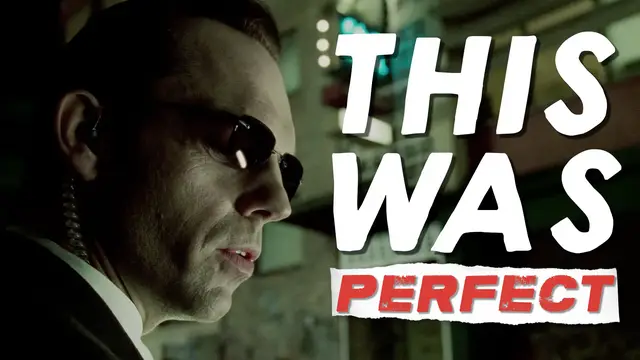
No, lieutenant, your men are already dead. In storytelling, there's a stock character referred to as an oracle
3:21
Not the oracle that appears later in the movie, but a harbinger. It's often used in horror or action movies to warn protagonists about the unknown
3:29
Someone akin to Cheech Marin's bartender in Desperado. They're there to broadcast not just a warning
3:34
but to let the audience know that this oracle has a history with what lies ahead
3:39
When the police burst into arrest Trinity, it happens. And we see what was known to the Wachowskis
3:45
to the agents, and to the disembodied voices over the phone. With a single impossible leap, Trinity freezes midair
3:51
The camera whips around her in a perfect 360 degree orbit and time seems to stop
3:57
This was bullet time and in 1999 nothing like this had ever been seen in a live action Hollywood film The Wachowskis weren just showing us a cool stunt They were introducing the visual language of The Matrix The entire movie exists in two realities
4:12
The false, simulated world of The Matrix, and the grimy, real world outside of it
4:17
Inside The Matrix, the rules of physics are negotiable. If you understand the system, you can bend those rules
4:23
And this one slow-motion shot tells us all of that instantly. It's not explained
4:27
There's no voiceover saying, in the Matrix, you can move faster than a bullet
4:32
We see it. And more importantly, we feel it. From here, Trinity has another call talking about a traced line and is given another destination, a phone booth
4:40
The scene then explodes into a foot chase across rooftops. Every beat of this chase serves a purpose
4:45
Trinity moves with inhuman speed and agility. While making impossible jumps from rooftop to rooftop, we still don't know what she's running from or toward
4:54
only that she is scared of what is behind her. This is brilliant scene construction because we've already watched her effortlessly drop every cop in her path without breaking a sweat
5:03
But the moment an agent appears, she's frightened. Without explanation, the film has already communicated a power hierarchy
5:11
The beat cops are nothing compared to the world bending of Trinity, and yet even she is afraid of the pursuing agents
5:17
That hierarchy will drive the stakes for the rest of the film. Hear that, Mr. Anderson
5:23
That is the sound of inevitability. Trinity eventually makes it to a phone booth, picks up the ringing receiver, and just before an agent plows into it, she vanishes
5:32
A character escaping by answering a ringing payphone. Later, we'll learn that in The Matrix, phones are exits, hard lines that allow characters to eject from the simulation
5:41
But right now, it's just another strange piece of a puzzle we can't yet see
5:45
When you break down the opening scene, everything about The Matrix is already there
5:50
The visual language of using bullet time, impossible wire work stunts, and that cryptic dialogue
5:55
All of it built specifically to tell you about the characters. And those characters operate in a world with rules
6:02
There a food chain of violence even to folks like Trinity who thanks to that visual language we know can bend physics and the world around them to their will How did you do that Do what You moved like they do
6:13
I've never seen anyone move that fast. By the time we meet Neo, we've already
6:17
been taught how to watch the movie. The Wachowskis have set the table so that when Morpheus tells Neo
6:22
he's living in a dream world, we just kind of think, yeah, that checks out
6:26
The cultural shockwave from that first scene can't be overstated. Before The Matrix, Hollywood action was still in the die-hard and lethal weapon mold
6:35
Fast cuts, practical stunts, maybe a little CGI enhancement here and there
6:39
Hong Kong action cinema, with its elaborate wire work and stylized combat
6:43
was mostly niche in the West. The Wachowskis fused those traditions with cutting-edge digital effects
6:48
and anime-inspired visual storytelling, then packaged it in a blockbuster framework. That very first bullet time shot became the most imitated visual effect of the early 2000s
6:59
and the influence went beyond the visual. That idea also repopularized starting your movie in media res
7:12
dropping the audience into a high-stakes sequence before they know the rules
7:16
Rewatching the opening scene today over 25 years later, it's shocking how well it works
7:21
The effects haven't aged the way you'd expect because the Wachowskis didn't use bullet time as a gimmick
7:26
they used it as storytelling. The slow motion moments are there to communicate ideas
7:31
They're not just cool, they're purposeful story beats. And the pacing is still immaculate
7:35
It gives you just enough information to stay hooked, but never so much that the mystery evaporates
7:41
In an era where blockbusters often explain themselves in the first five minutes
7:45
or the trailer for that matter, the restraint here is remarkable. The real trick of the opening scene of The Matrix is that it makes a promise
7:52
A promise that the world you're about to enter will obey its own rules
7:56
But those rules are going to surprise you. 25 years later, that first six minutes still feels like a transmission from another dimension
8:03
A burst of pure cinematic confidence from filmmakers who knew they were about to change the medium forever
8:08
And they did