Up next in 10



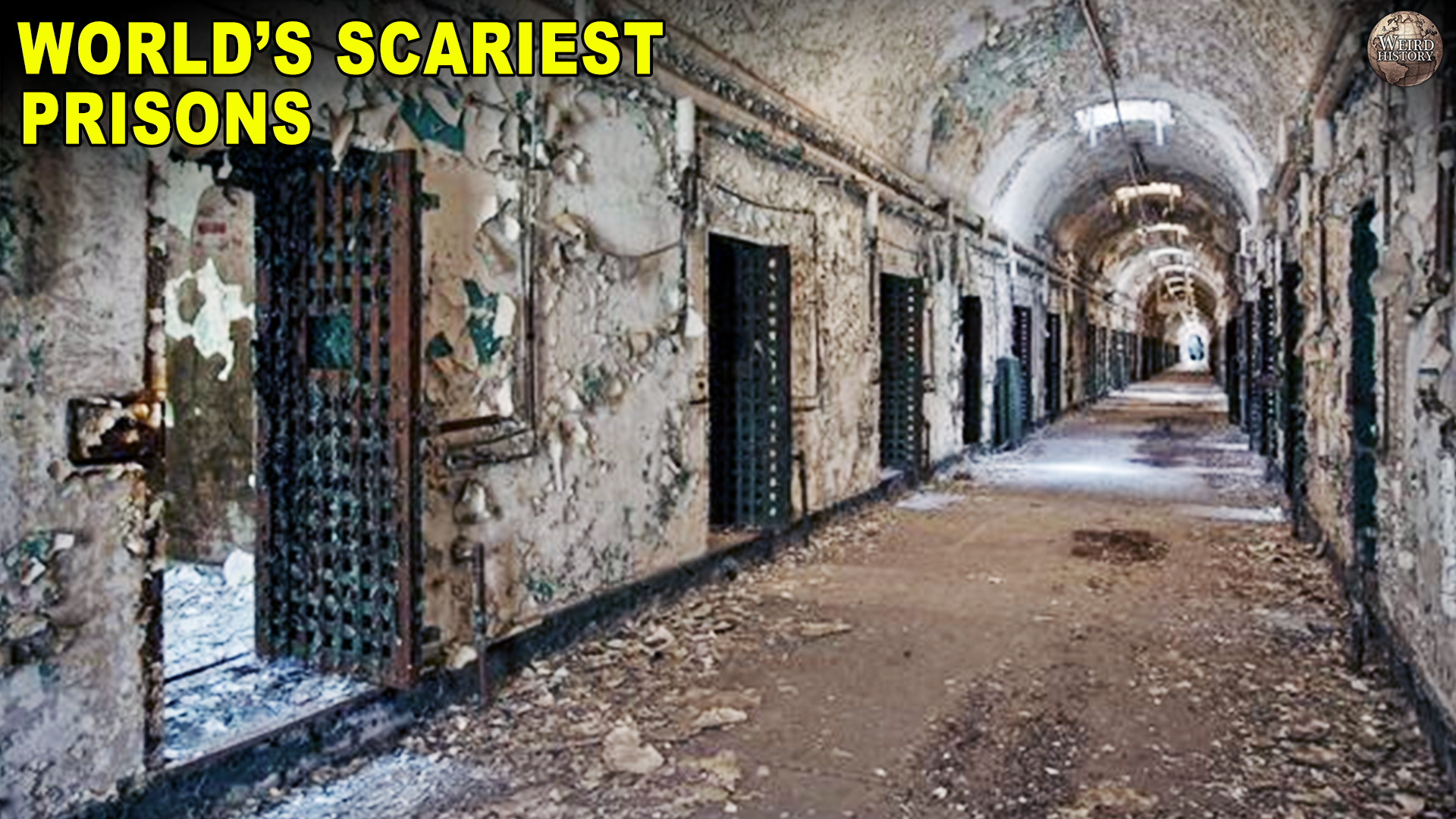
The concept of prisons as we know them today is relatively modern. In antiquity, jails served less as places of penitence and more as a purgatory before the final judgment of guilt, which was often punished either by enslavement or execution. Before the mega jails and super-maxes of today, historical prisons took on many forms, from isolated islands to underground dungeons. Excluding any prison that is currently open and also the horrifically depressing sub-genre of concentration camps, this list reveals some of the scariest prisons in history.
Show More Show Less View Video Transcript
0:00
For as long as there have been laws to break, there have been prisons to hold the people who
0:04
break them. And while prisons come and go, the most notorious facilities continue to haunt the
0:10
pages of history. So, today we're going to take a look inside some of the scariest prisons ever
0:16
built. Okay, time to throw away the key. We'll kick this little tour off in ancient Rome
0:27
at the Mamertine, where violence wasn't just brutal, it was biblical. The Mamertine was a
0:32
dank underground jail which played host to two of Christianity's most famous characters
0:38
St. Peter and St. Paul, both of whom who spent time locked up in the prison's dungeons at the
0:43
request of Roman Emperor Nero himself, who was not a man known for his restraint. In use since
0:49
the 8th century BCE, the prison contained two floors of underground cells, one on top of the
0:55
other, with the lower levels only accessible through holes in the upper levels. After many
0:59
prisoners succumbed to the torturous treatment and lack of food, guards disposed of their bodies
1:04
in the cloaca maxima, which is a fancy way of saying they dumped them in the sewers
1:13
Pitești was a communist prison built in Romania, famous for its intense and brutal brainwashing
1:18
experiments. Operating from 1949 through 1951, the Pitești experiment attempted to re-educate
1:24
wealthy intellectuals, bourgeois landowners, religious rebels, and political dissidents. Historically speaking, re-education is a phrase that can't be trusted. Prisoners at Piteshti
1:36
were malnourished and regularly subjected to intentionally humiliating punishments. Perhaps worst of all were the various attempts to get prisoners to turn on one another by making
1:46
them torment each other with methods so extreme we can't even discuss them. But trust us, it was bad
1:54
When explorer Roy Chapman Andrews, the future director of the American Museum of Natural History
2:02
arrived at the prison in Urga, Mongolia in 1918, he couldn't believe his eyes
2:07
The accommodations for prisoners in Urga's town jail were worse than any he had ever seen or studied before
2:14
How bad were they? The prisoners essentially lived in coffins. Yeah, inmates were housed in four-foot-by-three-foot boxes
2:22
Prisoners could reach through a single six-inch hole to receive their food rations or blankets in the winter
2:27
that is, when they got any, which was rare. Guards only cleaned the boxes every few weeks
2:32
and as such, a prisoner very rarely saw the outside of their cell
2:36
If a prisoner lived long enough, they would typically see their limbs atrophy from lack of movement
2:42
But that was a pretty big if. Potentially the most feared penal colony in history
2:50
Devil Island saw 60 prisoners sail in its direction and only 2 make it out alive Statistically speaking you have a better chance of surviving a fall from a seven building
3:02
an isolated island off the coast of French Guiana in the Atlantic Ocean
3:06
Napoleon III, the French, chose the island in 1852 because it was nearly impossible to escape
3:12
By day, prisoners were worked to the bone, building unending roads to nowhere and clearing trees
3:17
By night, they were shackled and left in the dark to be bitten by vampire bats that waited in the rafters
3:23
And not the cool kind of vampire bats that give you powers. They were the regular kind that give you rabies
3:29
The island's two most well-known residents were Alfred Dreyfus, a French captain falsely convicted of treason
3:36
and Henri Charrière, an inmate who escaped the island and wrote a memoir about his time there
3:41
His book, Papillon, was adapted into a famous 1973 movie starring Steve McQueen and Dustin Hoffman
3:49
When talking about terror on the high seas, few things could be more terror-inducing than
3:54
the HMS Hell. The boat's actual name was the HMS Jersey, but it was nicknamed Hell for reasons
4:01
that will soon become obvious. It was the most notorious of a number of warships that the British
4:05
used to hold prisoners during the American Revolution. Docked in the New York Harbor
4:09
the HMS Jersey and other ships like it held prisoners from 1776 to 1783 in appalling conditions
4:16
Packed below deck, prisoners simultaneously had to contend with diseased rats, inhumane guards
4:23
a lack of food, and extreme weather. By the time the British burned the ship at the end of the war
4:29
the HMS Jersey had claimed the lives of 11,000 prisoners. Constructed in 1895, Holmesburg Prison in Philadelphia, Pennsylvania, was the setting
4:41
for events that wouldn't feel out of place in the most tangled conspiracy theories
4:45
Most famously, government agencies and pharmaceutical companies subjected inmates at the prison to dangerous experimental drug testing
4:53
Dermatologist Albert Kligman, inventor of the famous acne drug Retin-A and the treatment for poison ivy, ran the Kmart of human experimentation out of Holmesburg for more than 20 years
5:04
From 1951 to 1974, Kligman conducted human testing at Holmesburg, slicing layers of skin
5:11
off prisoners and infecting them with herpes and athlete's foot. Thanks in part to Kligman's ethical flexibility, the U.S. government instituted federal regulations
5:20
with regard to medical studies in prisons in 1978. When you hear the name Galapagos, you probably think about Charles Darwin and his theory of
5:31
evolution, or your obnoxious cousin's destination wedding. But there is a much darker side to the place
5:38
The Galapagos Islands were also once used as a penal colony by Ecuador
5:42
and it was the kind of prison where the emotional toll of the work assigned to prisoners far surpassed the physical The island is notorious as the location of this 65 Wall of Tears a structure the guards forced the prisoners to build for absolutely no reason
5:58
Inmates spent years stacking rocks to construct a wall that went nowhere
6:02
and did nothing other than keep them working. The prison was active for roughly 20 years
6:07
in the mid-19th century, and again from 1946 to 1959. If the disease, starvation, and workload didn't get you
6:13
the overwhelming hopelessness probably did. Opened in 1829 in Philadelphia, Pennsylvania
6:24
Eastern State Penitentiary was the world's first penitentiary. Technically speaking, a penitentiary is a prison
6:29
with the aim of encouraging penitence, as opposed to just locking men up and throwing away the key
6:35
During its early years, Eastern State Penitentiary attempted to accomplish its goal with strict crushing isolation
6:42
Guards left inmates in their cells by themselves for most of their sentences, with each cell containing a tiny area of outdoor access
6:49
When they left their cells, inmates were hooded to prevent them from interacting with guards
6:53
and familiarizing themselves with the building. Essentially, inmates were forced to live a monastic existence
6:59
and were required to be inside their own heads at all times
7:03
attempting to reconcile with their wrongdoings. Eastern State Penitentiary's new approach was so influential
7:09
countries around the world adopted it. However, as time wore on, people began to question
7:14
the efficacy of such solitary confinement. After a visit to the prison, author Charles Dickens wrote
7:20
I hold this slow in daily tampering with the mysteries of the brain to be immeasurably worse
7:24
than any torture of the body. And Dickens knew a thing or two about prisons
7:28
Have you read his books? Carlisle Castle once imprisoned Mary, Queen of Scots
7:39
But the English castle's most famous resident isn't what makes it one of history's worst prisons
7:44
It's the treatment afforded to its lower-born prisoners that earned the castle such an infamous reputation
7:50
Built in 1092, the castle's dungeons housed prisoners in squalid conditions for centuries
7:56
For instance, during the Jacobite Rebellion, Jacobite prisoners were crowded into tiny cells in the dungeon
8:01
and were given so little sustenance that they were forced to lick the stone walls of the cells
8:06
in hope of finding the tiniest bit of water that may have collected on the walls
8:10
You can actually see the licking stones during tours of the castle, if you're into that sort of thing
8:19
In Alexandre Dumas' The Count of Monte Cristo, protagonist Edmond Dante spent 14 years at the Chateau d'If
8:26
before making a daring escape to freedom, an act that forever immortalized the castle fortress
8:31
in literature. Despite this being perhaps the most famous fictional prison break in history
8:37
in reality no one ever escaped the isolated French island They made damn sure of that Opened in the 16th century under the reign of King Francois I the prison spent 300 years serving as a home for political prisoners and common criminals Treatment of the prisoners
8:53
varied widely, with the richest able to live in comfort and the poorest housed in dungeons
8:58
and subjected to beatings and forced labor. It looks like some things don't change
9:02
If you're going to be a prisoner, it pays to be a rich prisoner. The beauty of the architecture at Kilmainham Jail in Dublin, Ireland, belies a much uglier history
9:17
Originally built in 1796 as a response to the problems plaguing older jails in Ireland
9:23
it didn't take long for Kilmainham to be bombarded by those very same problems
9:26
At that time, Ireland was being plagued by the Great Famine and experienced a rise in crime
9:32
which was at least partially attributable to starving Dubliners purposefully committing crimes
9:37
to get put in jail where they were assured at least a little bit of food. The jail was also being used as a holding facility for prisoners being sent to Australia
9:45
which led to massive overcrowding and a severe lack of resources. The jail imprisoned men, women, and children alike, all living together, often five to a cell
9:54
sometimes forced to sleep in hallways. According to one jail inspector, numbers of these wretched creatures are obliged to lie on straw in the passages and day rooms of the prison
10:03
without a possibility of washing or exchanging their own filthy rags for proper apparel
10:08
Consequently, disease and starvation ran rampant through the prison. The prison's bloodiest period took place in May of 1916
10:15
when officers eliminated more than a dozen Irish nationalist leaders of the Easter uprising via firing squad
10:22
One of the men, Joseph Conley, was too injured to stand in front of the line of rifles
10:26
So they carried him in on a stretcher and tied him to a chair. That was thoughtful of them
10:36
Infamous for being one of the prisons that held Nelson Mandela, Robben Island's history is as broad as it is scary
10:43
The Dutch originally founded the prison in the 17th century during their colonization of South Africa
10:48
Since that time, the island has changed hands multiple times and served many different purposes
10:52
It's been a political prison, whaling station, World War II military outpost, and an insane asylum
10:59
According to Mandela's autobiography, he and the other prisoners worked in a lime quarry
11:04
where the constant glare of the sun on the rock caused permanent eye damage
11:08
They received little food and clothing and were subjected to racism on a daily basis
11:12
which was not unusual for South Africa during apartheid. Upon Mandela's arrival, the prison guards welcomed him
11:18
by saying, this is the island, here you will die. In the end, however, the guards turned out to be wrong
11:24
Mandela was released from prison in 1990 and achieved the distinction of being the first president
11:29
of South Africa to be elected in a fully representative democratic election
11:33
The prison shut down shortly thereafter and is now a World Heritage site
11:37
You can even take a tour and visit Nelson Mandela's cell, though you probably wouldn't want to stay very long