Up next in 10



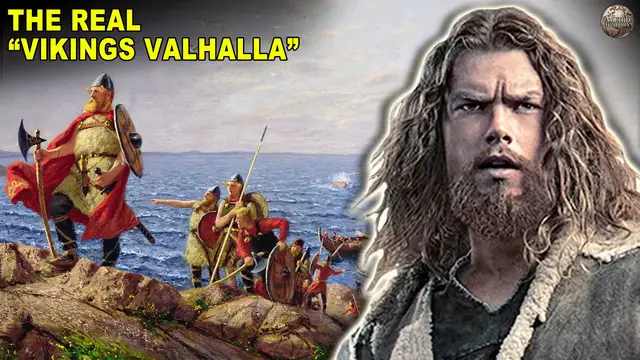
Vikings told the story of Ragnar Lothbrok, his first wife, Lagertha, and a host of other notable Scandinavians who lived, worked, and fought their way through the earliest part of the so-called Viking Age. The show depicted real men, women, and children with a mix of historical truth and fictional fodder through six seasons - but it only scratched the surface of the fascinating world of the Vikings.
Show More Show Less View Video Transcript
0:00
The television show Vikings told the story of Ragnar Lothbrok
0:03
and a host of other notable Scandinavians who lived through the earliest part of the so-called Viking Age
0:09
Its sequel series, Vikings Valhalla, picks up about a century later and delves into one of the most fascinating and intense periods
0:17
of medieval history. So today we're going to take a look at the real history
0:22
behind the main characters featured on Vikings Valhalla. Okay, time to hop in the longboats and raid some weird history
0:32
Leif Eriksson was the son of Erik the Red, the first Norseman to colonize Greenland after being exiled from Iceland
0:39
Oh, Erik's son. Oh, I just got it. Leif ventured to Norway around the year 1000 CE, where he entered the service of King Olav Tryggvason, who charged him with spreading Christianity
0:51
On his way back to Greenland, Leif supposedly ventured off course and took a detour that landed him in Vinland, an area located somewhere in what is known today as Canada
1:01
This likely makes Leif the first European to ever set foot in the New World, and he did it almost 450 years before Christopher Columbus was born
1:09
The details of this trip, however, are a little muddled. The Vinland expeditions were recorded in two separate sagas
1:16
the Saga of the Greenlanders and the Saga of Erik the Red, and each tells the story very differently
1:22
which leaves plenty of room for creative license. Music to a TV writer's ears
1:29
Erik the Red's daughter, Freyvich, was born around 970. In both Erik's saga and the Saga of the Greenlanders
1:36
she is portrayed as a fierce woman, chastising retreating men for their cowardice
1:40
and demanding a weapon of her own to join the fight, she was also brutally cunning
1:45
Thredisch recruited two Vikings to sail to Vinland, offering to split the spoils of the trip with them
1:50
But she double-crossed them when they arrived, accusing them of assaulting her
1:54
Thredisch's husband, Hurvart, annihilated the men. Thredisch then grabbed an axe and dispatched the five women
2:01
who had also accompanied them on the voyage. Note to self, do not answer any of Thredisch's Craigslist ads
2:10
As the King of Norway from 1046 to 1066, Harald Sigurdsson, a.k.a. Harald Hardreda
2:18
which means hard ruler or ruthless, spent his youth as a member of the Varangian Guard in the
2:23
Byzantine Empire. After traversing the Mediterranean and living in modern-day Russia for a time
2:29
Harald returned home and became King of Norway in 1047, following the death of Magnus the Good
2:34
Magnus had also been King of Denmark, but the Danes refused to submit to Harald. Hard to follow
2:39
a guy nicknamed The Good, particularly when you're Harald the Ruthless, which sounds like
2:44
a pretty cool wrestling persona. Around 1064, Harald set his sights on England instead
2:50
invading the countryside along Tostig the brother of King Harald Goinson in September 1066 Asserting he had a claim through his relative Canute the Great Harald saw King Goinsen as a usurper After arriving in England Harald Hardrada and Tostig
3:07
defeated the Northumbrian earls and their men at the Battle of Fulford on September 20, 1066
3:13
Five days later, the Battle of Stamford Bridge pitted Harald against Harald, which
3:19
had to have been confusing for everyone involved. But the confusion didn't last long
3:23
because King Harald Govinson won the battle, eliminating Harald the Ruthless and Toastig in the process
3:31
As one of the longest ruling kings of England, Athelred endured years of conflicts with Viking raids
3:37
and later inhabitants of England. It was under Athelred that England reinstated
3:42
Danegeld payments to the Vikings, which was essentially tribute money paid to keep the Vikings from causing trouble
3:48
sort of like a geopolitical protection racket. However, they didn't actually do much to keep the Danes away
3:53
The presence of the Danes in England was so problematic for the king by 1002
3:58
that he called for what is known as the St. Bryce's Day Massacre
4:01
St. Bryce's Day? Never really caught on, did it? Sounds more like the name of a tennis instructor doing time for a pyramid scheme
4:08
Athelred issued a charter that ordered the slaying of all Danish men in England
4:12
This only further antagonized the Danes. The raids continued, as did the Danegeld payments
4:18
And in 1013, Sven Forkbeard entered England and took Athelred's crown. When a guy named Sven Forkbeard comes to your hat, it's probably best just to give it to him
4:31
King of Denmark, Norway, and England through the early 11th century, Knut the Great did a whole lot of work for his nickname
4:38
He was the son of Sven Forkbeard. But after Sven's demise in 1014, England did not acknowledge Knut as its new ruler
4:45
opted to support Æthelred the Unready instead. Æthelred did eventually return to England
4:50
but he was unable to resist Knut's Scandinavian forces. Knut took control of England by 1018
4:56
married Æthelred's widow, and established an empire of sorts in the North Sea region
5:01
Knut became the sole ruler of Denmark in 1019 and ruled Norway as of 1028. He was the undisputed
5:07
holder of three world titles, like Mike Tyson in the 80s. Knut was a skilled warrior, but also
5:13
a clever ruler. He mingled personnel from England and Denmark to control his lands and issued a law
5:19
code in 1020. He also established diplomatic relationships with the Holy Roman Empire and
5:24
the Papacy. But Canute's death in 1035 created a power vacuum that pitted his sons against each
5:30
other, which is kind of weird. It's not like he didn't have enough kingdoms to go around
5:36
Emma of Normandy was the daughter of a Norman Duke, wife to two English kings and mother of
5:41
two more. Talk about versatility. Emma's first marriage to King Athelred the Unready resulted
5:46
in the birth of two sons, Alfred and Edward, and the birth of a daughter named Kijivu
5:52
To keep her children safe during the Norsemen strikes against England Emma sent her children to Normandy to be raised After Canute the Great smote King Athelred and took control of England in 1016 Emma wed Canute And they had two children a daughter Gunnhild
6:06
and a son, Hartu Canute, who went on to rule England from 1040 to 1042
6:11
Records indicate Emma was fairly active in making sure her son became king, purportedly securing a promise
6:17
from Canute that he would never set up the son of any wife other than herself to rule after him
6:22
This was intended to keep Harold Harefoot, Canute's son by his first wife, off the throne
6:27
All that pillaging created some complicated family dynamics, like a cutthroat Brady Bunch
6:32
Harold Harefoot and Hartacnut actually ruled England jointly after Canute's passing in 1035
6:38
Kind of like a share the kingdom with your little brother or nobody gets McDonald's situation
6:42
Harold Harefoot ousted his brother from power in 1037, but passed in 1040, leaving Hartacnut as the only living heir
6:50
King Olaf II of Norway, also known as Olaf Haraldsson, was brother to Harald Hardrada
6:59
You remember the ruthless guy? Olaf ruled Norway from 1015 to 1030, systematically bringing Norway's
7:06
chiefdoms under his control through the late 1010s. He lost the support of his nobles in 1029
7:11
however, and was sent into exile. Apparently he didn't grease enough palms. If only Lakers
7:15
tickets had been invented. He later returned to Norway, where he fought and perished at the
7:20
Battle of Stiklestad in 1030. Olaf was a devout Christian and sought to convert Norway, but his
7:26
particular brand of evangelicalism was more death metal than tabernacle choir. Olaf reportedly drove
7:33
many pagans out of the country. Other non-believers had their hands and feet mutilated and their eyes
7:37
yanked out, or were simply hanged. Maybe Olaf should have been the ruthless. Olaf was praised
7:43
for his efforts on behalf of Christianity and is now considered a saint. Godwin, Earl of Wessex
7:51
reached prominence in England during the reign of King Canute the Great. After Canute's demise
7:56
Godwin supported Hartle Canute's claim to the Danish throne. At the same time, Alfred
8:01
the oldest son of our bumbling pal Athelred the Unready, attempted to invade England
8:06
Alfred apparently took a page from his father's playbook. He was intercepted by Godwin and turned
8:11
over to Harold Harefoot, who blinded Alfred and had him executed. Godwin, on the other hand
8:16
was a shrewd figure. Between 1035 CE and 1042 CE, he shifted his loyalties to whomever held the
8:23
crown. Not the worst strategy. He was like Littlefinger, only better written. By the time
8:28
Edward the Confessor, Athelred's other son with Emma of Normandy, became king in 1042, Godwin
8:34
yielded immense power in England. Godwin's daughter, Edith, married King Edward in 1045
8:40
King Edward briefly exiled Godwin and his sons, Sven, Tostig, Goethe, Leofuin, and Harald
8:47
But they eventually returned to control pretty much the entire country. After Godwin passed in 1053, his oldest son
8:54
Harald, inherited the earldom of Wessex. By 1062 Tostig became the Earl of Northumbria Sven was the Earl of Herefordshire Girth held the Earldom of East Anglia and Leothwin was made Earl of Kent And when Edward passed in 1066
9:10
Harold was crowned king. Godwin was so dedicated to the long game that he didn't even live to see
9:15
his plans pay off. Edric Stryona was the Earl of Mercia during the reign of Athelred the Unready
9:22
eventually marrying the king's daughter, Algitha. Edric remained loyal to his father-in-law until 1015
9:29
when he switched his allegiance to Canute the Great. The bookie might give you great odds, but never bet on a guy called the Unready
9:36
Identified as a traitor by chroniclers like John of Worcester, Edric took up arms against Athelred's son, Edmund Ironside
9:43
when Edmund became king after his father's demise. Edmund only ruled from April to October of 1016
9:49
before he was booted off the throne by Canute. after the disastrous Battle of Essendun
9:54
Meanwhile, things were looking pretty good for Edric. But in 1017, his ever-changing loyalty finally caught up with him
10:01
when Canute the Great had him executed. It's not entirely clear which figure from Scandinavian history inspired Estrid Håkon
10:10
One possibility is Håkon Eriksson, also known as Håkon of Latte. Håkon of Latte was in Norway when Ola Haraldsson returned to take the throne in 1015
10:20
Haken later ruled Norway in Canute Stead during the 1020s, while Olaf Hallotson was in exile
10:26
The second possible inspiration is Håkon Sigurdsson. He was also Earl of Lata, albeit during the mid-10th century
10:34
Håkon Sigurdsson was dedicated to the pagan Norse gods, something that brought him support from Norwegian chieftains while he ruled Norway
10:41
However, in 995 CE, Håkon was betrayed by his own slave, Kark
10:46
who drew a large knife from his belt and decapitated him. Betrayed is certainly one word for that
10:52
There might be a lesson there, maybe about not owning slaves. Despite his bodacious name, Edmund Ironside only ruled England for a few months in 1016
11:04
Edmund inherited the throne in April from his extremely dead father, Æthelred the Unready, but he lost it to Canute the Great in October
11:10
after being defeated at the Battle of Asimdun and died just one month later
11:14
meaning Edmund was king for roughly one season of Major League Baseball. I don't know which is more boring
11:19
And much like his dad, Edmund's entire life was riddled with almost comically bad luck
11:24
Born around 988, Edmund's mother, Alfgivu of York, passed away when he was just a boy
11:30
He had numerous siblings, including two older brothers, named Athelstan and Egbert
11:35
Those would be tough names to have in high school. Both of his older brothers perished, leaving Edmund the doomed heir to their father's throne
11:42
interestingly Edmund's life loosely inspired an Elizabethan era play called Edmund Ironside
11:48
a war hath made all friends although the author of the play is unknown at least some academics
11:53
believe it may be a very early work by William Shakespeare that tiny footnote might be the most
11:58
notable thing to happen to Edmund Ironside but hey better than nothing