Up next in 10



History is full of famous feuds, between siblings, clans, and even people who aren't related to each other. The causes underlying these feuds are often similar, regardless of the individuals' class, time period, or nation of origin. Since humans have existed, they have competed with each other for power and resources. In regions where resources aren't abundant, families and groups come into conflict with each other, often with deadly consequences. In countries with dynastic monarchies, siblings are often pitted against each other. In more recent times, the rise of powerful corporations has created even more avenues for conflict.
Show More Show Less View Video Transcript
0:00
Let's face it, people love a good feud
0:03
That's why reality TV is so popular, and history is full of them
0:08
Bitter, violent conflicts that rise above the level of mere disagreement to drive a wedge between friends, siblings, clans, or families that lingers for generations
0:19
So, today we're looking at some of the most famous feuds in history
0:24
Now let's make like a feud good men, and handle the truth
0:30
Powerful Roman leaders Cicero and Marc Antony carried one of the world's most infamous feuds
0:39
and the seeds for their hatred were sown before either man was even born
0:43
That is some varsity-level feuding. Marcus Tullius Quicero, or Cicero, was born into a wealthy family
0:51
but lacked the class status and connections for a ready-made political career
0:56
He trained as a lawyer before working his way up the political ranks. ultimately serving as a consul in the Senate. Cicero's future rival, Mark Antony, had been born
1:05
into the ruling class and was a relative of famed general and statesman Julius Caesar
1:10
but he never once became a Latin pop sensation, so checkmate, Mark Antony
1:16
By the time of Caesar's assassination in 43 BCE, Cicero and Antony were among the most powerful
1:21
individuals in Rome, though on opposite ends of the political spectrum. Cicero was, above all else
1:28
dedicated to a democratic rule of Rome. In fact, Brutus, one of the infamous co-conspirators who
1:33
took out the authoritarian Caesar, was among Cicero's closest political allies. Antony
1:39
on the other hand, was one of the primary backers of Caesar's play to become a dictator
1:43
and worked in the aftermath of Caesar's death to continue Rome's transition from republic
1:47
to empire. No research on whether he suggested adding anchovies to a salad, however
1:53
Immediately after Caesar's assassination, Cicero and Antony became bitter public enemies. Cicero made 14 speeches harshly condemning Antony, known as the Philippics
2:04
while attempting to restore the Roman Senate. So Cicero was battle-wrapping before battle-wrapping was a thing
2:10
Checkmate, Eminem, in eight mile. Cicero's plans were ultimately undone by Caesar's 18-year-old great-nephew, Octavian
2:18
whom the late dictator had named as his heir. While Octavian initially appeared to support Cicero, he then formed a secret alliance with
2:26
Antony, survivor style. Alongside General Marocos Aemilius Lepidus, they formed a three-person government known
2:34
as the Second Triumvirate and seized control of Rome. And once the Second Triumvirate had secured their power, they ordered Cicero decapitated
2:42
and also had his hands removed as punishment for his written criticisms of Antony
2:47
Although, if we're being honest, guys, the first thing kind of takes care of that second thing
2:53
His remains were placed on the same rostrum in the Senate where he delivered his fiery speeches
2:58
That'll show him. In 1929 Chicago was home to two outspoken rivals The city Prohibition underworld was dominated by Al Capone on the south side
3:13
and George Bugs Moran up north. These guys raked in millions from all manner of criminal wheelings and dealings
3:20
But the most lucrative business of all was bootlegging. No, not burning DVDs of a shaky camcorder recording of Oppenheimer
3:27
We're talking the art of making bathtub booze. Now they have become moonshine, destroyers of worlds
3:36
In February of 29, Bugs received an offer to buy a truckload of bootleg whiskey
3:41
But when he and his men arrived at a garage in the city's Lincoln Park neighborhood, they were ambushed by four Capone goons, two of whom were disguised as police officers
3:50
Seven of Bugs' men were then whacked in an incident that became lovingly known as the St. Valentine's Day Massacre
3:57
Though Bugs himself managed to get away, the incident cost him his fearsome reputation
4:02
and he was unable to maintain a hold on his territory. Eventually, Capone absorbed much of the business of Bugs' Northside gang
4:09
But this was only two years before his infamous prosecution for tax evasion
4:13
ending his crime boss reign at the tender age of 33. The Medicis, a powerful and influential family of bankers
4:25
who prospered in Renaissance-era Florence, are among the most famous dynasties in European history
4:30
Far more seldomly recalled are their chief rivals, the Pazzi's. Because, like, who has time for the second most famous banking family
4:38
from 15th century Florence? In the 1470s, the Medici family's interests were looked after
4:43
by magnate Lorenzo and his brother Giuliano. And they were locked in constant competition with the Pazzi's
4:50
For example, when the death of Pietro Riario in 1474 1874 made an opening for the role of Archbishop of Florence, the Pazzi sought to fill it with one
4:59
of their own, Francesco Salviati, before losing out to Reinaldo Orsini, Lorenzo's brother-in-law
5:07
Francesco had to make do with being the Archbishop of Pisa, which is, you know, fine, I guess
5:12
Around this time, Lorenzo and the confusingly named Pope Sixtus IV found themselves disagreeing
5:19
over the small town of Imola, located conveniently on a trade route between Florence and Venice
5:24
Lorenzo arranged to purchase the property from the Duke of Milan, but it was sold out from under him to the pope
5:30
who wished to use it as the base for a new papal state. The disagreement led to the pope cutting all financial ties
5:36
with the Medicis and moving all of his banking over to the Pazzi's
5:40
The power of checking accounts compelled him. With his new, powerful connection forged
5:45
a number of Pazzi's started plotting to assassinate Lorenzo. While Pope Sixtus didn't directly support the effort
5:52
he sent a carefully worded letter making it clear that the papacy wouldn't be particularly upset
5:56
by the removal of the Medicis from power. Thou shalt not murder, but apparently thou shalt look the other way if it's good for business
6:04
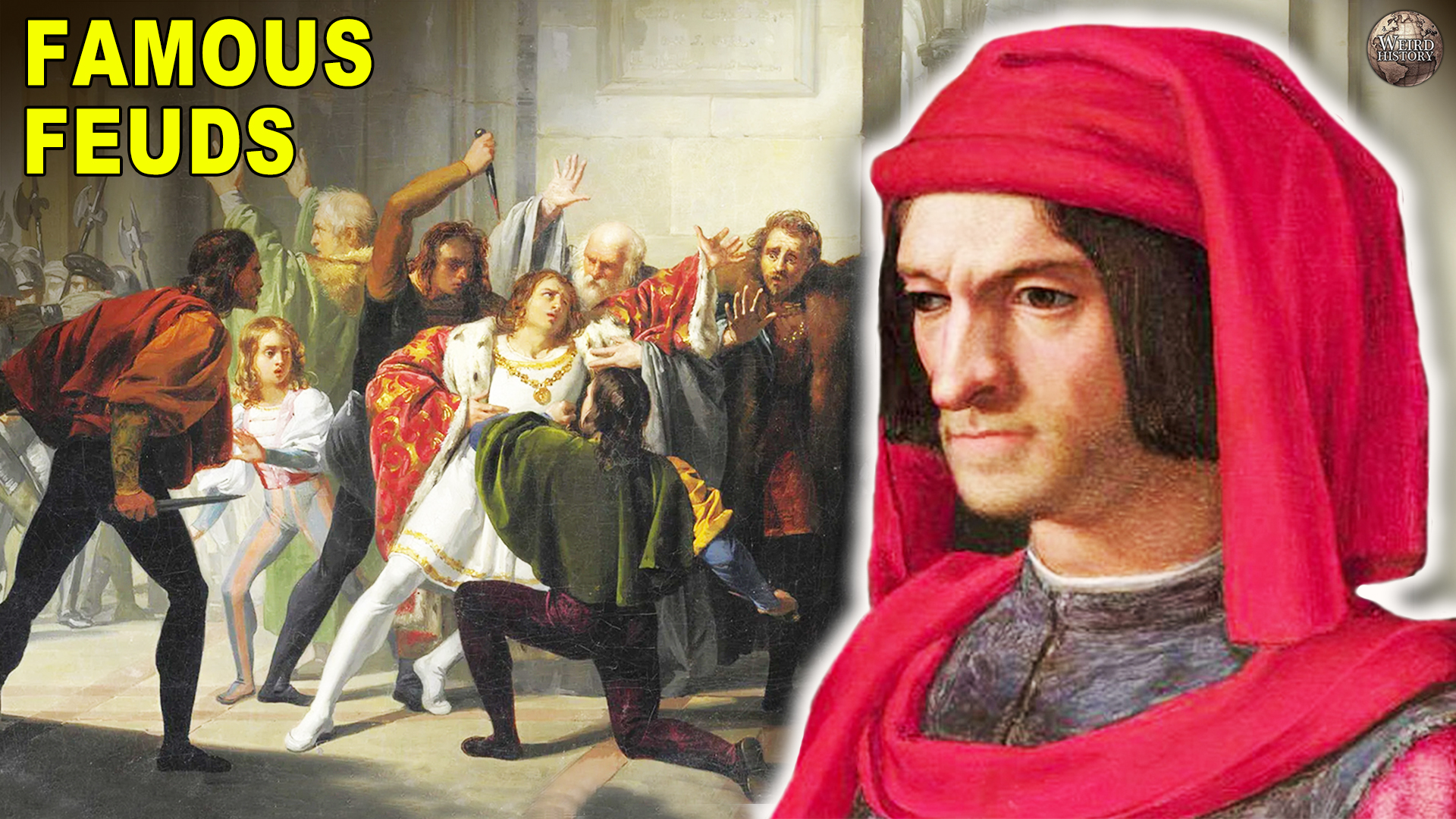
On April 26 1478 Lorenzo and Giuliano were attacked during high mass at the Duomo of Florence in front of a 10 crowd Giuliano was slain but Lorenzo managed to escape While the Pazis had hoped that the city of Florence might spontaneously rise up to support them
6:21
and join in the righteous destruction of Lorenzo de Medici, that didn't happen so much
6:26
Instead, the attack caused violent chaos to break out, and many of the would-be co-conspirators
6:32
were captured and hanged from the windows of the Palazzo della Signoria
6:36
That included Francesco Salviati, the archbishop who had to settle for Pisa, who had shown up and tried to take control of the crowd, but was
6:44
fatally unsuccessful. Now that's a leaning tower. Another familiar conflict went down in the Scottish Highlands in the late 17th century
6:58
Following the so-called Glorious Revolution of 1688, James VII of Scotland, who was also
7:04
James II of England, that multi-hyphenate, was deposed and replaced by his daughter
7:08
Mary II, and her husband, William III of Orange. James had been a Catholic, so when Mary and William
7:16
both Protestants, took the throne, it led to an immediate reshuffling of power. This, in turn
7:21
impacted two powerful and influential families, the Campbells and the McDonalds, who had already
7:26
been competing for land, cattle, and political power in the highlands for many years. But strangely
7:31
not for soup or chicken McNuggets. The McDonalds were Catholics who were aligned with James
7:36
So when William and Mary took over, it provided the Campbells with a powerful new ally
7:42
When the McDonalds refused to sign an oath of loyalty to the new monarchs
7:46
the Campbells received William's backing for a plan to drive the McDonalds off their land for good
7:51
In January of 1692, a group of 120 soldiers led by Robert Campbell of Glenlion
7:57
arrived at the McDonald property in Glencoe and demanded free quarters in lieu of taxes the family apparently owed to the government
8:04
Things escalated quickly, and by February, the soldiers now occupying the McDonald estate
8:09
received new orders to eradicate every member of the family under age 70
8:14
They sealed off the area, preventing McDonald family members from fleeing, and started sweeping through the glen, murdering anyone they found
8:22
An estimated 30 members of Clan McDonald and their associates were taken out in the massacre itself
8:27
while another 40 succumbed to exposure and related causes. A formal investigation followed, and though some Scots were critical of their government's violent response to political enemies
8:38
the McDonald's had been a largely unpopular presence in the region for many years
8:42
so there was little public outcry or demand for justice. The case soon faded from popular memory and only re-emerged as a hot topic amongst historians in the 1950s
8:52
the british isles of the 15th century also bore the famed clash between the york and lancaster
9:03
families a clash that inspired george rr martin's song of ice and fire books you think the family
9:09
names stark and lannister were chosen at random unlike most of the choices in game of thrones
9:14
last season they were not england king henry vi was part of house lancaster he ascended the throne at just nine months old following the passing of his father Henry V from a mysterious illness A timid and shy ruler Henry VI did not have an immediate heir
9:32
leading to a power struggle around him for control over the state. Two of Henry's cousins each had a potential claim
9:37
to the throne, Edmund, a Lancaster and the second Duke of Somerset
9:41
and Richard, the Duke of York. Despite being just the second Duke
9:46
Edmund got himself named as Henry's top advisor and launched a whisper campaign to discredit his rival
9:52
The Duke of York responded by raising an army of 23,000 soldiers and demanding Edmund's arrest
9:57
So, a bit of an overreaction. Henry sank deeper and deeper into mental illness as the houses of York and Lancaster volleyed for control of England
10:05
a conflict that came to be known as the War of the Roses. In 1455, Richard's forces eliminated Edmund at the Battle of St. Albans
10:13
But the war nonetheless dragged on until 1461. It was then that Edward, the new Duke of York, defeated the Lancasters at Mortimer's Cross
10:22
and was named King Edward IV for his troubles. Eh, still could have used some dragons
10:31
In the 1930s, German brothers Adolf and Rudolf Dassler collaborated on the first-ever athletic shoe company
10:38
known as the easy-to-pronounce Gebruder Dassler Schuhfabrik, A number of prominent athletes, including U.S. sprinter Jesse Owens, wore the brothers' shoes during the 1936 Olympics in Berlin, making them an internationally known commodity
10:53
There had always been some tension between the Dossler brothers, and success only served to exacerbate their personal issues
10:59
Then the arrival of a little thing called World War II drew them even further apart
11:04
While Adolf received a deferment from the army, allowing him to continue running the shoe factory
11:09
Rudolf was conscripted and stationed in a Jewish ghetto in Poland. It's one of the only situations where you'd rather be at a shoe factory
11:17
Following the war, each brother accused the other of being a straight-up Nazi
11:21
which is generally bad for business partnerships. So the shoemaking brothers split up
11:26
Adolf took full control over the shoe company, which he renamed Adidas, after his nickname Adif
11:32
Rudolph formed a new shoe company of his own, which he originally called Ruda
11:37
before swapping the name out for the less Germanic-sounding Puma. The brothers both remained in their hometown of Herzogenauroch
11:43
where they'd originally started their joint company, and essentially split their pre-war workforce between the two brands
11:50
The companies remained heated cross-town rivals until the brothers' deaths, at which point we assume their ghosts started battling it out
11:57
The familial feud even extended to their employees. Adidas workers wouldn't marry into the families of Puma staffers, and vice versa
12:05
The brothers never reconciled, even until their deaths. Rudolph's in 1974 and Adolph's in 1978
12:11
They're even buried on opposite ends of the same cemetery. But at least the anger between their two shoe brands has dissipated over time
12:19
In 2009, Adidas and Puma employees played in a reconciliatory soccer match to put the feud to bed
12:25
Just don't look up who won, or else this whole thing is going to start all over again