Up next in 10



As descendants of apes, it can be tempting to think that we humans are the apex of that evolutionary line. We've dominated the planet for thousands of years, and no other species has ever completely transcended the food chain the way we have. There is no doubt that human beings have the most evolved brains of the apes.
Show More Show Less View Video Transcript
0:00
When 1933's King Kong hit theaters, most people were clear it was fiction
0:05
But that doesn't mean giant apes are a figment of our collective imagination. Gigantopithecus blackie, for example, stood roughly 10 feet tall
0:13
making silverback gorillas look like adorable little puppies. So why isn't the earth overrun by them
0:19
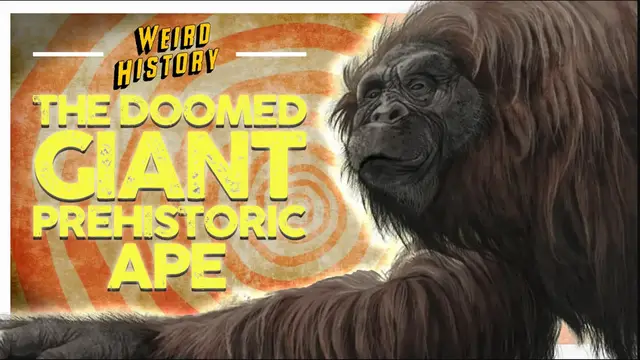
Well, today, we're going to take a look at Gigantopithecus, the giant prehistoric ape doomed by its own coolness
0:26
Okay, time to go ape weird history style. The first person to catalog any element of what would have become known as Gigantopithecus
0:39
Blackie was German paleontologist Gustav Heinrich Ralf von Konigswald, whose parents apparently
0:45
couldn't decide on a name, so they just gave him all of them. In 1935, he stumbled upon the ape's
0:50
teeth, but not out in the field. He was actually in a Chinese pharmacy where the prehistoric
0:55
chompers were being sold as dragon's teeth, allegedly a cure to a wide variety of ailments
1:01
After that, the teeth were largely ignored until, over the years, paleontologists found more of them
1:06
alongside a few pieces of jawbone. As the discoveries were cataloged, a clearer picture
1:11
of the great ape emerged. The researchers may have been bummed they didn't discover a dragon
1:16
but a giant ape ain't a bad consolation prize. Just ask the guys in King Kong
1:25
Gigantopithecus was related to the modern orangutan. Today, the average weight of an orangutan is 165 pounds
1:33
and they can grow as tall as 4.5 feet. That range has allowed the orangutan to compete in the jungle for thousands of years
1:40
But Gigantopithecus, by comparison, would have dwarfed its modern descendants. It even would have towered over the eastern lowland gorilla
1:47
who is the current title holder for largest primate at an average of 450 pounds
1:52
Gigantopithecus, on the other hand, was a stunning 10 feet tall and weighed as much as 1,100 pounds
1:58
So this guy was Donkey Kong big. It probably goes without saying for most prehistoric creatures
2:04
but you wouldn't have wanted to get into a fight with Gigantopithecus. A formidable opponent, it was likely even capable of challenging the giant cats of its era
2:12
However, the size that made Gigantopithecus so formidable may have ultimately doomed it to extinction
2:17
As creatures grow larger, their nutritional needs grow as well. Gigantopithecus was an herbivore, which surely came as good news to its friends and neighbors
2:26
That being the case, the giant apes relied on the forests to provide enough calories
2:30
to survive. For a while there was enough fruit and food to feed such a creature But during the Pleistocene era forests began to be converted to grasslands This left it scrounging for food in a new unfamiliar climate one that didn provide the calories it needed to feed itself
2:46
As the saying goes, the bigger they are, the harder they feed. Gigantopithecus lived in the dense forests of Southeast Asia for over a million years
3:00
which is a really long time for anyone to live anywhere. Must have been rent-controlled
3:03
When the jaw and teeth of Gigantopithecus were originally found, researchers noted similarities with the large teeth of pandas
3:10
and surmised it must have eaten bamboo as a primary form of nutrition. This theory caused pandemonium, but it was later debunked by carbon ysis
3:19
We won't get into the heavy science, but long story short, carbon isotopes allow the Smarties to identify trace carbon elements
3:25
stuck in the tooth enamel of ancient fossils. Using this technique, said Smarties were able to isolate specific carbon isotopes
3:32
in this case carbon-13 and carbon-12, which indicate a varied vegetarian diet
3:37
Variety is the spice of life, even when you're a giant ape. When faced with a creature we know little about
3:48
scientists tend to assume they function similarly to their modern descendants, kind of the evolutionary equivalent of saying the apple doesn't fall far from the tree
3:56
So, if we assume Gigantopithecus was simply a larger version of similar apes, like the orangutan
4:01
then it's unlikely they would have been able to sustain bipedal locomotion for extended periods of time
4:07
which means they likely walked on all fours in order to distribute their enormous weight evenly between four points of contact
4:13
However, anthropologist Grover Krantz has noted that both humans and Gigantopithecus had a jaw that widened toward the back of the mouth
4:21
and on that basis suggested that Gigantopithecus may well have walked like a man
4:25
We can only hope he sang it like Frankie Valli. The Gigantopithecus was not the only enormous beast walking the Earth during its time
4:38
The Pleistocene era saw a flowering of megafauna, which is to say, enormous mammals, birds, and fish
4:43
So it was kind of like the age of kaiju, and there were no giant robots to keep them in check
4:48
At the height of the Pleistocene, these animals included giant herds of mastodons, enormous sloths
4:54
saber-toothed tigers, and pteratoran birds whose wingspans measured as much as 25 feet
4:59
When you're that big, you have to fly business class. These megafauna are now mostly extinct
5:04
However, there is some controversy over the true reason for their decline. Many point the finger at climate change, a likely culprit in the disappearance of
5:11
Gigantopithecus specifically But some claim it was a mysterious disease while others blame the arrival of humans and their advanced hunting techniques Ultimately every species has an upper limit on size When you large and in charge
5:24
food gets harder to find, populations get smaller, and the species become more and more vulnerable
5:29
to collapse. According to scientists who have studied and mapped the extinction rates of these
5:33
large mammals, most of the advantages of being large are short-term. Extinction rates actually
5:38
rise as animals get bigger, largely because they need more food to sustain themselves
5:43
Plus, Gigantopithecus may not have been a prodigious breeder. After parsing a thorough study of dental records
5:49
scientists determined that Gigantopithecus may have had a slower rate of reproduction
5:53
meaning it had children less frequently and its term of gestation was longer
5:56
This would have contributed to its extinction in a number of ways, including limiting its adaptability
6:02
If a creature has fewer children, there are fewer generations and fewer opportunities for beneficial mutation
6:08
In other words, bigger is not always better, unless we're talking monster trucks
6:13
The Gigantopithecus existed alongside its smaller orangutan cousins for many years
6:22
probably beating up on the little guys like Biff Tannen with George McFly. So why did the massive ape go extinct while the smaller orangutans survived
6:30
The answer has to do not only with the size of Gigantopithecus, but in the unique evolutionary traits of orangutans
6:36
Orangutans are capable of slowing their metabolism during famine seasons. This adaptation, which might as well be a primate's superpower
6:44
may have spelled the difference between extinction and survival for the smaller apes
6:53
For an ape who was so big, Gigantopithecus only left a tiny bit behind
6:57
Little is known about the massive primate, because so far, researchers have only found teeth and a few fractured pieces of jawbone
7:04
As Gigantopithecus researcher Hervé Bochiron says, There is no skull, no post-cranial skeleton. Everything is very mysterious
7:12
Barcherons is part of a team that conducted extensive research on a gigantopithecus tooth found near a dam in Thailand
7:18
The dam was soon completed and the site was washed away, along with any other traces of gigantopithecus that may have been lurking in the area
7:25
It's a potent reminder to take care of your teeth. They may have to represent our entire species someday
7:29
When it comes to cryptids, there's pretty much always someone ready to suggest the mysterious
7:39
creature is a prehistoric animal that survived to the present day. The Loch Ness Monster
7:43
for example, is often thought to be a plesiosaur. In that spirit, some members of the Bigfoot
7:48
hunting community have seized on Gigantopithecus as a perfect explanation Of course Gigantopithecus lived in Asia and Bigfoot allegedly lives in North America although he notoriously shy about his address But according to these theorists all the Gigantopithecus would have had to do was cross the Bering Strait That was possible in the Pleistocene era so it could have wandered its way
8:08
across and populated the forests of North America. It's almost too easy. Naturally, there are those
8:14
who have pointed out some problems with this theory. The forests of North America are nothing
8:18
like the forests of Southeast Asia, which means the Gigantopithecus would have had to completely
8:22
change its diet in an impossibly short amount of time, like being stranded on a desert island with
8:27
nothing but your least favorite Pop-Tart. That being said, Sasquatch enthusiasts, as well as
8:32
fans of the film Harry and the Hendersons, are unlikely to be swayed by this information
8:37
Science takes a lot of the fun out of Bigfoot. Nobody asked for live-action remakes of Disney animated classics, but Disney went ahead and made
8:49
them anyway. In 2016, they released a reimagined version of The Jungle Book. You know, the one where
8:54
Scarlett Johansson plays a giant snake. One of the villains in the story is King Louie, reimagined in
9:00
the remake as a gigantic orangutan. While audiences likely saw this as just an exaggeration for the
9:05
sake of the movie, the animators actually based King Louie on the gigantopithecus. You see, the
9:10
creators of the remake were concerned with scientific accuracy, at least as much as you can be for a
9:15
movie with a talking bear. Early on in the process, they learned that orangutans never lived in India
9:20
However, it's likely that Gigantopithecus did, so the filmmakers seized on that information to make
9:25
Louis' presence in the jungles of India more plausible. It's a nice touch. That being said
9:30
even for Gigantopithecus, King Louis is a bit too tall at 12 feet. Also, Gigantopithecus never
9:36
coexisted with anything approaching modern humans. And then there's the fact that very
9:40
few of them could sing like Louis Prima or Christopher Walken. We mentioned King Kong way back at the start of this video
9:52
The 1933 classic is considered one of the greatest movies ever made
9:56
But in reality, there's a reason why there's no Kong-sized apes roaming the jungles, or New York City
10:01
It also happens to be the same reason why Gigantopithecus went extinct
10:06
You may recall we mentioned that every species has an upper limit in terms of size
10:10
a point at which it can't feed itself, can't produce children, and can't compete as a species
10:15
From a survival perspective, going from Gigantopithecus, who was about 3 meters tall
10:20
to King Kong, who was at least 10 times that, would octuple the creature's overall volume
10:25
In other words, each meter added would make the ape 8 times bigger overall
10:29
requiring even more calories for basic sustenance and reproduction, not to mention fighting Godzilla
10:35
At a certain point, even Gigantopithecus had to tap out