Up next in 10



Whether it's the extent of their actions, how they got caught, or the continued search for their identities, some offenders are pretty well known. Alongside the mobsters, thieves, and other offenders we may recognize from the media, movies about their lives, and documentaries, there are criminals who committed comparable - if not bigger - offenses, but we don't know much about them.
Show More Show Less View Video Transcript
0:00
We tend to take modern conveniences like lawnmowers and vacuum cleaners for granted
0:05
but it may surprise you to learn that many of the most common tools of modern living
0:08
first appeared much earlier than you may think, especially if you spend a lot of time thinking about lawnmowers
0:15
So, today we're looking back at when historic things happened for the first time
0:20
Time for some armchair archaeology. The history of footwear is spotty in parts
0:31
As humans didn't typically make their shoes out of materials that stand the test of time
0:35
we wear flexible, comfy stuff on our feet, not stones. Nonetheless, some shoes have survived long enough for us to learn about the feats of the ancients
0:44
One very old shoe in particular, known as the Armenian Arrini 1
0:48
dates back to 3500 BCE and suggests that even way back then
0:53
people were already wearing shoelaces. The leather shoe features slotted eyelets on the side
0:59
where some kind of primitive shoelace must have been tied. Additionally, a preserved body known as Utzi the Iceman
1:05
who lived around 3300 BCE, was still found wearing shoelaces that were composed of lime bark string
1:11
Modern laces have one major advantage over their prehistoric counterparts, those little plastic coatings on the end
1:18
called aglets. These make the laces more easy to pass through the shoes and tie together
1:23
and they also prevent the ends from wearing and fraying over time. Though, truthfully
1:27
they're not super great at that second thing. The first aglets were designed by Harvey Kennedy
1:31
in 1790. Witnesses to the event were quoted as saying, hold up, aglet him cook
1:42
The hassle of dealing with insurance companies may feel like a modern-day kind of problem
1:46
But actually, the concept of insurance has been with us since the ancient times
1:50
The famed Code of Hammurabi, written around 1750 BCE in ancient Babylon
1:56
is one of the earliest surviving legal texts from all of human civilization
2:00
and it also outlines one of Earth's first-ever insurance policies. A significant portion of the Babylonian economy centered around seafaring and trade
2:09
Often, merchants would take out loans to fund trading expeditions, relying on sales of the cargo they received to pay back their lenders and turn a profit
2:17
When ships were lost at sea or attached by pirates, it could threaten these merchants' entire livelihoods
2:22
and their ability to pay back their loans and fund future expeditions. So a primitive insurance system was developed
2:28
Merchants paid lenders an additional amount up front, above the total cost of the loan
2:32
in exchange for a guarantee that the loan would be forgiven if the ship was tragically lost
2:36
The historical record is unclear on when Talking Geckos got involved. It seems intuitive that automatic doors require electricity or some other modern power source to function Yet the historical record suggests that the idea at least occurred to some humans centuries even millennia before the Industrial Revolution
2:58
In the first century AD, a mathematician named Heron, working in the Egyptian city of Alexandria
3:05
then still part of the Roman Empire, devised a method for automating the door to the city's
3:09
main temple. A priest would heat a brass vessel containing water over a large fire
3:14
Eventually, some of the boiling water would be pushed from the main vessel into attached containers
3:19
The water made these containers heavier, causing them to sink to the floor
3:23
and an attached collection of ropes and pulleys used gravity to pull the temple doors open
3:27
Heron reported using the system not only in the temple, but ultimately to open the city's main gates as well
3:32
It saved the populace from some serious muscle aches. The first modern automated doors, which use an optical device to identify when pedestrians need them opened
3:41
were designed in 1931 by engineers Horace Raymond and Sheldon Robey of the Stanley Works Company
3:48
They were designed specifically for a West Haven, Connecticut restaurant called Wilcox's Pier, where servers needed to constantly ferry around plates of food and drinks both inside
3:57
and out. The entire setup apparently cost the restaurant $100 to design and install
4:06
The original water hose allegedly comes to us from the ancient world
4:10
though there's some uncertainty about these accounts. According to various reports, in ancient Greece
4:16
crude hoses were constructed from the bladder and intestines of an ox
4:20
Filling the organs with water and compressing the bladder would theoretically allow the Greeks to spray water
4:25
which was particularly helpful in putting out fires and or running through sprinklers
4:29
These primitive devices didn't hold up for very long and were likely pretty unpleasant to use
4:34
However, these accounts may be entirely apocryphal, as no compelling physical evidence that ancient Greeks used ox hoses has ever been found
4:42
But in fairness, gut hoses aren't really built to last. The first contemporary fire hose was designed in 1673 by Dutch artist and inventor Jan van der Heide
4:53
As a child, he witnessed a devastating fire that destroyed Amsterdam's town hall
4:58
The incident left such an impression on him that 20 years later, he decided to produce a flexible water hose that could aid in extinguishing flames
5:06
Von der Heiden's initial design was produced from linen, which may sound like an odd choice
5:11
but linen is water-resistant. He eventually stumbled upon the idea of stitching together leather tubes, which would make the
5:17
hose both flexible and sturdy. Today's fire hoses upgrade the materials, but otherwise, they're fairly similar to
5:23
von der Heiden's initial design, including the standard 50-foot length. Humans have been keeping gardens for centuries now
5:35
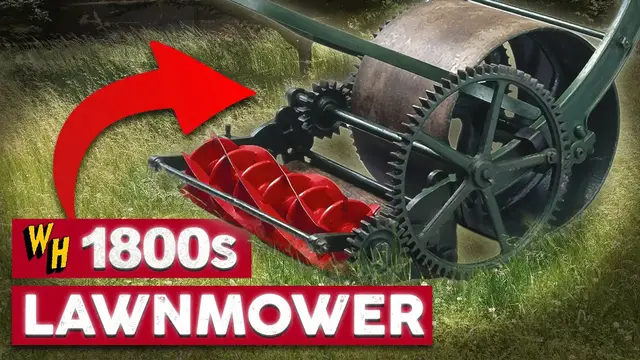
But prior to the early 19th century anyone who needed grass cut would either have to purchase some grazing animals or employ a specialist armed with a scythe Yep that metal blade the Grim Reaper carries
5:46
is essentially a gardening tool. It's right there in his name. In 1830, English inventor Edwin Beard Budding
5:53
devised the first-ever mechanical lawnmower, basing his concept on a similar mechanism
5:57
he saw in use at a cloth mill. His very first design required two operators working in tandem
6:03
one on each side, pulling the machine in opposite direction. It was presumably quite whimsical. Redesigns reduced the device's size so one person could
6:11
operate it, and added more cutting cylinders, along with an extra handle in front to pull the
6:16
machine along. Budding's later designs largely resembled the og lawnmowers of today
6:21
though he had never really imagined his invention as a familiar device that would be in everyone's
6:25
home. He'd originally produced his invention primarily for sporting grounds, royal gardens
6:30
and other large industrial uses. Among Budding's first customers were the Regents Park Zoological
6:35
Gardens in London and the colleges at Oxford. As with lawnmowers, modern vacuum cleaners were
6:46
designed for industrial purposes and required several upgrades before transforming into the
6:50
essential household items we all own today. Well, those of us who didn't just buy a Swiffer
6:55
The first vacuum cleaners, known as carpet sweepers, were manual devices, gathering dust
7:01
via a rotating brush and then using a bellows to generate suction. In 1901, British engineer Hubert Booth and American inventor David Kenney
7:09
simultaneously but independently developed the first powered vacuums. It's likely Booth also coined the term vacuum cleaner
7:17
although that is not the most creative name. His device used a horse-drawn combustion engine
7:22
to pump and then suction air through a cloth filter, while Kenney's system used a steam engine along with a system of pipes and hoses
7:29
that would run through an entire building. Huh, why doesn't Dyson have a horse-drawn model
7:34
Easily portable vacuums designed for the home started appearing a few years later
7:38
In 1905, English manufacturer Walter Griffiths introduced a device he called Griffiths Improved Vacuum
7:45
Apparatus for Removing Dust from Carpets. Maybe take another crack at that name, Walt
7:49
Like Booth's model, it had a bellows-like device which sucked up dust through a pipe
7:54
The first portable electric vacuums were patented in 1908 by James Murray Spangler, who had worked as a department store janitor in Canton, Ohio
8:02
He used suction from an electric fan to blow dirt into a pillowcase, along with a rotating brush to scrape up all lingering debris
8:09
This basic design became the template for modern vacuums. It may surprise you to hear it, but ballpoint pens needed to be reinvented a few times
8:21
before we got them totally right. The original concept was devised and patented in 1888 by an American cashier named John J Loud He wanted to invent a device that could write legibly with ink on leather products which was impossible using the fountain pens that were the current standard
8:37
Loud's design featured a rotating steel ball that was held in place by a socket
8:41
It was effective for its intended use, writing on coarse or rough substances like leather and wood
8:47
But Loud's pen could not write clearly on paper, so it didn't have a lot of everyday practical uses
8:52
He never had an opportunity to exploit the patent and eventually allowed it to expire
8:57
The pens were essentially reinvented in 1930 by Hungarian-Argentine journalist Naslo Biro
9:03
While watching children playing marbles near a puddle, Biro observed the small trail of water
9:07
that the marbles would leave in their wake and realized this same principle could produce
9:11
a clean and easy-to-use writing implement. Biro developed his design along with his chemist brother, Jörg
9:17
Their major improvement on Loud's version was allowing the ball to turn freely within its socket
9:21
It could now pick up ink easily from the cartridge and neatly roll it onto a piece of paper
9:27
Now, if only they could make it not smear so easily for those lefties out there
9:36
Superglue was developed accidentally by a researcher working on military applications. In 1942, Dr. Harry Coover was designing a new chemical substance
9:45
he hoped to fashion into a clear plastic lens, which could serve as an accurate gun sight
9:50
The substance Coover created ended up being too sticky to form into a lens
9:54
but he observed that it was remarkably effective as an adhesive. Starting in the 1950s, he designed a similar compound for use in jets
10:02
to hold parts together permanently, even at high speeds and pressure. Yeah, those jets were literally glued together
10:09
Superglue had another vital military application as well, sealing open wounds on the battlefield
10:14
Though it didn't receive FDA approval as a liquid bandage until the 1990s
10:18
a sprayable version was used in the field to treat U.S. soldiers fighting in Vietnam
10:22
Ah, enemy combatants typically won't wait for you to find a needle and thread
10:30
It seems just like any random person could have come up with the idea for disposable tissues
10:35
But those were also first developed for the troops. During World War I, cotton tissues
10:40
were used as liners for gas masks. But cotton was also required for field dressings and bandages
10:45
and was becoming an increasingly rare and valuable commodity in Western Europe
10:50
So these cotton tissues were ultimately swapped out for respirators. Post-war, the company Kimberly-Clark adapted the cotton
10:56
tissues into what they called disposable towels. At first, these were marketed exclusively to women
11:02
as a clean and efficient way to remove makeup. But the company soon discovered that, all on their own
11:07
consumers had started utilizing cotton tissues as disposable handkerchiefs, sort of like how people use Q-tips
11:12
to clean their ears. Despite the brand insisting that's not the intended use
11:17
so Kimberly-Clark changed up their marketing and introduced a new brand name, Kleenex