Up next in 10

The Feud Between Thomas Jefferson & Alexander Hamilton Is Deeper Than You Thought
Mar 30, 2026


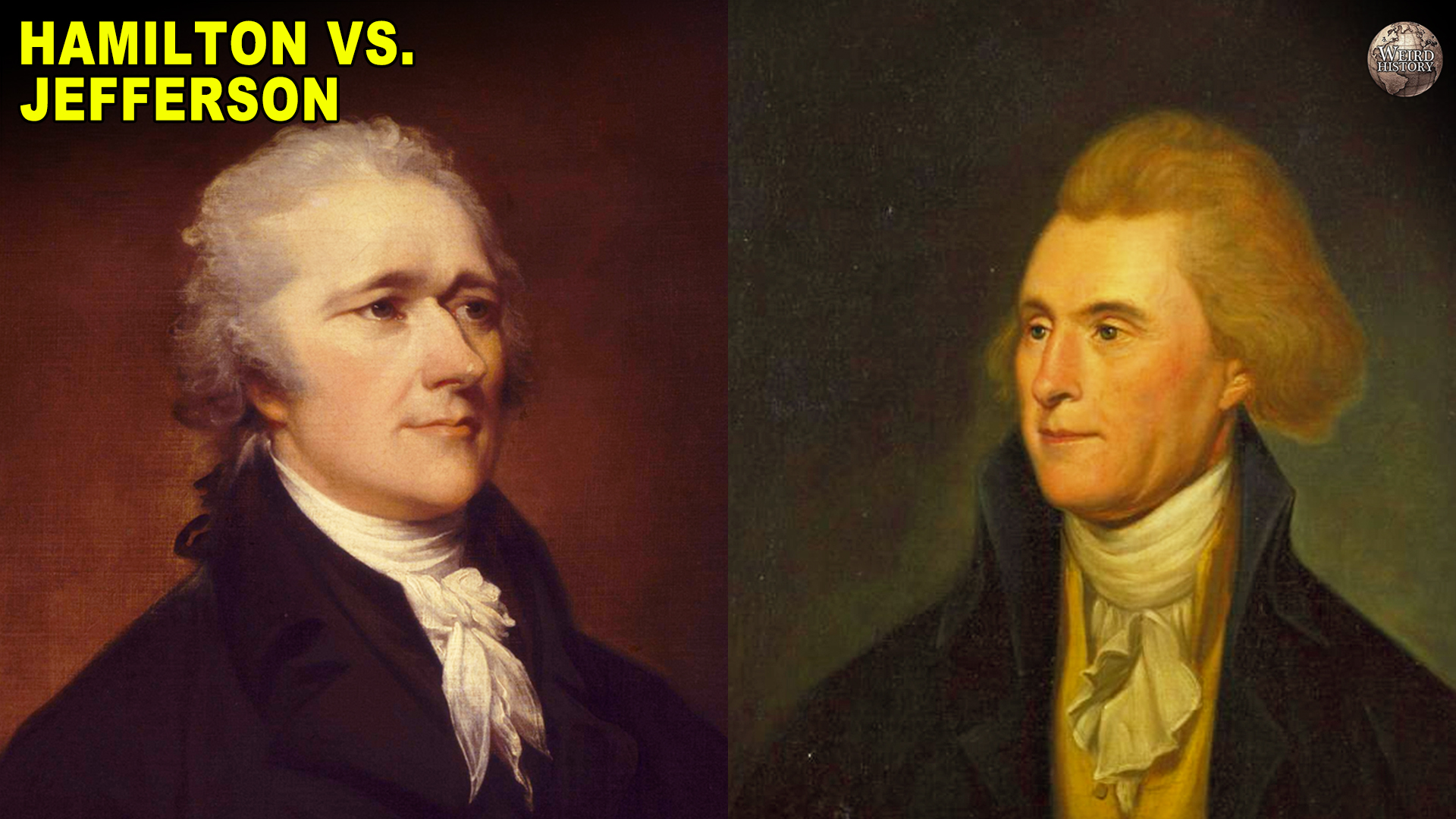
The first—and perhaps the most important—political rivalry in U.S. history was between Alexander Hamilton and Thomas Jefferson. The two Founding Fathers clashed over political differences, each trying to sway President George Washington to his side. But there’s more to the Hamilton and Jefferson feud than you thought.
Show More Show Less View Video Transcript
0:00
The first political rivalry in US history was between Alexander Hamilton and Thomas Jefferson
0:07
But their beef went far beyond their political differences. And in the end, both men would destroy their own reputations in order to attack each other
0:17
Today, we're going to take a look at how the beef between Thomas Jefferson and Alexander Hamilton was worse than you thought
0:23
OK, time to throw on the original cast recording of Hamilton. When George Washington became America's first president in 1789
0:35
he appointed both Alexander Hamilton and Thomas Jefferson to serve in his cabinet
0:40
Hamilton as Secretary of the Treasury and Jefferson as Secretary of State
0:44
This probably seemed like a good idea at the time, since both Hamilton and Jefferson had a close relationship with Washington
0:51
But we've all had those friends who just don't get along, so maybe Washington should have seen the pair's legendary feud coming
0:58
Maybe if he wasn't so busy chopping down cherry trees with his wooden teeth
1:03
That's how the story goes, right? Hamilton was only 22 when he served as Washington's secretary during the American Revolution
1:09
and they remained close for years after the war ended. In fact, it was Hamilton who encouraged a reluctant Washington to run for president
1:18
Jefferson shared a similar background to Washington. Both were Virginia planters, and both distinguished themselves during the Revolution
1:25
Jefferson by penning the Declaration of Independence, and Washington by winning the war
1:29
Also, both men married widows named Martha, and we all know the power of a shared Martha
1:35
As you promise, Martha won't die tonight. Sadly, the three men did not quite form the dream team
1:43
Washington probably hoped for. Hamilton and Jefferson both saw themselves as Washington's closest advisor, which sparked a rivalry
1:51
The two began to compete for Washington's approval, and that competition would eventually turn the rivalry into an all-out feud
1:58
It was a real mean girl situation. Hamilton and Jefferson may have run in similar circles, but they were very different men
2:09
Hamilton was from the Caribbean, born the illegitimate son of a Scottish peddler
2:14
In 1772, he moved to New York City, and the Big Apple turned Hamilton into a proponent of urban commerce
2:21
He saw America's cities and its merchant economy as the economic engine that would drive progress
2:27
and he believed a strong central government was necessary for the country's survival
2:32
Jefferson, however, was more of a farm boy. In his eyes, Hamilton was advocating a return to European-style monarchy
2:40
the thing they'd just fought a whole-ass war to get away from. Jefferson's perspective favored a decentralized government
2:46
which he believed would allow for more personal liberty. Both men thought they could sway Washington
2:50
toward their vision for America Early in Washington presidency the general seemed to side with Hamilton more than with Jefferson To say Jefferson took it personally would be an understatement
3:01
Jefferson was convinced that Hamilton was a corrupt, self-interested monarchist. And in 1792, he complained to Washington
3:08
that Hamilton had a squadron devoted to the nod of the treasury
3:13
According to Jefferson, these men wanted to form the most corrupt government on Earth
3:17
which sounds like hyperbole, but Jefferson apparently really believed it. Washington tried to cool the friction between his two BFFs. In a letter to
3:26
Jefferson in August 1792, Washington wrote, How unfortunate, and how much is to be regretted then
3:33
that whilst we are encompassed on all sides with avowed enemies and insidious friends
3:38
that internal dissension should be harrowing and tearing our vitals. Essentially, Washington was
3:44
saying, Squash this beef, I've got real problems to worry about. But Jefferson didn't get the hint
3:50
Instead, he wrote back to Washington and doubled down, declaring that Hamilton's ideas
3:54
flowed from principles adverse to liberty and were calculated to undermine and demolish the
3:59
republic. In short, Jefferson was accusing Hamilton of being a traitor. It's rarely a good idea to be perceived as the dangerously unhinged guy in the office
4:12
but Jefferson refused to let go of the idea that Hamilton was a traitor. In October of 1792
4:18
Jefferson even told Washington that Hamilton was heading a monarchist plot to seize the government
4:24
Jefferson claimed that Hamilton had told him that the Constitution was a shilly-shally thing of mere
4:30
milk and water, which could not last and was only good as a step to something better
4:35
Shilly-shally, them's fightin' words, Jefferson. In response, Washington, who was apparently done
4:41
humoring his increasingly venomous pale, dismissed Jefferson's claims as ridiculous. The president then added that Hamilton's plans actually worked
4:50
and were already bringing financial stability to the new country. But rather than back down, Jefferson concluded
4:55
that the 62-year-old Washington's brain had been enfeebled by age. Hamilton held sway in Washington's cabinet
5:02
but things changed with the election of 1796, in which Jefferson won himself a spot as John Adams' vice president
5:10
Sensing that Jefferson's pettiness would only get worse now that he was VP
5:14
Hamilton marshaled the Federalists, his political allies in Congress, to oppose Jefferson's
5:19
Republican Party. In 1798, Hamilton's Federalists passed the now notorious Alien and Sedition Acts
5:27
which were designed to suppress political dissent. Jefferson raged against the law
5:32
calling it detestable and worthy of an eighth or ninth century. As for the Federalist government
5:38
it was a reign of witches. And Jefferson saw Hamilton as being behind the whole mess
5:44
proclaiming him our Bonaparte, a reference to Napoleon who was busy conquering Europe at the time and may or may not have appreciated the comparison For what it worth modern legal experts widely agreed that the Alien and Sedition Acts were unconstitutional
6:00
So why didn't Jefferson challenge the laws in the Supreme Court? Well, because the country was still so young
6:06
the court hadn't yet asserted its power of judicial review. The Supreme Court wouldn't establish its authority
6:12
to declare laws unconstitutional until 1803. In 1791, Hamilton met a woman named Maria Reynolds
6:23
The two had an adulterous affair, which was probably a lot of fun for Hamilton
6:27
until he found himself being blackmailed by Maria's estranged husband, James Reynolds
6:34
Reynolds demanded $1,000, roughly the equivalent of $32,000 today, to keep the relationship secret
6:41
Worried that Reynolds would tell his wife about his indiscretions, Hamilton paid the money
6:46
But you must regard it as a personal loan. It has nothing to do with the treasury
6:50
But he did not end the affair. When James Reynolds was arrested in November 1792 for forgery
6:57
he wrote to Hamilton's rivals, promising information that would destroy Hamilton's reputation
7:03
Wonder if all that crime had something to do with Maria betting down with Hamilton. James Monroe heard Reynolds' tale and went to Hamilton to get his side of the story
7:12
Hamilton privately confessed to the affair, and Monroe agreed to let the matter drop
7:17
But Monroe also made a copy of the letters from Maria Reynolds
7:20
and gave them to Thomas Jefferson. In other words, Hamilton was totally screwed
7:26
It may be hard to believe, but Jefferson didn't immediately use the letters to destroy Hamilton
7:31
In fact, five long years passed before they would come into play
7:35
During that time, the rivalry between Hamilton and Jefferson grew more and more personal
7:40
Finally, in 1796, when Jefferson was running for president, Hamilton accused the Virginian of hypocrisy
7:47
Hamilton said that while Jefferson might seem like a simple, humble farmer
7:51
the Virginian's reputation was a flimsy veil to the internal evidences of aristocratic splendor
7:57
sensuality, and epicureanism. Although it's not entirely clear, it seems possible that Hamilton was referencing the
8:04
rumors about Jefferson's affair with Sally Hemings, who was not only his slave, but also
8:09
his deceased wife's half-sister. What time did you get off work? Um, never
8:15
Jefferson did not feel like sitting on the letters any longer after that. He turned to his attack dog, muckraking journalist James Callender
8:23
to finally reveal Hamilton's affair. Callender published the story of Hamilton's affair in 1797
8:29
and given that he was Jefferson's handpicked messenger, he did not pull any punches
8:34
Callender called James Reynolds a pimp and printed Maria's letters to Hamilton
8:38
He also attacked Hamilton's loyalty to his country, writing, So much correspondence could not refer exclusively to wenching No man of common sense will believe that it did Hence it must have implicated some connection still more dishonorable In other words nobody would write this many letters to
8:55
a woman unless they were guilty of corruption. As the scandal blew up, Hamilton decided that
9:00
his only chance to defend himself was to admit to the affair. He eventually penned a response
9:05
asserting that his only crime was an amorous connection with Reynolds' wife. Hamilton's
9:10
mission came as a shock to allies and enemies alike, and it ultimately did little to help his
9:15
reputation. One New Yorker even told Hamilton, you have widened the breach of dishonor by a
9:20
confession of the fact. Once news of Hamilton's affair became public, his reputation was destroyed
9:29
Hamilton surely blamed himself for the disaster, but he also blamed James Monroe for copying his
9:34
love letters and giving them to his greatest rival. What the hell, James? Furious, Hamilton
9:39
stormed over to Monroe's house, where he implied that the future president of the United States
9:45
was a liar. Monroe didn't take the accusation too well and immediately challenged Hamilton to a duel
9:52
which Hamilton quickly agreed to. Monroe called on Aaron Burr to serve as his second at the duel
9:57
Burr, who would later fatally shoot Hamilton himself in a duel, spent months acting as an
10:03
intermediary, and eventually convinced the men to call the whole thing off. Hey, Siri, what's the
10:08
definition of irony? The Reynolds affair ultimately destroyed Hamilton's hope for any future office
10:14
Jefferson, meanwhile, noted just how useful the muckraking Calendar had been and decided to use
10:20
the newspapermen as an attack dog in his campaigns for the presidency. But Jefferson was
10:25
playing with fire. In 1800, Calendar was arrested for writing a vicious anti-Federalist paper and
10:32
was prosecuted under the same sedition act that Jefferson had already opposed. By the time
10:38
Callender got out of jail, Jefferson had been elected president. Callender expected Jefferson
10:42
to help him out, but the president just ignored him. So Callender retaliated by publishing
10:48
scandalous stories about Jefferson's affair with Sally Hemings. Turns out that the founding fathers
10:53
were basically the messiest clique in high school. In 1804, Aaron Burr whacked Alexander Hamilton in
11:02
a duel. After the event, Thomas Jefferson, in a show of maturity and respect, finally stopped
11:08
tearing into his old rival. Nah, just kidding. Jefferson kept ripping on Hamilton for years to
11:14
come. In a private letter dated 1820, Jefferson complained that Hamilton was chained by native
11:21
partialities to everything English. He also argued that Hamilton wanted to destroy America's
11:27
insulation from the abusive governments of the old world. In another piece, Jefferson continued
11:32
his accusations of corruption by claiming Hamilton was so bewitched and perverted by
11:37
the British example as to be under thorough conviction that corruption was essential to
11:41
the government of a nation. Way to stay classy, TJ
Politics
Political Science
Public Policy