Up next in 10



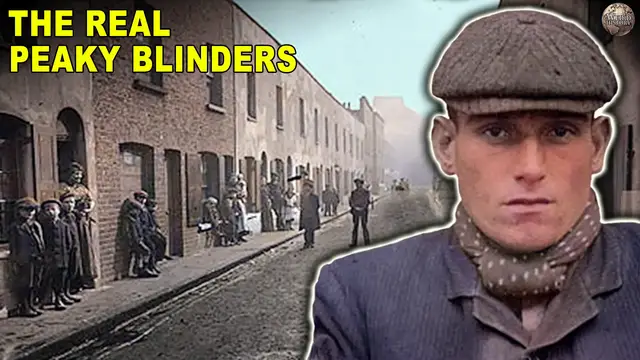
Who were the real Peaky Blinders? On the BBC show, boss Tommy Shelby (Cillian Murphy) violently dominates the streets of Birmingham, England, while wearing tailored, fashionable clothes. And in reality, the gang members did wear a signature dressy look, complete with silk scarves, to class up their extralegal enterprise. But they also sewed razor blades in their caps to injure the faces of their rivals and victims, causing a crime wave that infuriated the police.
Show More Show Less View Video Transcript
0:00
On the BBC show Peaky Blinders, crime boss Tommy Shelby violently dominates the streets of Birmingham, England
0:07
while wearing tailored, fashionable clothes. But who were the real Peaky Blinders
0:12
And what made them the most feared gang in all of Britain? Well, today we're taking a look at the fascinating true story that inspired BBC's Peaky Blinders
0:21
Okay, time to take a peeky through these blinders. That's just fun to say
0:25
Must be why that show's such a hit. Birmingham was a booming, industrialized city by the second half of the 19th century
0:36
More like Boomingham, right? Am I right, you guys? Yeah, you'll come around
0:40
But this growth led to a wave of crime. Historian Philip Gooderson reported that by 1870
0:46
Birmingham's gangs had grown increasingly territorial, battling to claim different sections of the city. In fact, Gooderson's research showed gangs sometimes spend more
0:55
time clashing over turf than committing offenses. Because you can't set up a racketeering operation
0:59
if you don't have a place to put all your racketeers. Surviving testimony from West Midlands Police Superintendent Spear
1:06
confirms that in 1872, gangs of boys terrorized parts of Birmingham. Spear reported several weeks of complaints from Birmingham residents
1:13
in Cheapside and Barford Street about crowds of boys who swept into the neighborhood breaking windows and calling out insults
1:20
The Birmingham Daily Post also recorded that in 1872, a mob of boys threw brickbats and stones at the windows of general stores and confectioners
1:29
To clarify, a brick bat is a chunk of brick, and not nearly as cool as a bat made of brick
1:35
By 1895, these gangs were being referred to as Peaky Blinders. Children suffered from Birmingham's
1:41
economic downturn just as much as adults, as poverty drove people into the slums indiscriminately
1:46
The Peaky Blinders emerged around 1880 as a crime wave swept across Britain, and they were only too
1:52
happy to take advantage of the recruiting pool offered by destitute kids. And why not? Even
1:57
Sherlock Holmes had a gang of kids on the payroll to do his dirty work. Records show that the West
2:02
Midlands police arrested 13-year-old David Taylor for carrying a gun, and gang member Charles
2:07
Lamborn was only 12 when police arrested him in 1905. As surely as the gang didn't mind recruiting
2:13
very young boys, they also had nothing against older men. For example, authorities arrested
2:18
Peaky Blinders member Thomas Gilbert in 1904 when he was 38. The West Midlands police took
2:24
Gilbert's mugshot, recorded his missing finger and a scar on his knee as identifying characteristics
2:29
and listed his occupation as fishmonger. Sounds like a guy who sells bootleg concert CDs on eBay
2:34
the fishmonger. While law enforcement detained several other members of the gang for theft or
2:39
breaking and entering, offenses that landed them in jail for up to eight months, Gilbert faced
2:44
charges for false pretenses. The charge implies Gilbert was tricking or defrauding victims
2:49
rather than engaging in the more violent acts of the younger gang members So he wasn a fishmonger Man you think you know a guy
3:01
But why were they called Peaky Blinders? What the hell does that even mean
3:05
And why would any serious criminal embrace such a silly-sounding name? Well, as is the case with most British slang
3:12
the phrase was much more serious than it sounded. To explain, take a look at the photographs
3:16
taken by West Midlands police depicting real members of the Peaky Blinders gang
3:20
in their signature outfits. Consider the 1905 mugshot of Stephen McKickey. His cap, which had a hard brim
3:27
would have helped him and his fellow gang members commit crimes. According to historian David Cross
3:32
who is the curator of the West Midlands Police Museum and not the supporting star of Arrested Development
3:38
they used their hats with razor blades sewn in to rob people. That's what a Peaky Blinder was
3:43
This type of cap was referred to as a Peaky at the time
3:47
The men would headbutt their victims, doling out terrible cuts and causing temporary blindness
3:52
earning them the name Peaky Blinders. And that does sound better than Stabby Cappies or the Slice Hats
3:59
But just how accurate is that explanation? Historian Carl Chin has pointed out that the BBC show Peaky Blinders
4:05
gets a few things wrong about the storied gang. First off, it's worth pointing out that while Cillian Murphy is a riveting leading man
4:12
there was no real Tommy Shelby. They just made him up for the show. Also, the leader of a London street gang named after a facial mutilation tactic
4:20
probably wouldn't be quite as dreamy. Another thing the show gets wrong is the time period
4:25
The BBC drama is set in the 1920s. But in real life, the Peaky Blinders' heyday was in the 1890s
4:31
That's a swing of 30 years. That's like telling people World War II ended in 1975, the same year Jaws came out
4:38
And as for the idea that the Peaky Blinders sewed razor blades into their hats
4:43
Chin said it probably never happened. Oh man, that was the cool part of the story. Razor blades were still uncommon, expensive items in the 1890s, during the height of the Birmingham gang activity. It's unlikely a gang of street toughs would have had the ability or the inclination to arm themselves in such a complicated and costly manner, especially when an easily affordable knife would get the job done just as well
5:04
David Cross, the historian, not the TV star, counters that the stiff hats probably didn't need blades to be effective mugging tools
5:12
The gang members targeted victims who appeared to have money and head-butted them with their caps
5:16
The move caused the victims' eyes to tear up, making them temporarily blind
5:20
At that moment, the gang members took money or anything that they could sell quickly
5:25
Chin, however, believes the name Peaky Blinders was simply a reference to the gang's relatively elegant style of dress
5:31
And the whole blinding people with their hats thing is just a folk etymology. According to him, in the late 19th century
5:36
Peaky referred to any flat cap with a peak. And blinder was Birmingham slang for something or someone
5:42
of dapper appearance. In fact that slang is still used in modern Birmingham So really the gang could have been named the fancy head butters We leave it to you to decide if you believe cross or chin But there nothing like a no historian fight to get the blood flowing huh
6:02
One thing historians do agree on is that the Peaky Blinders wore recognizable outfits
6:07
Gang members wore silk scarves around their necks, sported thick wool jackets, and of course
6:12
topped it all off with the famous flat cap that was at least capable of hiding razor blades
6:17
whether or not they were ever really used for that purpose. Predicting the fashions of the 1970s by a good 80 years
6:23
the gang members also often donned bell-bottom pants and heavy boots, like Elton John going to work in a coal mine
6:30
Why all the fancy threads for a rough-and-tumble street gang? Well, according to historian David Cross
6:35
the gang chose its outfits to add class to their thieving, because presumably a victim would feel better about being robbed
6:41
if they could at least see how their money was being spent. Clothes make the man, but they also make the woman
6:46
So the Peaky Blinders weren't the only ones who dressed up in Victorian Birmingham
6:50
Their girlfriends also followed the gang's lead by wearing expensive, tailored clothing
6:55
As historian Philip Gooderson relates, the girlfriends often wore pearls and imitated
7:00
their boyfriends by wearing silk handkerchiefs. Unfortunately, the lavish outfits typically went hand-in-hand with physical abuse
7:06
As one woman said, he'll pinch and punch you every time he walks out with you
7:10
And if you speak to another chap, he don't mind kicking you. It's an important reminder that an idiot in fancy clothing is still just an idiot
7:18
The Dapper gear also helped distinguish the Peaky Blinders from rival gangs, who we assumed dressed like absolute trash
7:24
As surely as the Jets had to face off with the Sharks, and the Warriors had to do battle with the Gramercy Riffs
7:30
the Turnbull ACs, the Orphans, and the other 18 gangs crammed into that movie
7:34
the Peaky Blinders weren't the only group of ruffians in Victorian Birmingham
7:38
The streets were also home to the Sloggers, a rival gang dating back to 1870
7:43
The Sloggers allegedly took their name from their favorite weapon, which were large belts with buckles that could be used to beat victims
7:50
What is it with 19th century British gangs being named for weaponized articles of clothing
7:54
Also known as the Cheapside Slogging Gang, the Sloggers had plenty of their own brushes with the police
7:59
For example, according to an 1872 Birmingham Mail article, about 400 roughs brought indiscriminate violence to the Cheapside area
8:06
attacking and stealing. That sounds like a full-blown revolution, but the newspaper may
8:11
have overstated the chaos. The article admits their authorities only arrested three people
8:16
during the incident, two of whom were impoverished children. Sensationalism to sell news. Glad we
8:23
don't do that anymore. The Peaky Blinders had a long rap sheet with the West Midlands police
8:32
According to court reports, the Peaky Blinders were foul-mouthed young men who stalked the streets in drunken groups, insulting and mugging passersby
8:41
Basically they were a bunch of Dickensian street thugs on a perpetual bar crawl regularly engaging in robbery theft and riots Gang members carried knives may have sewed razor blades in their hats and beat enough people to earn the name sloggers which true to the
8:55
conventions of British slang, sounds like it could either mean they were violent thugs or
8:59
really great kissers. But the real Peaky Blinders weren't a single gang for their entire history
9:05
In Birmingham, some grouped multiple gangs, including the Brumagen Boys, the Netchel
9:10
Sloggers, and Wainwright Street under the title Peaky Blinders. It was basically a franchise
9:16
It's sort of like how every neighborhood has a McDonald's, except in this one
9:20
Ronald McDonald headbutts you and takes your wallet. In 1873, the Birmingham Daily Post wrote about a fight between two rival groups known as the
9:33
Bradford Street Gang and Park Street Gang, and the clash was just the beginning. Within two years
9:39
The Allinson Street Slogging Gang had a new captain who led an attack against another gang
9:44
leader named William Smallwood, a.k.a. Billy Smalls, a.k.a. WSMW, probably. The attack was
9:50
meant to avenge Smallwood's vicious beating of two rival gang members, during which he severely
9:55
injured the men's heads with a belt buckle. At his trial, Smallwood argued that his attack was
10:00
self-defense, and the magistrate let him go. As the gangs continued to fight for territory
10:05
they directed much of their violence toward each other, rather than on other Birmingham residents
10:10
which we imagine was something of a relief to those residents. While gang warfare was certainly
10:14
a reality in late 19th century Birmingham, much of the misdeeds attributed to the Peaky Blinders
10:19
was petty crime and property damage, rather than the opening scene of Gangs of New York
10:24
Arrest records of Peaky Blinders made by the West Midlands police more than a century ago
10:28
detail some of those serious offenses. For example, law enforcement apprehended 19-year-old
10:34
Harry Fowler for stealing a bike and trying to sell it. Ooh, scary. They also detained another
10:39
member of the Peaky Blinders, Stephen McKickey, for breaking into a shop down the street from his
10:44
house. It's not exactly the kind of stuff that earns you a star-studded series on the BBC
10:49
That's when you start making up stories about wearing razor hats. In truth, many gangs fought on the streets of Birmingham, including groups like White House
11:02
Street, the Aston Sloggers, and the Ten Arches, any one of which would have also made a pretty
11:07
badass name for a TV show. The lines between these gangs were sometimes blurry, since they
11:12
frequently teamed up to take on rivals. In 1886, hundreds of gang members clashed in Rocky Lane
11:18
Birmingham. They fought with belts and bricks, requiring a full mobilization of the police to
11:22
stop them. According to historian Carl Chin, many of these gangs eventually earned the nickname
11:27
Peaky Blinders. By the 1890s, however, the city unveiled programs to civilize the working-class
11:33
boys battling in the streets. By the early 20th century, gang activity in Birmingham
11:37
had begun to decline, but we'll always have the BBC