Up next in 10



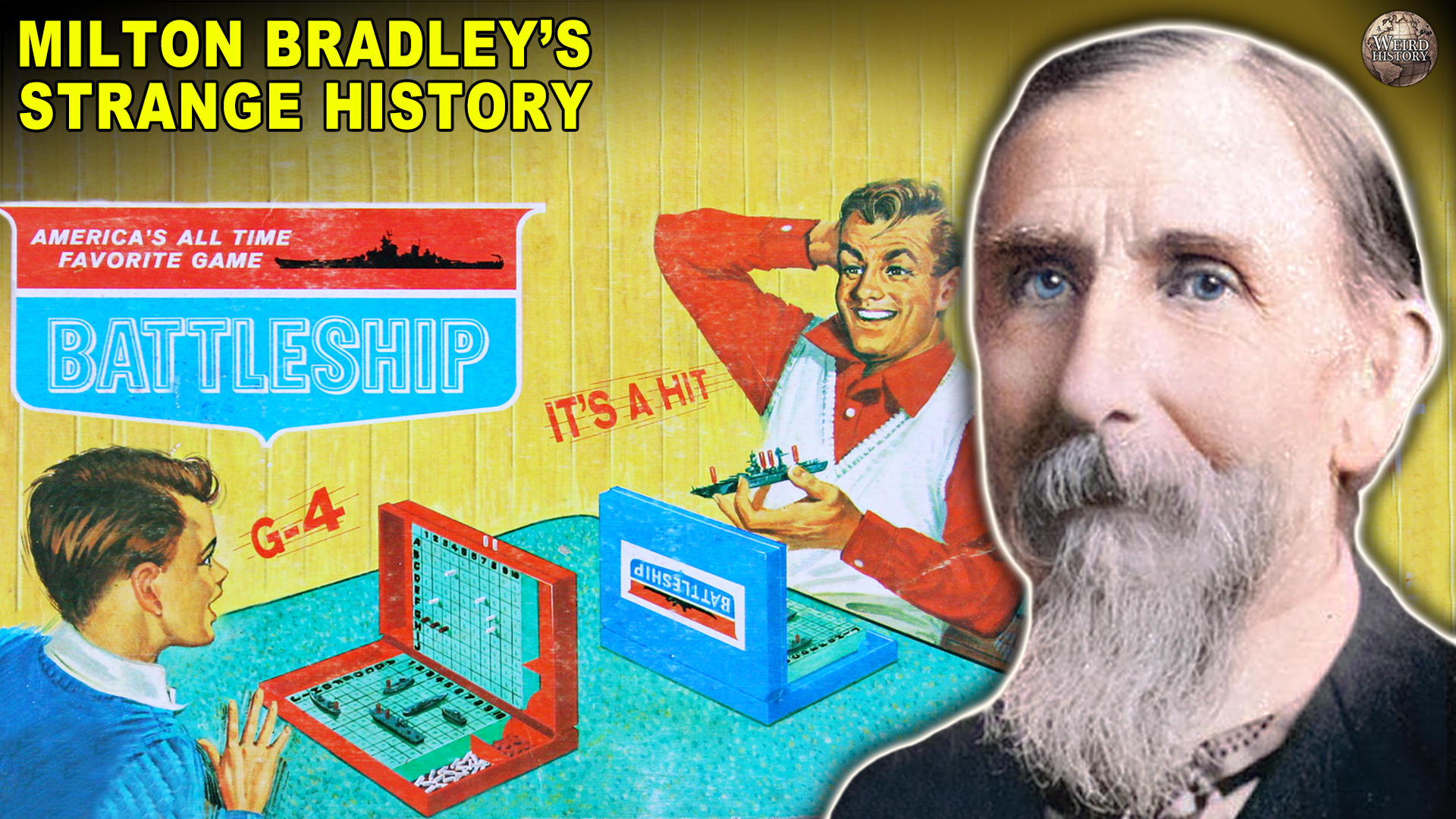
The Milton Bradley corporation produced some of the most memorable family-friendly board games in history, like Operation, Candy Land, and Chutes and Ladders, before being purchased by Hasbro. Their games aren't as innocent and carefree as everyone believes, though; they have weird histories. In fact, there are strange stories behind many children’s games.
Show More Show Less View Video Transcript
0:00
The Milton Bradley Corporation produced some of the most
0:02
memorable family-friendly board games in history, including classics like Operation, Candyland, and Chutes and Ladders
0:09
But the company and its beloved games have an unusual history that isn't as innocent and carefree
0:14
as you might think. So today, we're going to take a look at the bizarre history of Milton Bradley board games
0:19
OK, game on. It's funny to think that one man making the decision
0:27
to grow facial hair could change another man's life forever. But that is exactly how Milton Bradley wound up in the gaming business
0:33
Bradley was born in Vienna, Maine in 1836. At the age of 20, he set up the first color lithography shop in Springfield, Massachusetts
0:41
where he decided to print and sell an image of the Republican presidential nominee, Abraham Lincoln
0:45
Despite the fact that Lincoln wasn't particularly well-known at the time, the lithographs were a big hit at first
0:51
You see, Abraham Lincoln was clean-shaven until, as the story goes, an 11-year-old girl wrote him a letter mentioning that Lincoln's face
0:59
would look a great deal better with a beard because his face was so thin
1:03
How did Lincoln recover from that body shaming? The child also noted, all the ladies like whiskers
1:08
and they would tease their husbands to vote for you, and then you would be president
1:12
While the story may be apocryphal, Lincoln did end up growing a beard and becoming one of the most famous presidents in American history
1:18
Historians are divided on how much they think the beard affected his popularity, but some believe it helped
1:23
However, the beard also ruined Milton Bradley's career by prompting customers to demand refunds on his lithographs
1:29
of a clean-shaven Lincoln, rendering them totally worthless. Bradley burned the rest of the lithographs
1:35
and went in search of an entirely new product to sell. Inspired by an imported board game that had been gifted to him
1:40
by a friend, he decided that his new signature product would be board games
1:44
He got to work, and at the end of 1860, he released his first game, the Checkered Game of Life
1:49
Despite enjoying success as a board game publisher, the Milton Bradley Company was almost bankrupt
1:54
when World War II started. So to help with the World War II effort, and maybe to avoid financial distress, the corporation
2:00
started producing missiles and landing gear joints for fighter jets. Hopefully those pieces were much more difficult to lose than the ones in Axis and Allies
2:07
It was a weird turn for what was essentially a children's toy company. But it turned out to be a big moneymaker that both saved the company and helped the American soldiers
2:19
When Milton Bradley first created the checkered game of life, it was a very, very different
2:24
game for the modern game of life we all know. Nobody loves the game of life when hour three rolls around and you still paying off that college loan for a gender studies degree How is it even legal to make that loan But whereas the current version is just good clean fun
2:38
the original was used to teach morality. The checkered game of life featured positive squares called honesty, bravery, and success
2:45
as well as negative squares called poverty, idleness, and disgrace. A player's goal was to gain on his journey that which shall make him the most prosperous
2:52
and to shun that which will retard him in his progress. So basically, as long as you're not lazy and remain free of scandal, you'll succeed in life
3:01
Unless you land on the suicide square. Yeah, you heard that right. A suicide square
3:05
The old version sounds like a more realistic game. Players who landed on it automatically lost, for reasons that are entirely explained by the space's name
3:13
In regards to the suicide square, the rules simply stated, whoever moves to suicide is thrown out of the game
3:19
It wasn't until 1960 that the game had a makeover, opting for squares about life events like jury duty and adoption
3:25
instead of idleness and disgrace. Jury duty is not exactly a fun time
3:30
but it's way better than the suicide booth. When you think of the Civil War
3:39
you probably think of historic strategists like Ulysses S. Grant, Robert E. Lee
3:43
and Iron Man and Captain America. What you probably don't think about are board games
3:48
especially tiny versions of them. But during the Civil War, soldiers were often left for long periods of time
3:53
with few opportunities for amusement. The Milton Bradley Company did their best to help alleviate that problem by producing
3:58
miniature versions of chess, checkers, and other games. These travel-sized versions were sent to the Union soldiers
4:05
In fact, Bradley's creation, the checkered game of life, was the country's first travel-sized game
4:15
In 1946, schoolteacher Eleanor Abbott was recovering from polio in a hospital in San Diego
4:21
California. Streaming reruns of The Office were still a few decades away from being invented
4:27
so she had some time on her hands and decided to create a game for the polio-stricken children
4:31
who share the ward with her. That game turned out to be the now classic Candyland. Abbott made the
4:36
board game very colorful and imaginative because it was intended to serve as a diversion for
4:41
bedridden, severely ill children. She possibly even drew the artwork herself, although no one
4:46
knows for sure. The kids in the polio helped Abbott test the game
4:50
and even suggested that she try and sell it to the Milton Bradley company
4:54
Milton Bradley bought the game and released it in 1949 as a fill-in for their principal product, which
4:59
was school supplies at the time The original Candyland sold for and was so wildly successful it eclipsed Milton Bradley previous bestselling game Uncle Wiggly and made Milton Bradley a serious competitor to Parker Brothers
5:12
Candyland remains extremely popular, and the game was nearly adapted into a movie in 2012
5:17
before a lawsuit over some of the characters halted production. Even the king of Candyland has to deal
5:22
with intellectual property rights. Is there no escape? Originally called Pretzel, Twister was co-created by Charles Foley, who had an idea for a game that used people as game pieces, and Neil Rabbins, who came up with a colorful matte
5:41
The idea was snapped up by Milton Bradley. But while Twister may seem like an innocent game, and has even been included in the Toy Hall of Fame as of 2015, the interactive experience used to be considered quite risque
5:53
In 1966, the game was deemed too inappropriate for the Sears catalog
5:57
Critics even called Twister Sex in a Box, which is a title that might have made it sell more copies
6:02
Due to the backlash, however, Milton Bradley halted production of the game. Luckily for Milton Bradley and the game's creators
6:08
Johnny Carson and Eva Gabor played Twister on The Tonight Show later that year
6:13
And that television appearance changed everything. The segment revitalized the game's image
6:17
And by 1967, roughly 3 million editions had been sold. If you've ever played Chutes and Ladders and thought
6:30
this game could use more snakes, then boy, do we have some news for you. Turns out, Chutes and Ladders was based on an Indian game
6:36
called Snakes and Ladders. In both games, players must navigate from the bottom square
6:40
to the very top one. But whereas Chutes and Ladders is now widely played as a race involving luck, Snakes and Ladders
6:46
originally represented life's journey and the implications of virtues, represented by the ladders
6:51
and vices, represented by the snakes. The Indian version also deals with different planes of beings
6:57
and reincarnation, which maybe kids are into. Maybe Chutes and Ladders will include that in an expansion set
7:09
Sometimes, irony is a toe-tapping Alanis Morissette song. And other times, it's kind of just a bummer
7:15
Take, for example, the story of John Spinello, who created the prototype for the board game Operation
7:20
as a school project in 1964. He received top marks on the assignment
7:24
then sold the rights to the Milton Bradley Corporation for $500, which is roughly $4,500 in 2022
7:31
That's not a small amount of money, unless you compare it to the million operation has earned for Milton Bradley since they purchased it So where the irony Well in 2014 Spinello was in need of an operation himself
7:44
but he couldn't afford it. His health care wouldn't cover an oral procedure, putting him on the hook for $25,000
7:50
Spinello turned to crowdsourcing to raise money, even selling his original operation prototype
7:55
Admirably, Hasbro, the current owner of Milton Bradley, stepped in to buy the prototype, and Spinello
8:00
was ultimately able to afford the surgery. As of 2019, he was working as an Uber driver in Chicago and traveling the country, talking
8:08
about his life and selling autographed copies of Operation to raise money for charity
8:12
Not bad for the creator of a game that made us hate the shape of buckets. That was impossible to grab
8:22
The Great Depression, lasting roughly from 1929 to 1939, marked a period of extreme financial
8:29
distress for many people. So the Milton Bradley Corporation created a diversion from the economic hardship by releasing
8:35
a game called Easy Money in 1935 that gave everyone huge stacks of cash to play with
8:41
Nothing eases the stress of a financial apocalypse like losing thousands of fake dollars to your grandma
8:46
The game was a lot like Parker Brothers' classic Monopoly, but there were some key differences
8:51
For example, players started with $2,000 instead of $1,500 and were given $250 for circling
8:57
the board instead of the usual $200. OK, maybe there weren't that many differences
9:02
which means easy money was a Monopoly knockoff, right? Well, kind of
9:06
The fact is, Monopoly wasn't all that original to begin with. Monopoly took its inspiration from an even older creation
9:11
called The Landlord's Game, which was produced by Elizabeth Maggie in 1904
9:16
to condemn people who hoarded wealth. A far cry from the game that now requires you
9:20
to become a real estate mogul to win. Monopoly was created by Charles Darrow
9:24
who designed it after losing his job during the Great Depression. He tried to sell his idea to the Milton Bradley Company
9:30
but they passed on the game. Eventually, the Parker Brothers Corporation scooped up the pitch
9:34
and sold Monopoly with great success. In fact, it was such a success that Darrow was the first game
9:39
inventor to ever become a millionaire. Not bad for a game that nobody can actually finish
9:44
When Milton Bradley owners saw the popularity of Darrow's idea, they released easy money in direct competition
9:50
But Parker Brothers sued them over the imitation and won. The Bradley Company was forced to license Monopoly's patents
9:55
and release a new version of their game. Interestingly, Elizabeth Maggie had previously tried
10:00
to sell the Landlord's Game to Parker Brothers. They passed and later picked up Monopoly instead
10:05
She eventually wound up selling her patent to Parker Brothers, who presumably bought it to prevent her
10:10
from suing them over Monopoly
Arts & Entertainment
Entertainment Industry
Board Games