Up next in 10



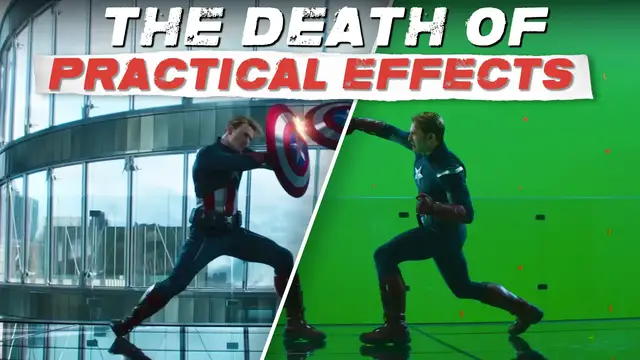
The art of Practical Effects in movies is becoming a lost art form. Once the foundation of Hollywood filmmaking, practical effects used real materials, makeup, miniatures, and animatronics to create some of cinema’s most iconic moments. From Star Wars and Jurassic Park to The Terminator, filmmakers once blended real-world craftsmanship with groundbreaking VFX to build believable worlds.
Show More Show Less View Video Transcript
0:00
Oh, what a day! What a lovely day
0:02
This is Mad Max Fury Road. Setting time to target? Two minutes, 15 seconds
0:08
2.15, that's impossible. This is Top Gun Maverick. Two films widely divergent in tone, style, and substance
0:19
but that were marketed off the same simple idea. Reality. Or more precisely
0:24
that everything you're seeing was captured in camera. The only problem being, that's not the whole truth
0:30
I couldn't believe it was real. So it's completely real. Filmmaking is magic. It's putting together disparate visual elements
0:37
adding some music underneath, and revealing a sum greater than its parts
0:41
Film is an artificial reality made to transport you into another person's perspective
0:46
It's said one of the key ways it accomplishes this task is by building a tangible reality for
0:51
the viewer to believe in. It's rumored that at the turn of the century, when moving images were
0:56
first being displayed, that early cinema goers would scream and duck when footage of the train
1:01
careening toward the camera played. Why? Because what was being shown was a document of something
1:06
that had happened, and the viewing public's palette was not emotionally sophisticated to
1:10
understand the intricacies of the filmmaking process. These people witnessed a real train
1:15
coming towards them, and it sparked a deep, primal, emotional response. The Lumiere brothers had invented the movies. It was like a new kind of magic
1:25
Buster Keaton, Boris Karloff's Frankenstein, Jackie Chan, they all have the same effect
1:30
They're real. The human eye can look at them and understand the magic on screen
1:34
But this fundamental element of the filmmaking process would be called into question during
1:39
the early 80s. Films like Tron, The Abyss, or Star Trek IV pioneered a new means of storytelling, computer-generated animation
1:47
It was pretty clear the tides were changing. From a storytelling perspective, anything was rapidly becoming possible
1:53
Ideas and stories that previously would have been wildly expensive to produce were now becoming feasible Massive battle scenes in Lord of the Rings CGI baby Talking Pirate Squidman in Pirates of the Caribbean CGI Spider swinging through the New York skyline CGI
2:08
all day long. And that's nothing to say of the magnum opus of CG animated films
2:13
attempting to pretend they're live action. You're not used to your avatar body. This is dangerous
2:17
This is great. The storytelling possibilities of what Hollywood was capable of were evolving
2:22
and expanding by the day. And yet with that came a hollowness
2:26
a shallow feeling of unrealness. The uncanny valley. The what? Do you remember that weird animation style
2:34
in the early 2000s where everything looked real, but nothing looked right
2:38
Oh yeah, that stuff was creepy. This hypothesis predicts that an entity appearing almost human
2:44
will risk eliciting eerie or uncomfortable feelings in the viewer. Whenever it's attempted to be too close
2:50
to a photorealistic interpretation, it just feels off, and it shatters the illusion
2:55
that the film is trying to construct. It exposes the source code in the magic trick
3:00
Well, you coming? Where? Why, to the North Pole, of course! This is the Polar Express
3:08
Take the opening of Doctor Strange in the multiverse of madness. This is such an outlandish
3:13
and garish display of spectacle that it devolves into something distinctly other
3:18
I'm so sorry. This is the only way. This resistance to CGI, despite its ubiquity, has caused another swing back in the other direction
3:26
They're desperately trying to market films as being real. In the lead-up to Mission Impossible Dead Reckoning, Tom Cruise and Christopher McQuarrie heavily marketed the film for its real stunts
3:36
This is far and away the most dangerous thing we've ever attempted. There's a lot going into this stunt
3:40
Tom Cruise just rode a motorcycle off a cliff six times today
3:45
However, when you look at the sequence of crews jumping off the mountainside on a motorcycle
3:49
and parachuting onto a moving train it also features immense amounts of CGI augmentation You can see over ramp and layers of digital clouds
4:06
which look, of course they're going to have to paint out the ramp, but the digital clouds
4:11
they exist to help handhold the audience by showcasing the movement of space and time
4:15
Similarly with Top Gun Maverick, so much of the marketing of the film revolved around the fact
4:20
that crews and the rest of the cast members shot scenes in actual planes
4:24
We worked with the Navy and the Top Gun school to formulate how to shoot it practically
4:29
because if we're going to do it, we're going to fly in the F-18s. And yet, over 2,400 shots in Maverick featured either digital augmentation or full CGI implementation
4:39
Primarily, many of the F-18s that were used to shoot the film practically
4:42
were completely rotoscoped out and digitally painted over. Furthermore, the highly advanced Dark Star Jet was entirely CGI
4:50
as was every example of a Russian Sioux 57. So that's a lot of CGI for how much pomp and circumstance was put into
4:57
we shot all this practically. The same can be said for Mad Max Fury Road
5:01
Digital stunt doubles, digital vehicle replacement, and scenic augmentation abound. The film was made deep in the Namibian desert
5:08
Each scene was a shot with vehicles careening across the terrain at a minimum of 45 miles an hour
5:13
That is absolutely true, and you can feel it in the film. However, that serves as the baseline for the digital manipulation to work on top of
5:21
In Dan Trachtenberg's Prey, they had a practical Predator suit on set
5:25
and a face mask that was fully remote-controlled. However, in the climax of the movie, when the Predator loses his mask
5:31
they fully CG replace the face. Is this a step forward or back
5:36
This all begs the question, where's the line? How much digital augmentation is acceptable
5:40
How much improves the finished product? How much weakens it? Do you copy
5:45
Yes! I copy! Look, I'm just trying to help you. Okay, I need you to take a step back
5:50
and pull yourself together because I am under a lot of pressure right now The joy and majesty of the transportive power of film is slowly being chipped away day by day in search of something ever so slightly more perfect
6:03
We're trying to sand away the imperfections of the slightly awkward details of Tom Cruise throwing
6:08
himself off a cliff instead of comprehending that the flaws are in fact what makes these experiences
6:13
great. We absorb them subliminally and it's those imperfections that key us into just how real the
6:19
events we are watching actually are. Removing them actually makes the reality less real. Most
6:24
working directors are just desperately attempting to just get a semblance of their vision on screen
6:29
but today that's getting harder and harder. The only movies that are getting made are big budget
6:33
studio fair where they're largely CGI and green screen together. This is to say that only auteurs
6:39
even have the privilege of attempting to find the divining line. Strong artists with a definitive
6:44
vision. George Miller, Tom Cruise, he doesn't fit the typical director-focused lens of that question
6:50
but he is an individual who largely guides the production of these projects
6:54
and who literally puts his life on the line to accomplish them. Just producing these movies is going to be daunting. They're the most
7:00
fun to produce. They're the most complex. While digital effects are essential and are a vital tool in creating outlandish visions of
7:08
what could be, they're also an ever-evolving set of technologies that rapidly level up
7:13
and then phase out. The reason why films like Raiders of the Lost Ark, Jaws, and Alien are
7:18
remembered nearly a half century after their release is because they used real objects to
7:23
create fantasy. They used stop-motion animation, optical effects, and matte paintings. Human hands
7:28
moving literal objects through space and time to transport a viewer into another world. And that has
7:34
to mean something. It has to. In the end, all I'm advocating for is for artists to be able to tell
7:40
the stories the way they want. And most of the time, these digital augmentations feel like
7:44
something forced on them from vigety studio execs and tech company would be moguls. Maybe I'm wrong
7:50
Maybe that's not the case. But these days, it's just so hard to tell what's real