Up next in 10



A rainbow-clad stranger with a silver pipe saves a town from a rat infestation. But when that town stiffs him, he steals their children and vanishes into the hills, never to return. It sounds like a campfire story, but according to the people of Hamelin… it happened. The questions are: What happened?
Show More Show Less View Video Transcript
0:00
A rainbow-clad stranger with a silver pipe saves a town from a rat infestation
0:06
But when that town stiffs him, he steals their children and vanishes into the hills, never to return
0:12
It sounds like a campfire story, but according to the people of Hamelin, it happened
0:17
The questions are, what happened? And, was the real Pied Piper terrifying
0:27
We all know the broad strokes. Sometime in the Middle Ages, the German town of Hamelin is overrun by rats
0:34
and a mysterious piper in multicolored or pied clothing offers to fix it
0:40
He plays his pipe and the rats follow him to the Vaser River where they drown
0:46
But the people of Hamelin refuse to pay, so he returns on the feast of John and Paul
0:51
the saints, not the Beatles. He plays his pipes again and this time all of Hamelin's children follow him out of town
0:59
never to be seen again. Versions differ on the ending, but in any case, the term Pied Piper
1:05
eventually became a shorthand for a charismatic leader, conman, or anyone with dangerous charisma
1:12
cult leaders, politicians, Taylor Swift. You get the idea. People also sometimes connect it to the
1:18
idiom, pay the piper, though proverb scholars note that phrase is more likely an abbreviation
1:24
of the unrelated expression he who pays the piper calls the tune. Anyway, there are a lot of versions
1:30
of the tale. Johann Wolfgang von Goethe referenced it in an unfinished 1803 poem, treating the piper
1:37
as a supernatural power. The Brothers Grimm, collecting German folk tales in the early 19th
1:43
century, polished it into a moral fable, a community's ingratitude punished by the loss
1:48
of its children. And in 1842, Robert Browning's poem, The Pied Piper of Hamelin, turned it into a
1:55
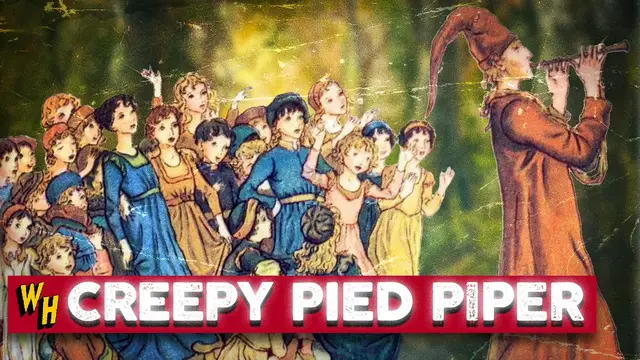
sing-song Victorian children's story, because Victorian children were apparently pretty hardcore. From there, the piper escaped folklore entirely. Painters like Kate Greenaway illustrated him for
2:06
nursery books. Composers wrote operas and ballets. In the 20th century, filmmakers reimagined him as
2:12
everything from an anti-establishment hero to a proto-rock star, and Looney Tunes reimagined him
2:18
as everything from Porky Pig to Sylvester the Cat. The story's tone has swung wildly
2:23
Comic, romantic, tragic, but its pull remains universal. Each era projects its own fears onto him
2:30
In Plague Years, he was death's herald. During industrialization, he was the price of progress
2:35
And in the age of mass media, he became a warning about blind celebrity worship
2:40
And in the Pied Piper of Guadalupe, he was a foil for Speedy Gonzales
2:44
the fastest mouse in all of Mexico. And yet, beneath every retelling, one unsettling detail refuses to fade
2:52
The town of Hamelin says it's real. In fact, for centuries, it kept records marking the day our children left
2:59
And that haunting civic note turns a fairy tale into one seriously creepy mystery of history If you walked into Hamelin parish church around the year 1300 you might have seen
3:15
a stained glass window showing a colorfully dressed figure leading children in white
3:20
The window was lost in the 1600s, but it was described and copied before it broke
3:25
A modern reconstruction survives, and that spooky image is why many historians think the
3:30
legend commemorates a specific tragedy. Outside the church, the town itself kept the date alive
3:37
A 1384 note in Hamelin's town records solemnly counts time from the catastrophe. It is 100 years
3:43
since our children left. That chilling phrasing shows the memory was civic, not just literary
3:49
You can even still touch the story in stone. A fragment of a town gate built in 1556
3:55
mentions the disappearance. And a 17th century inscription on the Ratenfange house, or Ratcatcher's
4:01
house, on Bunglos und Strasse retells the basics with a precise date, June 26, 1284. In fact
4:09
according to locals, the street earned its name, which means drumless street, because music and
4:14
dancing were banned there afterwards. Kind of like a medieval version of Footloose. We also have an
4:20
early written narrative known as the Lüneburg manuscript from the mid-15th century. It lays
4:25
out the core. A well-dressed young man plays a silver pipe. 130 children follow him out the east
4:31
gate to a place called Calveria, or in some telling, Koppenburg, and they vanish. Notably
4:38
rats are nowhere in sight. That absence matters. The rat-catcher detail isn't attested until the
4:44
mid-1500s, three centuries after the event. Earlier sources focus only on the disappearance
4:50
of the children, but if the Pied Piper wasn't a rat catcher, who was he
4:59
Given how infrequent it is for a disgruntled exterminator to steal an entire town's offspring
5:04
it's natural to wonder what was actually going on there. Luckily, historians and folklorists
5:09
who have nothing better to do, have floated a range of explanations. One long-standing theory is that the story reflects a real tragedy, perhaps an epidemic
5:23
drowning, or landslide that wiped out many of Hamelin's children. The people of medieval Europe
5:28
weirdos that they were, liked to personify catastrophe, and death was often imagined as
5:33
a piper or fiddler leading victims in the dance macabre. So in this version, the piper isn't a man
5:39
at all, but an allegory for mortality. If a plague or a flood killed a generation, the image of a
5:46
figure leading them away would have offered both symbolism and solace. And some local geology even
5:52
hints that subsurface collapses near the Veser could have caused sudden drownings or entrapments
6:01
Europe saw strange outbreaks of collective dancing between the 13th and 16th centuries
6:06
sometimes called Choreomania or St. Vitus's Dance. In 1237 a group of children reportedly danced from Erfurt to Armstadt until they collapsed Another in Strasbourg in 1518 saw hundreds dance uncontrollably for days And the Piper might memorialize such an episode
6:26
Chroniclers of these manias described bright clothes, exhaustion, and processions to shrines
6:31
for relief, all echoing Hamelin's image of color, rhythm, and trance. Another theory links the event to itinerant preachers of the early 13th century who rallied
6:46
child crusaders, groups of young people convinced they could peacefully reclaim the Holy Land
6:52
which, spoiler alert, they could not. The famous Children's Crusade of 1212 ended in disaster
6:59
with many dying or sold into slavery. So if a charismatic zealot passed through Hamelin
7:05
decades later, promising salvation or glory, parents might retell it as a bewitchment
7:11
The piping could be rhetorical charm, the music of persuasion, remembered later as literal melody
7:21
Another interpretation holds that the piper was a trafficker who led Hamelin's youth to distant
7:27
lands or markets. Medieval recruiters and traders sometimes enticed or coerced workers with false
7:34
promises. And since life sucked back then, selling or indenturing children certainly wasn't unheard
7:40
of. A community might later soften the scandal by recasting the culprit as supernatural. It's grim
7:47
but it parallels other moralizing tales where a town's sin brings a haunting retribution
7:55
But by far the most macabre theory, suggested by historian William Manchester
8:01
is that the legend masked a series of child murders or abductions by a predator
8:07
Not the monster Arnold Schwarzenegger fought in the movies. The all-too-real humankind
8:13
With no organized law enforcement, towns sometimes mythologize crimes as visitations of evil
8:19
In this retelling, the Piper's magical charisma is the chilling magnetism of a psychopath
8:25
There's no medieval evidence for it, but as a study in folklore psychology, it's potent
8:30
transforming trauma into allegory allowed the town to grieve without confronting the true horror
8:40
Those explanations are plausible, or at least plausible-ish, but most historians think something
8:46
else happened. To understand Hamelin's children, start by translating medieval civic language
8:53
Children of the town usually means townspeople, not literal kids, and in 13th century Germany
8:59
younger sons had few prospects. Thanks to the legal concept of Majerat, the eldest inheriting
9:05
most or all, younger siblings often had to hope an opportunity appeared. And that opportunity
9:11
arrived with the Ostsiedlung, the German eastward expansion. After key military shifts in the 1200s
9:18
opened land south of the Baltic royals wanted settlers to clear forests found towns work mills and just generally do all the crap labor they themselves would never do Enter the Locators sharp middlemen who recruited colonists across the Holy Roman Empire
9:36
and led caravans to new sites in Brandenburg, Pomerania, Silesia, and Transylvania. In other
9:42
words, if you were a cash-strapped 18-25 year old in Hamelin, a smooth-talking organizer promising
9:48
a plot of land and a fresh start, was basically linked in with a hat and a ledger. The fit to the
9:54
legend is Eerie. A well-dressed young man arrives. Music aside, he's a persuasive closer. He leads
10:01
exactly the demographic he wants. The town's unmarried youths out the east gate toward the
10:07
hills and beyond. The devastated parents memorialize the date forever. Over time
10:12
storytellers graft on rats, vengeance, and a moral about keeping promises. The recruiter
10:18
morphs into a supernatural figure with a flute. Local memory and onomastics, the study of names, add color
10:25
Scholars have traced medieval Hamelin surnames eastward into the Uckermach and Pomerania
10:31
And nearby Westphalian villages like Bivorungen have place-named twins like Beweringen, Berowingen
10:39
marching toward modern Poland. That's exactly the trail you'd expect if a cohort left en masse
10:45
and founded or bolstered new settlements along the way. there's also a plausible Transylvanian echo
10:51
Beginning in the 12th century, German-speaking settlers, the Transylvanian Saxons, established towns in what's now Romania
10:59
Later folklore even claimed the lost children of Hamelin re-emerged there via caves
11:04
a romantic back formation that at least points to a real migratory current
11:09
It also links the story to Transylvania, which is always creepy. So, was the real Pied Piper terrifying
11:21
If you were a parent in Hamelin, absolutely. One summer day in 1284, your sons and daughters, likely teenagers and young adults
11:30
joined a recruiter and walked away for good. Whether they chased wages, land, or salvation, they didn't come home
11:38
For later audiences, the story needed a villain you could shake your fist at
11:43
The Locator's persuasive pitch became a spell. His travel stipend, a flute
11:48
and the eastward trek of vanishing. The rats, added centuries later, are what storytellers call
11:54
seasoning, dramatic, memorable, and not original to the dish. That doesn't mean the other theories
12:00
are junk. Medieval Europe did have dance frenzies, crusade recruiters, and landslides. But the
12:06
emigration model accounts for the civic memorials, the precise dating, the age profile implied by
12:11
children of the town, and the eastward breadcrumbs and names and place names. It also explains why
12:17
the earliest texts, don't mention vermin. The original trauma was human, not rodent. So the
12:23
real Pied Piper was terrifying. Not as a sorcerer. As a salesman. One who
12:29
could walk into a town and convince its youth to leave forever. And that's
12:33
the kind of influence that haunts a place for centuries