Up next in 10



The sound of children singing alone can be quite scary (see the Poltergeist main theme, or the "1-2 Freddy's coming for you" song from A Nightmare on Elm Street), but when coupled with certain weird and creepy nursery rhymes, the shudder factor rises exponentially. Let's take a closer look at some of these disturbing nursery rhymes, and perhaps you'll think twice before teaching them to your kids.
Show More Show Less View Video Transcript
0:00
Nursery rhymes are brief poems associated with children
0:05
so you might think they'd be all sweet and upbeat. But as any parent who has spent more than three minutes
0:11
listening to Cocoa Melon will tell you, many, if not most, of these nursery rhymes have a dark side
0:17
So today on Weird History, we're counting down some of the strangest, weirdest, and creepiest
0:24
nursery rhymes from history. Hickory Dickory Dock, which you might know from a very not-safe-for-work Andrew Dice Clay routine
0:34
features the image of a mouse running up a clock, which could be a reference to the very real Exeter Cathedral in southwest England
0:42
Beginning in the 15th century, the building featured a large clock that displayed not just the time of day
0:47
but the phase of the moon. The clock had a round hole cut in the bottom of an access doorway specifically for the cathedral's cat
0:54
who kept the mechanism clear of rats and mice. So theoretically, one might actually see a mouse running up the clock
1:00
to get away from its natural predator. And then we all turn that mouse's run for its life into a little rhyme
1:07
And then a guy in a leather jacket turned it into a comedy career. Rats
1:15
Marry, marry, quite contrary, how does your garden grow? with silver bells and cockle shells and pretty maids all in a row
1:26
While that rhyme first appeared in print in the 18th century, it could have been inspired by the real story of 16th century monarch Mary I of England
1:34
whose aggressive attempts to reverse the English Reformation in the 1550s included burning over 280 religious dissenters at the stake
1:43
earning her the nickname Bloody Mary. Yes, like what you say in the mirror to scare yourself
1:48
and somehow also yes, like the drink. In this interpretation, how does your garden grow
1:54
could either refer to Mary's lack of heirs, to England becoming a vassal state to Catholic Spain
1:59
and the Vatican under her watch, or to Mary's chief minister, Stephen Gardner
2:03
He must have felt pretty weird when he heard that rhyme for the first time. The pretty maid's line could either reference
2:08
Mary's various miscarriages or her executions of notable Protestants, including highly respected aristocrat Lady Jane Grey
2:16
Hey, we did an episode about her. Mary I's reign even provides a satisfying explanation for the title
2:23
She was quite contrary about accepting the Protestant reforms of her father
2:27
and attempted to reverse course upon taking the throne, again, via lots and lots of violence
2:33
Those are some steaming hot daddy issues. Still, this is all just a literary theory
2:38
an educated historical guess without concrete historical evidence Or is that just what Bloody Mary wants us to think The familiar song London Bridge is Falling Down
2:51
also has an unclear connection to real history. The lyrics seemingly reference attempts
2:56
to renovate the actual London Bridge, though similar rhymes can be found across Europe
3:00
even predating the English version. So it was potentially an adaptation of another song
3:06
rather than a reference to a real-world construction project. Evidently, London isn't the only place with bridges. Who knew? The rhyme appears in
3:15
Tommy Thumb's Pretty Songbook from the 1700s, but literary evidence suggests it dates back even
3:21
earlier than that. A comedic play from around 1636 titled The London Chanticleers contains what
3:27
could be an early reference to the rhyme. And Henry Carey's satirical 1725 poem Namby Pamby
3:34
includes the casual reference, London Bridge is broken down. An 1823 magazine article even suggests the poem dates all the way back to the reign of Charles II in the mid-17th century
3:46
way before plagiarism lawsuits were a thing. A number of alternate interpretations have been suggested for the song's meaning
3:52
Some aspects of the melody recall an ancient Norse saga, the Heimskringla
3:57
which references the alleged destruction of a bridge in London by Olaf II of Norway in the 11th century
4:02
In one translation, the verse reads, London Bridge is broken down. Gold is won in bright renown
4:11
Shields resounding, war horns sounding. Hilda's shouting in the din. Arrows singing, mail coats ringing
4:22
Oathen makes our Olaf win. Stirring stuff, the kind of rhyme you'd expect a Viking Braveheart to shout
4:29
Wouldn't that be Vikingheart? However, this translation might have been intentionally modeled on the nursery rhyme
4:36
not the other way around. Parts of the song also present a punishing perspective on justice
4:40
One verse asks, Who has stole my watch and chain? Watch and chain
4:45
Watch and chain. And while the answer never quite comes, the sentencing sure does
4:50
Off to prison, you must go. You must go. You must go
4:54
That fair lady doesn't seem quite so fair all of a sudden. Speaking of, we're not positive who the fair lady is
5:01
but some posit she's Eleanor of Provence, consort to Henry VIII. In the 13th century, Eleanor had custody
5:08
of bridge revenues accrued by England. And when the peasants and people of London
5:12
grew discontent with Hank and Ellie's unstable rule and erratic tyrannical behavior
5:17
they pelted Eleanor with eggs and stones as she traveled on London Bridge itself
5:21
Eggs and stones is that what they mean when they say an English breakfast Another explanation is even darker than Viking invasions and remorseless prisoners if you can imagine British folklorist Alice Bertha Gomes suggested that the rhyme could reference burying children
5:38
perhaps even alive. In the foundations of the bridge during its construction, this largely hinges on a verse
5:44
from the extended version of the song, which most Americans don't bother to sing
5:48
Said a man to watch all night, watch all night, watch all night
5:52
said a man to watch all night, my fair lady. Rather than referring to a living watchman
5:57
this could reference a body that was left in the foundation of the bridge, out of superstition
6:02
This would make the gamified version of the song, in which children run and catch each other in the lowering bridge
6:08
a veiled reference to the practice of human sacrifice. If that seems like a stretch, consider this final postscript
6:15
Real corpses were indeed found enmeshed beneath London Bridge in 2007. Hmm, maybe just stick to Red Rover
6:26
For the sheer grimness of its subject matter, it's hard to find a more chilling nursery rhyme than Rock-a-Bye Baby
6:33
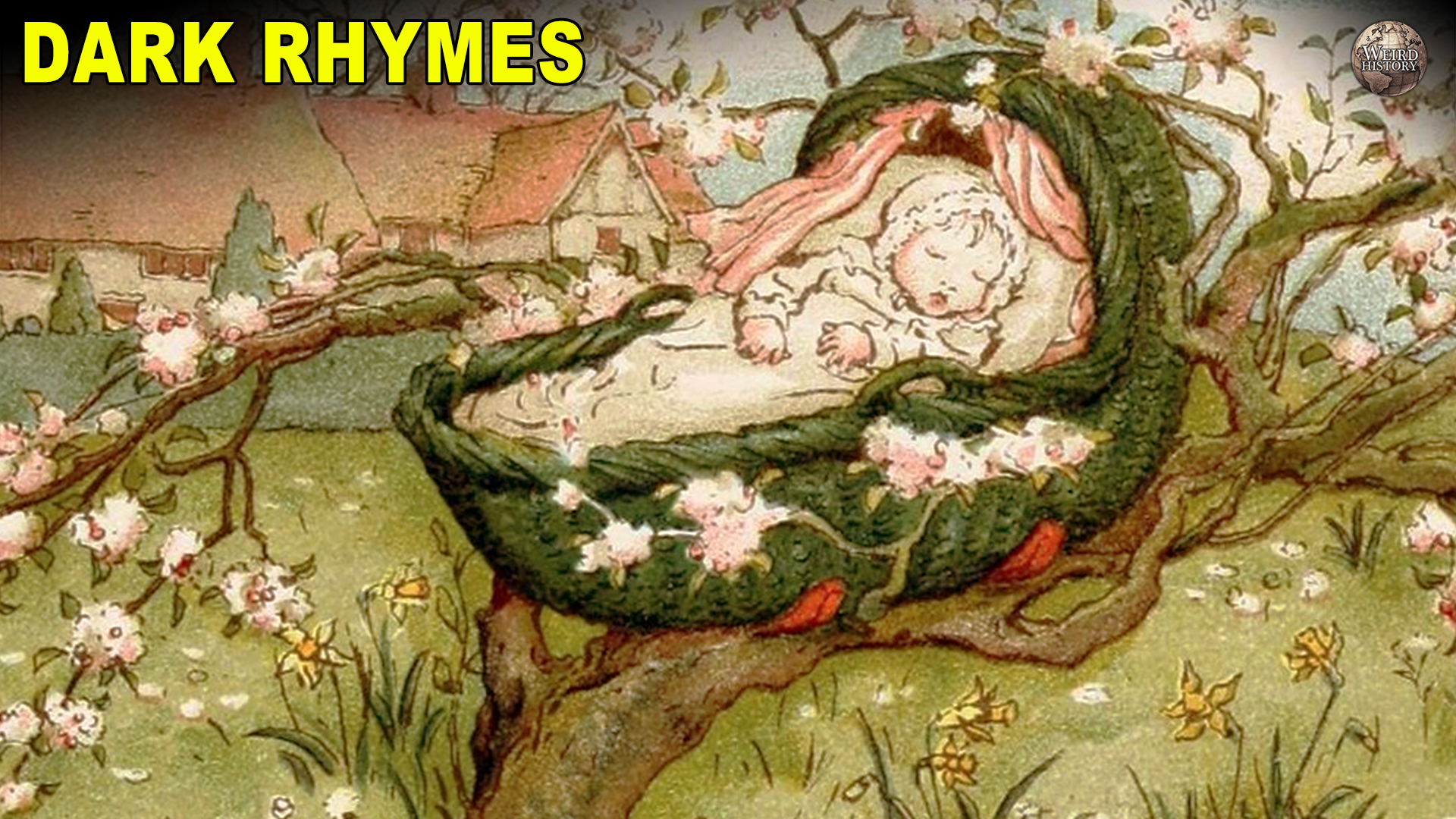
The most famous version imagines a baby in a cradle resting in the treetops
6:37
only to come crashing down to earth after a stiff breeze shakes one of the branches loose
6:42
However, the rhyme doesn't tell you what happened to the baby after falling out of the tree, or who put the cradle up there in the first place
6:48
So while it may be effective at putting kids to sleep, it is less effective as a true crime story
6:53
Not everything can be a podcast. The earliest known version of Rockabye Baby appears in the 1765 collection Mother Goose's Melody, likely published by John Newbery
7:03
It features a similar version of the rhyme to the one known today, but follows up with a little moral lesson
7:09
This may serve as a warning to the proud and ambitious who climb so high that they generally fall at last
7:15
Kind of seems like a strange lesson to attach to a rhyme about a literal cradling infant
7:21
But in fairness, we've never met the baby in question. And as anyone who has read a Grimm's fairy tale can tell you
7:27
old-timey literature has no problem scaring life lessons into children with stories exactly as dark as Rockabye Baby
7:34
So Newberry's lesson, while harsh, wasn't out of the ordinary. No actual origin for the rhyme has ever been identified
7:41
Various theories have suggested that the baby references the ancient Egyptian god Horus
7:46
that the lines were written by a colonist after witnessing a Native American mother rock her baby to sleep in a bark cradle
7:52
or that it's based on a true story about a woman in Derbyshire, England
7:56
who lived in and potentially raised children in a large yew tree
8:00
Yes, the housing market was rough then, too. Our favorite spookiest theory
8:05
Scholars Iona and Peter Opie say the very first line of the poem which establishes the whole baby sleeping in a tree premise might have resulted from the corruption of its original French text bas la la lou which translates to Hush there the wolf
8:21
So this whole time, we might have been rhyming about a were-baby. You may not recognize the title of the early 19th century poem
8:32
What Are Little Boys Made Of?, but you almost certainly recognize the words
8:36
At the very least, from the Powerpuff Girls opening sequence. The song reveals that the primary ingredients for making young men are snips, snails, and puppy dog tails
8:45
while girls are composed of sugar and spice and everything nice. The rhyme is typically attributed to English poet Robert Southey, though it's never been definitively proven
8:54
More troubling than its origins is its suggestion that some children are, in fact, edible
9:00
Just kidding. Obviously, we're not meant to take the poem literally. At least, we hope not
9:06
Thematically, it praises little girls as being sweet while condemning little boys as rascals
9:11
leaning into common stereotypes. It's a joke, in other words, but one that young children may not really understand
9:18
It may just be a way for parents to secretly dunk on their babies. The surprisingly violent children's tune
9:27
Who Killed Cock Robin? isn't particularly well-known in the US, possibly because American kids couldn't stop giggling
9:33
at one of its key words. Still, it appeared all the way back in Tommy Thumb's Pretty Songbook in 1744
9:40
ranking it amongst the oldest known nursery rhymes. The rhyme has a familiar, repetitive structure found in children's poems
9:48
A narrator continually asks questions about the death of Cock Robin, which other animals then answer
9:53
For example, Who killed Cock Robin? I, said the sparrow, with my bow and arrow
9:59
Or, Who will make the shroud? I, said the beetle, with my thread and needle
10:05
It was presumably a frustrating day for the forest's lead homicide detective
10:10
Some versions of the rhyme even end with the other animals executing the guilty party for
10:14
the heinous crime, proving it's never too early to teach about the lengthy appeals process
10:19
Though the earliest published version dates back to the mid-1700s, there are some indications
10:24
that the cock-robin rhyme goes back a lot further. The death of a robin via bow and arrow is depicted in a 15th century stained glass window
10:33
in a Gloucestershire rectory, which also features some other imagery suggesting it might relate to the rhyme
10:39
Plus, a 1508 poem by John Skelton titled Philip Sparrow features a narrator eulogizing his deceased bird friend
10:47
and features some similarities to cock robin. For example, rhyming owl with trowel
10:52
That can't be a common rhyme in too many poems, no matter how dark they get