Up next in 10



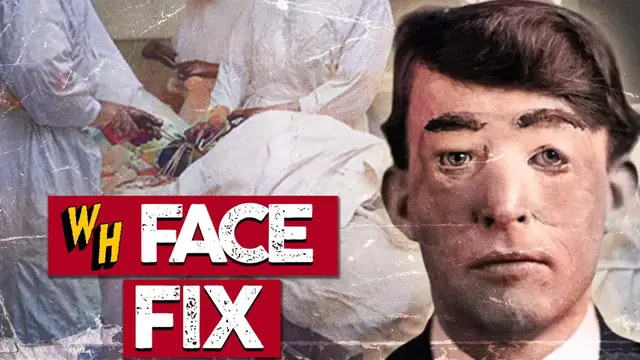
Walter Yeo was injured in battle and would have had to live out the rest of his life with a severely marred face if it hadn't been for one daring doctor by the name of Sir Harold Gillies. Together, the two of them would attempt a completely revolutionary surgery that would give Yeo back his life (and his face), and secure Gillies a place in the history books.
Show More Show Less View Video Transcript
0:00
Today, plastic surgery is about as simplistic as ordering a fast food meal
0:04
And probably safer, too. But that hasn't always been the deal. The first modern plastic surgery on record was performed during World War I
0:12
a fantastical and dangerous procedure that nearly killed the man under the knife
0:16
So, today we're revealing the untold story of the first plastic surgery in history
0:22
For now, we need 50 cc's of surgical history. Stat! Walter Ernest O'Neill Yeo was blessed with three surnames and born in 1890 in Plymouth
0:37
Devon. Within a year of Yeo's birth, his father's ship, the HMS Serpent, sank after crashing into
0:42
rocks at Punta Bay. Of the three people to survive the wreck, Petty Officer Francis Yeo
0:47
was not one of them. So growing up, it was just Walter, his sisters, and his mom tending to things
0:53
in their southwestern English home. To make ends meet as a single mother, Rondisera Yeo was employed
0:59
as an ale maker at the Royal William Yard. We hope she wasn't one of those microbrewers
1:03
who just drones on and on about homebrewed IPA. How she thinks she finally got the hops just right
1:09
Whether she was or not, growing up wasn't exactly rosy for the Yeo family
1:14
It was a tumultuous time during the turn of the century leading up to the First World War
1:18
But even at his young age, Walter Yeo had a powerful love for his country
1:21
and the high seas. At 12 years old, when most kids are collecting Pokemon cards
1:27
or in his generation's case, Poking a hoop with a stick, Walter joined the Royal Navy
1:32
He was eventually made a petty officer and held the post until World War I began
1:36
He was stationed on a Queen Elizabeth-class battleship called the HMS Warspite
1:41
which is a cool name for a ship that won many a battle, including the infamous Battle of Jutland, which would change the course of Yeo's life
1:53
While manning the guns during the Battle of Jutland, Yeo was wounded at his post
1:57
with the constant barrage of shells hammering the warspite that were bound to be casualties
2:02
and Yeo's face was one of them. The upper half of his face sustained terrible burn damage
2:07
completely losing his upper and lower eyelids, leaving him unable to blink
2:11
but granting him the soft skill of eye contact, which is crucial to any job interview
2:16
Look, we're trying to find a silver lining here. Since documentation was poor in the mid-1910s, it is not known which hospital admitted him first
2:24
However he was eventually brought to Plymouth Hospital to wait for better accommodations at the coveted Queen Mary Hospital The bad news that short wait ended up lasting 15 months But the good news is that Queen Mary results were worth the wait
2:44
When he finally arrived at Queen Mary's, Yeo's case was given special attention by a physician named Sir Harold Gillies
2:51
Gillies was a famous doctor who had invented a technique for grafting skin from undamaged parts of the body onto damaged parts
2:58
But Yeo's situation was unique, and not necessarily a walk in the park
3:02
For starters, Gillies noted that Yeo's severe disfigurement was causing waxy scar tissue to form on the forehead and nose
3:09
The good doctor decided this was going to be a long and arduous process
3:13
and opened up a special ward in the hospital designed specifically to treat severe facial wounds
3:18
Yeo was the first patient brought in, making history in the process. The method of helping Yeo get his face back was both incredibly ingenious and absolutely horrifying
3:27
Skin and soft tissue are moved from one place in the body and attached to a section where the skin and flesh needs to regrow
3:33
The resulting flap of skin is known as a tubed pedicle. Both ends of the skin need to be anchored to allow blood to circulate and flow
3:40
until one end is able to be severed and moved closer. Little by little, the replaced skin gets closer and closer
3:46
until the skin is healthy enough to live on its own. For the early 20th century, that process is downright magical
3:53
While this all sounds well and good on paper, it required Gillies to operate from a completely unique circumstance
3:59
essentially rebuilding a significant portion of Yeo's face in the process. There are many different kinds of masks, porcelain, wood, rubber, etc
4:13
In the case of Walter Yeo, and Leatherface specifically, masks can be made of human flesh
4:19
In order to make a new face, Gillies had to get pretty creative. Initially, good skin was taken from undamaged parts of Yeo's body and then attached via tubes of flesh to allow blood flow
4:30
This required tracing out the graft, t it down just perfectly, making slits for the eyelids, and then slapping the whole shebang on what used to be Yeo's face
4:39
It couldn't be simpler. This portion of the facial reconstruction was one of the most arduous
4:44
occurring over several weeks, with Yeo having to remain completely still through all of it
4:49
And this was before doctors' offices had TV showing Netflix to pass the time
4:53
Can't even imagine. When talking about Yeo's face mask, that's not to indicate this is the kind of mask
4:58
that slips comfortably on top of the old and busted flesh In order to consider the surgery a success Gileas needed the skin to become fused to Yo face This meant that some of that face skin needed to come off
5:11
Oof. The skin around the initial injury was scarred and waxy, in line with how most scar tissue works
5:17
This damaged skin needed to be removed to allow the new skin to grow properly
5:21
Yo was anesthetized, which back then may just have involved a well-placed chokehold
5:25
and the damaged skin was forcibly evicted. The process of growing new eyelids
5:29
cheeks, brows, and a nose had begun. Listen, we're not going to pretend that everything was
5:42
hunky-dory with major cosmetic surgery done roughly at the turn of the century
5:47
This delicate procedure, while innovative and potentially life-changing, did not all go as
5:51
planned. Five days after his first operation, Yeo developed a pretty serious infection which
5:57
required surgical intervention. While Yo was not badly harmed by the first infection, a second
6:02
infection after the mask had been put into place was far worse on poor Yo. Drastic surgical procedures
6:07
were employed to fix the issue and keep Yo alive, despite Yo's flesh and skin floating in pus
6:13
to put it into the colorful terms used by Gillies. To his credit though, Gillies and his team of
6:18
doctors were able to save Yo and the mask. Repairing a blown up human face isn't something you can just
6:24
rush through like a NASCAR pit crew, not even in modern medicine. Though Yeoh was originally
6:29
injured in May of 1916, the first surgery did not happen until November of the following year
6:34
that following January 1918. The tubes of skin and flesh which attached the mask to his face
6:40
were finally able to be removed, but the surgeries were far from over. Minor revisions such as skin
6:46
trims, tucks, and alterations had to be made for aesthetic purposes. The result was something that
6:50
could pretty much pass for normal, or as close to normal as could be. By July of 1919, Yeo was
6:56
fit for discharge three years after the injury and two after the surgeries began
7:08
Yeo's first-of-its-kind procedure, despite being an unbelievable success, did not mean he was
7:14
totally out of the woods forever. It turns out, when a new face is built, the recovery contains
7:18
all manner of issues. Records show that Yeoh underwent further operations related to his
7:23
reconstruction surgery in August of 1921, with notes reporting his condition was improved but
7:29
still severe He ended up in the hospital for four months before again being discharged Another visit to the Royal Navy Hospital in 1938 treated a corneal ulcer Yeo had been dealing with But after that discharge little else is known about
7:41
his health until his death. After surviving a traumatic event, few of us would be willing to
7:52
return to the scene of the crime to tempt fate again. But Yeo had a new face and a strong
7:57
commitment to his service. In 1919, after his surgery was declared successful, Walter Yeo was
8:03
approved for active service again. He promptly returned to the Navy, now with his rank of
8:07
warrant officer, one he would hold for the remainder of his service. Beyond that, not much
8:12
is known about the remainder of Yeo's time in the Royal Navy, but hopefully it didn't involve any
8:16
more face explosions. What would be the odds of that? While the first attempt at this procedure was not without its issues
8:28
overall it was revolutionary in the world of reconstructive surgery. The successful surgery kicked Gilly's new facial reconstruction ward into high gear
8:36
as he began using this technique to treat other injuries sustained in battle. Additionally, each new surgery advanced the medical field's knowledge around the grafting of flesh
8:44
Gilly's ward alone provided over 1,000 beds in 1917, all with the notion that they were not only finding a medical cure
8:51
but drastically improving the quality of life of these victims in the process. With over 11,000 operations on over 5,000 men
8:58
plastic surgery as we know it today relies heavily on these pioneer procedures
9:03
all starting with Walter Yeo. And what of Yeo, the man with the shiny new face
9:15
Well, you'll be pleased to know he carried on a full and fruitful life after his injury
9:19
He had married Ada Edwards in 1914, a few years before the infamous accident, and had two children
9:25
Lillian Evelyn Yeo was born in 1914 during Yeo's original face phase
9:30
and his second daughter, Doreen Y. Yeo, was born in 1919 after his surgeries had been completed and his new face was in place
9:37
Yeo lived in Plymouth all his life and never really left home, except when naval duty called
9:42
He died in 1960 at the ripe old age of 70. While we don't know very much about the man's life, his legacy in medicine will carry on
9:49
The surgery that shaped his face would go on to improve the lives of countless others
9:53
and pave the way for all modern cosmetic surgery. He was also the inspiration for some enemy characters in the video game Bioshock
10:00
which is only slightly less significant. Meanwhile, a search for members of Yeo's family
10:05
who can shed more light on his extraordinary life, continues to this day