Up next in 10



Creatures like the narwhal, okapi, and Komodo dragon are on the short list of mythical creatures proven real. Yet, while scientifically interesting, these examples aren't in the realm of more fanciful and legendary animals like unicorns, Bigfoot, or the more hilarious mythical creatures that cryptozoologists fawn over. Mythical creatures in real life often fail to live up to the expectations formed by old legends, fairy tales, or cartoons.
Show More Show Less View Video Transcript
0:00
Cyclopses, unicorns, and other mythological creatures
0:03
obviously never really existed. Um, probably. And while we can't ever be fully certain
0:08
about the origins of ancient beliefs and superstitions about these creatures, there are some pretty compelling theories
0:14
about why people may have believed in them. Today, we're taking a look at some surprisingly plausible
0:19
real-life explanations for mythical creatures. OK, this is another fine myth we've gotten ourselves into
0:25
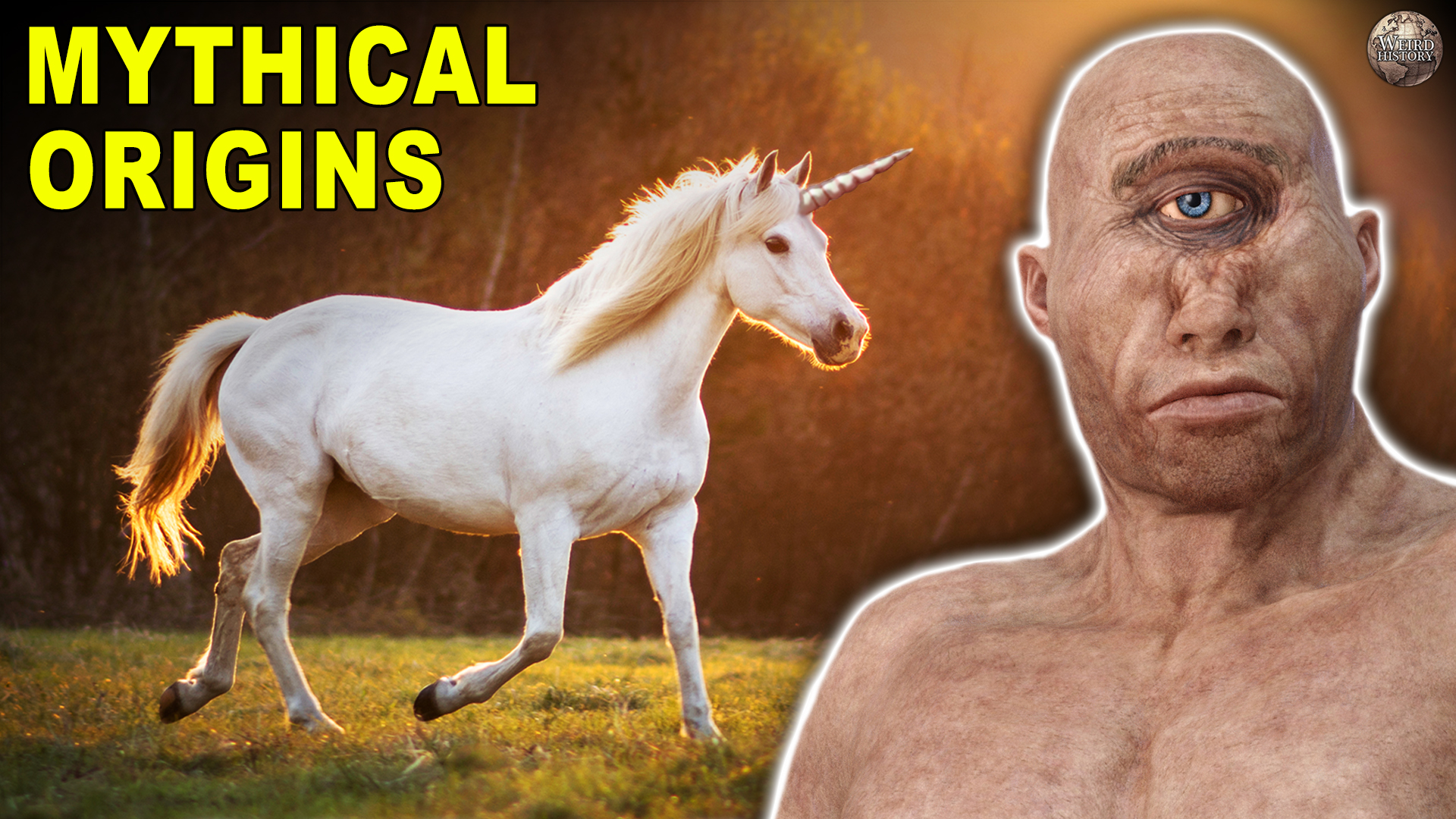
Theories abound for the origin of the massive one-eyed cyclops from ancient Greek and Roman
0:33
mythology. There's a real condition known as cyclopia that can affect human fetuses
0:38
causing one eye cavity to drift toward the center of the skull. But this almost always
0:42
results in miscarriages or stillbirths, rather than producing gigantic living people with just
0:46
one eye in the center of their heads. Most ancient people were likely unaware that this
0:50
condition even exists. Another real medical condition, known as acromegaly disorder, can cause a number of symptoms, including enlargement of the hands
0:58
feet, and face, and limited vision. This aligns in some ways with the description of the cyclops
1:03
in literature. It is possible that the creature's one eye was metaphorical
1:08
indicating a more generally limited ability to see. It's also possible that stories about the cyclops simply emerged
1:14
from accounts of people with just one eye, or even perhaps people wearing cleverly disguised eye patches
1:19
But perhaps the most compelling theory centers around elephant skulls, particularly those
1:24
left behind by the long extinct Cretan dwarf mammoth. These skulls would be much smaller than those from a modern-day elephant, and notably have
1:33
a large hole in the center. This was where the animal's trunk connected to the rest of its head
1:38
But on a glance, it kind of resembles a big eye socket. It's entirely possible that ancient people found skeletal remains of dwarf mammoths
1:45
assumed these were humanoid creatures with just one major honking eye in the center of their heads
1:51
and began to tell stories about the mighty Cyclops, the creature from the Odyssey, not the X-Man, probably
1:59
Tales of flying snakes were very common in ancient Egypt. The Greek historian Herodotus wrote down anecdotes from Arabian travelers
2:06
about small-winged serpents that apparently lived in Boswellia trees, making them much more dangerous to harvest for frankincense oil
2:15
Herodotus himself claimed to have visited an area in Arabia known as Butos, which contained
2:20
a massive number of animal skeletons, some of which looked like the remains of giant
2:25
flying snakes. Herodotus' narrative aligns with another ancient Egyptian story about a shipwrecked
2:31
sailor who washes ashore on a beautiful island and encounters an enormous serpent
2:35
The serpent speaks to the man because it's an ancient story and claims it was a member
2:39
of a once mighty race that was wiped out by a falling star. A popular theory on Reddit theorizes that these stories could have been inspired by a
2:47
real place known as Wadi al or the Whale Valley Here thousands of ancient whale skeletons dating back to the Eocene era remain visible Without more accurate knowledge of geological history
2:59
and the idea that dry land could have been underwater millions of years earlier, it's entirely possible
3:03
ancient people mistook these whale remains or other similar deposits for the skeletons of flying snakes
3:09
Those flippers do kind of look like wings. The Egyptians were one of many ancient cultures
3:16
that believed in the existence of giant sea snakes. Everyone loves a good sea monster
3:21
It's possible that living whales could have inspired some of these stories, because when you think about it
3:26
whales are basically sea monsters. When pods of humpbacks are swimming nearby, for example
3:31
humans only see their backs and their mouths emerging above the surface of the water
3:35
It wouldn't be difficult for a person to see multiple whales rising out of the water at once
3:39
and mistake them all collectively for one giant sea serpent. It's also possible that a very real animal
3:45
the oarfish, could have inspired legends about giant ocean snakes. According to National Geographic, oarfish can grow up to 30 feet long
3:53
which is too big for any animal with the word fish in its name. And because they live in the ocean depths and only approach the surface when compelled by powerful currents
4:02
they weren't well known and recognizable for most ancient societies. A person seeing an oarfish during a rare trip near the ocean's surface
4:09
or individuals spotting a dead oarfish that washed up on shore, may have become confused and come to believe that they had seen a giant sea serpent instead
4:20
In Norse mythology, a creature known as Jörg Mungandr, or the Midgard Serpent
4:26
was a massive worm or possibly snake-type creature that lived in a space ocean
4:31
encircling the Earth, which absolutely rocks. Because its body surrounded the entire planet, it was also sometimes referred to as the World Serpent
4:40
which also rocks. Normally, Jörg Mungandr remains in a perfect circle around the Earth, fighting its own tail
4:47
The Vikings believed that one day, the serpent would release his tail and plunge into the Earth
4:52
kick-starting the apocalyptic event known as Ragnarok, otherwise known as the best Thor movie
4:57
Some historians and scholars have suggested that the Midgard serpent myth could have been
5:01
inspired by an actual event. Around 7,000 years ago, a meteorite entered the Earth's atmosphere
5:06
above present-day Estonia before breaking apart and hitting the ground. The resulting
5:11
Kali meteorite crater field is still visible on the Estonian island of Sakroma to this day
5:17
This was one of human history's largest meteorite strikes near a populated area
5:21
and would have been sufficiently devastating. Wiping out a lot of wildlife and probably even
5:26
a few people is enough for the surrounding population to have spoken about it for generations
5:30
You don't forget the night an exploding rock fell from the sky. It's certainly possible that
5:33
they may have attached religious or supernatural significance to such a massive, inexplicable
5:38
and terrifying event. The reality of living in the dangerous world of the Bronze Age or even the Stone Age before that likely inspired a lot of mythological stories in all kinds of ways For example it long been suspected that myths and folktales about vampires originated
5:55
in real reports about people suffering from rabies. Our modern understanding of vampire myths was codified by author Bram Stoker in his wildly
6:03
influential 1897 novel, Dracula. But stories about vampires predate the book by several centuries
6:09
A rabies outbreak that ravaged Hungary in the 1700s may have been a significant source
6:14
for vampire lore. The disease would have impacted mostly men, and some of the symptoms can include hypersexuality
6:21
insomnia, an objection to certain strong odors, like garlic, as well as sensitivity
6:26
to mirrors and bright lights. Obviously, these all have clear counterparts in vampire stories, including Count Dracula
6:31
himself, a seductive, masculine figure who stays up all night stalking victims, hates
6:36
garlic, and can't see his own reflection. Many contemporary anthropologists and scholars believe that aboriginal stories from natives
6:46
of Australia and Oceania, known collectively as Dreamtime, were influenced by the real natural
6:51
world of the late Ice Age. Some Dreamtime narratives date back over 65,000 years
6:57
so it is likely that they do refer to long extinct creatures and plant life that early
7:02
humans actually encountered long ago. A mythological creature known as the bunyip
7:07
For example, supposedly had a long neck, round head, and large ox-like body, and lived near
7:12
swamps and other shallow bodies of water. We now know from the fossil record that a creature known as the diprotodon roughly fits
7:19
this description and would have lived in Australia's marshlands around 65,000 years ago
7:24
The creature would also have stood over 6 feet tall, making an encounter likely very memorable
7:28
for an early human. Your shorts don't stay dry after that kind of meeting
7:32
it's possible the Diprotodon may have inspired stories, anecdotes, and even folklore
7:40
Middle Eastern legends about a gigantic bird known as rock, capable of grabbing and carrying
7:45
away large mammals like elephants for food, may have been rooted in some form of reality
7:50
Though the rock has long been thought of as a purely fictional creation, mentioned in the narrative anthology 1001 Nights and the writings of Venetian traveler Marco Polo
7:59
the stories were likely based on a real animal, sometimes known as the elephant bird of Madagascar
8:04
This was a large, ostrich-like bird that stood around nine feet high
8:08
weighed about 1,000 pounds, and probably went extinct in the 16th or 17th century
8:13
I guess he flew too close to the sun. Admiral Etienne de Flacourt describes the creature in detail
8:18
in his Histoire de la Grande-Ire de Madagascar, written in the 1600s
8:23
Even Polo's anecdote about a creature mentions that it was originally seen in Madagascar
8:27
Madagascar, making this connection even more likely. The Maori people of New Zealand also
8:32
relate folk tales about a monstrous bird known as the puwakaya which is large and fierce enough to stalk and kill humans It possible these stories were inspired by another real animal known as host eagle This was the largest ever
8:45
eagle species on Earth, weighing in at around 30 pounds with a wingspan of around 10 feet
8:51
In other words, it was a big damn eagle. Though the eagles primarily fed on flightless birds
8:56
it's theoretically possible they could have also posed a threat to individual humans
9:01
particularly small children. Imagine being a babysitter and having to explain that to the parents
9:06
The Haas seagull would have lived around New Zealand's South Island around the year 1400
9:11
right around the time when the Maori first arrived and settled in the area. It's even possible that the Maori hunting of the moa bird
9:17
the eagle's primary food source, led to its extinction. Sometimes an animal doesn't even need to go extinct
9:27
in order for its mysterious remains to inspire folklore. For example, nearly every biological sample ever collected
9:34
that was supposedly taken from a Sasquatch or Yeti has come from a dead bear
9:38
In 2016, National Geographic shared a specific story about an American black bear named Petals
9:44
who had injured his front legs and learned to walk around upright on two limbs. A human sighting of another creature
9:49
that had made a similar adjustment could have easily inspired legends about Bigfoot
9:53
particularly if this creature also suffered from a genetic deformity, mange, or some other illness
9:58
that disguised its appearance. Such mistakes or substitutions were even more common in the ancient world
10:03
when zoological understanding and the ability to test and confirm conclusions about new species
10:07
was far less advanced, and there weren't any Bigfoot hunting shows on cable
10:15
Frequently in ancient literature, writers would get the specific descriptions of exotic animals
10:19
wrong. There was no photography, of course, so unless they had seen an animal with their own eyes
10:25
writers were relying on verbal or written descriptions, or sometimes crude drawings
10:29
Ancient Greek depictions of lions, for example, more closely resembled dogs than actual big cats
10:34
And the Greek word hippopotamus translates as river horse. Sure, it kind of looks like that
10:40
The point is, they didn't always get these things exactly right. Some anthropologists and historians believe that mythological tales of unicorns
10:47
actually resulted from people attempting to describe real animals, such as the rhinoceros
10:53
Hundreds of years ago, there were more living varieties of rhinoceros. Creatures with multiple horns were known as rhinoceros
11:00
whereas those with just one horn were sometimes called unicorns. To this day, the genus for some Asian rhinos remains unicornis
11:07
Recently uncovered fossil evidence points to the existence of an ancestor to the modern rhino known as a Serbian unicorn
11:14
These fur-covered giant rhinos lived in the grasslands of Eurasia around 39,000 years ago, meaning they shared the Earth with early humans
11:22
It's possible these shaggy rhinos specifically gave rise to stories about a mythological horn horse
11:28
inspiring countless Lisa Frank notebooks in the years to come