Up next in 10



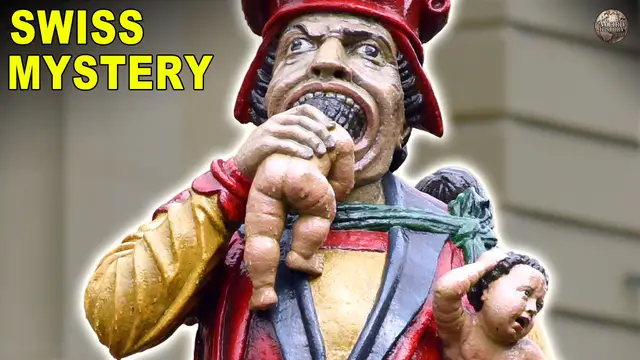
A strange child-eating statue stands in the center of the scenic Alpine city of Bern, Switzerland. Set between quaint sandstone buildings and the picturesque River Aare, the man in the statue stuffs a child into his gaping maw. He’s clearly ready to move on to more children once he’s finished his appetizer. Who is the mysterious child eater of Bern? He has been standing in Bern since the 1500s, creating a nearly 500-year-old mystery about the meaning of the statue. In Bern, they call him the Kindlifresser – literally “child eater.” He is also known as the ogre.
Show More Show Less View Video Transcript
0:00
In the center of Bern, Switzerland, set between quaint sandstone buildings and the picturesque River Ar
0:06
there stands a monstrous statue of a man. Who is this mysterious child-eater of Bern
0:12
Well, as it turns out, that's a good question. So, today we're going to take a look at the mysterious origins of the Kindleifrasse
0:21
a 16th century statue of a man eating children. Okay, time to gobble up some weird history
0:30
Bern, Switzerland, is a scenic city dotted with sandstone houses and a distinctly medieval air
0:38
It boasts the Rose Garden, Bear Park, and the Winding River R
0:43
It is both the capital of Switzerland's government and the gateway to the Swiss Alps
0:47
And while Paris may be the city of lights, Bern is the city of fountains
0:51
Today, the city has over 100 fountains. In the 1500s, Bern was reaching the peak of its power, expanding to add territories along Lake Geneva and adding much of the French part of Switzerland to the country's territories
1:04
Somewhere around 1550, Bern hired artists to create elaborate new fountains to replace some older wooden ones
1:11
One of those artists was Hans Ging, who decided to commemorate the occasion with a distinct piece of nightmare fuel
1:17
Originally called the Platzbrunnen, which means plaza fountain, around 1666, people started
1:24
referring to Ging's grotesque statue as the Kintleifressebrunnen, literally the fountain of the eater of small children. It kind of sounds like that's what it means too. The reason behind
1:35
the name change speaks for itself. Additionally, the statue is sometimes called the ogre for reasons
1:40
that also speak for themselves. Ging made at least three of the 11 fountains erected in Bern in the
1:45
1550s, as well as several public fountains for his hometown of Fribourg, a small Swiss town
1:51
southwest of Bern. Unfortunately, he left no records about his disturbing creation
1:56
and its meaning has now been completely lost to the ages. But the mystery only adds to the draw
2:01
of the Kindleiflesse, which has been luring curious visitors to Bern for centuries. And
2:07
while we may never know exactly what King was going for when he built the thing, there are a few credible theories
2:15
For a theory about the child eater's origins to be more upsetting than the statue itself
2:21
is saying something But this is the Kittlai Fresse we talking about One particularly disturbing theory suggests that the figure was intended to be a representation of Europe Jewish population
2:32
The biggest clue is the ogre's hat, which bears a resemblance to the hats Jews were required to
2:37
wear across medieval Europe by Catholic Church law. The Fourth Latrine Council of 1215 declared
2:42
that Jews had to be visually distinguishable from Christians. To quote them directly
2:46
We order that they, Jews and Saracens of both sexes, in all Christian lands and at all times
2:53
shall be publicly differentiated from the rest of the population by the quality of the garment
2:57
Why was it so important for Jews to be visibly distinguishable from Christians
3:01
So that Christians could avoid accidentally mingling with Jewish people and producing
3:05
offspring with mixed bloodlines. But it's not just the hat that suggests the ogre could be
3:10
anti-Semitic. Medieval Christians accused Jews of making their matzah out of Christian blood
3:15
and using blood in Passover rituals. These accusations were supported by heavily coerced confessions
3:21
including claims that Jewish groups were fattening up young children for consumption
3:25
A 15th century image of a Jewish woman even showed her eating the hand of her own child
3:30
The response to these conspiracy theories was often extreme. For example, the city of Wroclaw forcibly baptized Jewish children under the age of seven
3:39
So the idea that the child-eating ogre might be a representation of a particularly rampant anti-Semitism of the 16th century
3:46
isn't hard to believe. But that's not the only possible explanation. Christian parents of the era were apparently extremely concerned
3:58
and witches have always made great scapegoats. That's why witch hunts are called witch hunts
4:02
And Switzerland was a hotbed for witch hunts in the 1400s. As you might have guessed, one of the most common crimes
4:08
attributed to those alleged witches was the harming of children. In fact, the most popular book on witch hunting, Malalus Maleficarum, contained numerous references
4:18
If you're wondering how a book with a goofy Harry Potter title could have caused such an uproar
4:22
remember that a similar controversy surrounded the actual Harry Potter books when they were published in the 1990s
4:27
During the major witch trials, which occurred in the 1500s and 1600s
4:31
right around the time when the Kintylai Flessa was built, the majority of witches executed were women
4:36
However, only 70 to 80% of the people accused of witchcraft were women
4:40
In fact, in Pays du Vaux, just a few miles away from Bern, 42% of people accused of witchcraft between 1539 and 1670 were men
4:48
It very possible then that the statue is meant to be a male witch erected as a warning about the threat of covens and their voracious child diets Speaking of warning children some believe that the Kintlaifrasa is meant to be the likeness
5:01
of Krampus, a beast-like creature from folklore who punishes misbehaving children at Christmas time
5:07
kind of like the anti-Santa Claus. Anti-Claus, if you will. This theory suggests the statue is
5:12
meant to help parents keep their kids in line. After all, a decent amount of fairy tales and folklore
5:17
is designed to coerce children into behaving. And what child wouldn't tremble after hearing, finish your broccoli, or Kintleiflase will find you
5:25
That statue would make any kid into a broccoli connoisseur. The children of Bern must have been the best behaved in the world
5:31
Another similar theory claims that the Kintleiflase isn't a reference to Krampus, or any particular person or people
5:37
but rather is simply intended to be a generic ogre meant to frighten spoiled children
5:41
While it is certainly possible that the Kintylaifrasa is a monument to getting kids to finish their vegetables
5:52
some believe the statue is meant to symbolize the Greek god Kronos
5:56
According to mythology, Kronos and his wife Rhea were the first Olympians
6:00
Kronos did not want to lose his position as top god, so he ate each of their children as they were born
6:06
Not exactly father of the year material, although probably saved a bundle on the hospital bill
6:10
Kronos' youngest son, Zeus, only escaped because Rhea wised up to Kronos' child gobbling and hid the baby, feeding her husband a swaddled rock instead
6:20
I mean, how many kids does it take before you realize that's where they are? He's eating them
6:25
Zeus then led a revolt against Kronos, overthrowing him to take his spot as king of the gods, which means old Kronos was correct to be fearful of his children
6:33
It's the kind of self-fulfilling prophecy you make statues about. So could the statue be Cronus
6:38
It's possible. But there's at least one major problem with this theory
6:42
Cronus only had six children, while the child eater has eight to consume
6:46
Eh, maybe the hospital was supersizing that day. A folk theory claims that the Kintleifrasse is a representation of the older brother of
6:58
Byrne's famous founder, Duke Berchtold. Berchtold founded Byrne in 1191. And as the legend goes, he named the city after the first animal he saw in the woods where the city eventually grew, which was a bear
7:10
Berthold's family, the Zerringer, ruled over much of what is modern-day Switzerland
7:15
And Bern became a key military outpost that strengthened the family hold on their territory Berthold older brother grew so jealous of being overshadowed by his younger sibling overshadowing him that he went insane and stormed through the town
7:28
gobbling up all the loose children he could find. So according to this theory, the Kintleifleser
7:33
represents Berthold's slighted brother. It certainly could be true, but there's not much evidence to support it
7:40
For instance, there's no mention of this brother in any of Berne's history books
7:44
And that's probably a fact that would be in a history book. Speaking of bears, Bern has been associated with the animal for over 800 years
7:52
The bear has been on the city's seal and coat of arms since at least the 1220s. The Berrenplatz
7:57
literally Bear Plaza, was reportedly once a bear pit in the 1400s and 1500s. And the statue has an
8:04
interesting base. Bears dressed in armor, preparing for war. Did I say interesting? I meant totally
8:09
bodacious. So could the statue be a warning to Bern's children to avoid the town bear pit
8:14
just in case they may fall in and be devoured? It's possible, although if that were the case
8:19
why wouldn't the child eater be a bear instead of some deranged weirdo
8:23
Others have suggested the statue could be a warning to Byrne's enemies that Byrne would crush any foes like the statue crushing children in his teeth
8:30
That seems like an even bigger stretch. You'd be forgiven for assuming that the Kintlaifresa
8:40
is the strangest statue made in the 1500s, But the Fountain of the Virtues in Nuremberg, Germany
8:45
gives old baby swallower a run for its money. The fountain, built in 1589, depicts the six virtues
8:52
courage, justice, humanity, temperance, wisdom, and transcendence, as classically garbed women surrounded by cherubs
9:01
But look more closely, and you'll notice that the virtuous women are shooting water
9:05
through their nipples. Why? I don't know. The point is, art is frequently strange and indecipherable
9:11
Something that may have been an obvious piece of commentary in the 16th century
9:14
loses most of its context over the course of 500 years. In fact, the Kintlaifrasa may not even be the strangest statue in Bern
9:22
Bern is lousy with statues, and some of them are just as bizarre as a man in a jaunty hat
9:27
desperately eating his way through the town's Little League team. For example, this 18th century statue of an enormous pink ape holding a golden axe
9:34
It was installed in the 1700s to represent the city's stonemasons and bricklayers
9:39
There is no record of what burned stonemasons and bricklayers thought about being compared
9:43
to an ape or why the comparison was made to begin with. But we assume they were relieved their statue wasn't a child-eating ogre