Up next in 10



Modern people often think of the Middle Ages as an unsophisticated period, when science and technology were almost unheard of. This is especially true of medieval weapons and warfare. Depictions of medieval warfare often portray it as chaotic and brutal, with two armies bashing away at each other with swords and shields. In reality, medieval warfare could be nearly as complex as it is today.
Show More Show Less View Video Transcript
0:00
Depictions of medieval warfare often portray it as chaotic and brutal
0:04
with two armies bashing away at each other with swords and shields
0:08
In reality, medieval societies were capable of producing massive weapons that could devastate the battlefield
0:15
So today, we're going to take a look at medieval superweapons that sound made up, but aren't
0:24
Fire and wooden ships are a dangerous combination, and nobody knew this better than the Byzantines
0:31
They were the originators of Greek fire, a mysterious flammable liquid that was used both in naval and land-based engagements
0:39
Greek fire could be sprayed through a hose or launched in a projectile form
0:43
and it was very difficult to put out. A Greek Christian named Kalinikos is credited with inventing Greek fire between 668 and 678 CE
0:52
The mixture most likely included petroleum or naphtha, as well as quicklime, sulfur, resin
0:58
and potassium nitrate. But the Byzantines kept its exact recipe a secret from the rest of the
1:03
world. And for good reason. Greek fire allowed the Byzantines to carve out a massive empire in
1:08
the eastern Mediterranean that would last for nearly 800 more years. Greek fire remained a
1:14
potent weapon into the Middle Ages, but it disappeared from the historical record after
1:18
the sack of Constantinople by the Crusaders in 1204 CE. Whether it was used after that is unknown
1:24
but today its recipe has been lost to time. In 1452, the crumbling Byzantine Empire, led by Emperor Constantine XI, was facing a new threat
1:38
the emerging Ottoman Empire and its 21-year-old Sultan Mehmed II. That year, a Hungarian mercenary
1:46
siege engineer named Orban approached Konstantin with an offer to cast an enormous bronze cannon
1:53
or bombard, for defense against the Ottomans. But when Konstantin couldn't pay Orban's high fee
1:59
Orban took his design to Mehmed. Arms dealers, you gotta love them. Anyway, the gun Orban built
2:05
for Mehmed was called a horrifying and extraordinary monster. Orban's bombard measured
2:11
27 feet in length. The barrel was fortified with 8 inches of bronze to absorb the blast
2:17
and the diameter was 30 inches. It fired a cannonball weighing up to 1,500 pounds
2:22
and required 200 men and 60 oxen to transport. When first tested, the cannon fired a projectile
2:28
over one mile, burying it 6 feet into the earth when it landed. When Mehmed brought the bombard
2:34
to the siege of Constantinople in 1453, the massive gun was the centerpiece of an array
2:40
of artillery that included over 60 more cannons and numerous trebuchets The artillery devastated Constantinople walls and allowed Mehmed troops to sack the city
2:50
which had been thought to be the best defended in medieval Europe. We're guessing Constantine regretted not coming up with money for that purchase
3:01
An armored medieval knight could be a devastating force on the battlefield
3:05
and their image as formidable warriors has lived on in the popular imagination
3:10
In reality, however, a peasant with a longbow could give them plenty of trouble
3:15
A Welsh longbow was around six feet long, made from yew wood, and required almost double
3:20
the draw strength of a modern hunting bow to fire. That was powerful enough to punch through some types of armor
3:26
In fact, after one encounter with a Welsh longbowman around 1300, an English knight claimed he
3:32
took an arrow that passed through his thigh, which was covered in chainmail, and then penetrated
3:37
his saddle and took out his horse. Most likely, the Normans adopted the longbow from the Welsh after conquering England in 1066
3:45
If you've seen Braveheart, you know that King Edward I used them somewhat effectively against
3:49
William Wallace at the Battle of Falkirk in 1298 CE. And if you know your Shakespeare
3:55
you probably remember that Henry V's longbowmen overwhelmed the heavily armored French at the
4:00
Battle of Agincourt in 1415 CE. Since longbows were so effective and relatively inexpensive to
4:06
produce, they also became the backbone of England's defense of its homeland. The catch was that they
4:11
required a great deal of training and skill to be used effectively. Laws dating back at least as
4:16
early as the 13th century required that every Englishman earning more than two pounds a year
4:21
must own a longbow, and males up to age 60 were expected to know how to use them
4:26
High-tech weapons are cool, but sometimes it's best just to keep things simple
4:36
And the Dutch Hellburner was devastatingly simple. It was basically just a ship packed with as much gunpowder as possible
4:43
designed to drift into an enemy formation and explode from a slow-burning fuse
4:47
Few Hellburners were ever built, but each contained around 7,000 pounds of gunpowder
4:53
Italian military engineer Federico Gembelli came up with the idea at the beginning of the
4:58
80 Years' War between Spain and the Netherlands, which began in 1568
5:02
Like the cannon builder Orban had done a century earlier, Gembelli tried to sell his idea to
5:08
both sides of the conflict before the Dutch hired him. If you don't love the arms dealers, you have to admire them
5:14
Gembelli and the Dutch used his hellburners to break the Spanish siege of Antwerp in 1585
5:20
Hidden among 32 flaming decoy ships, two hell burners drifted into the Spanish Armada as it was docked on the River Skelt Only one detonated but it was more than enough The explosion claimed over 1 Spanish lives and could be heard for up to 50 miles
5:37
Given their effectiveness, you'd think hellburners would quickly be all the rage, but they
5:42
were incredibly expensive to build and were rarely used afterward. In the medieval period, rulers built castles
5:52
with fortified walls as a way to control their territories. and they were designed to withstand sieges that could last months or even years
5:59
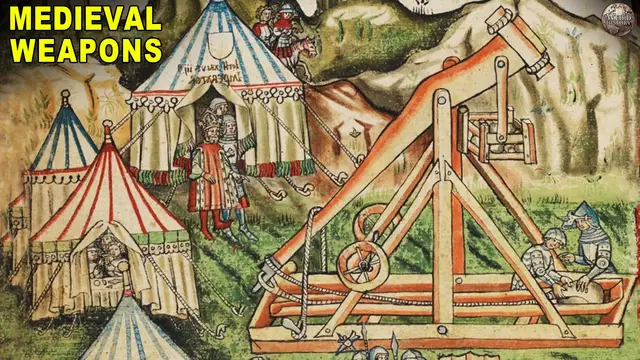
To counter castle walls, medieval armies began to use trebuchets. Today, they're often mislabeled as catapults
6:06
But trebuchets are actually a specific kind of catapult that can launch a much heavier projectile
6:11
Although their use in castle warfare has made them commonly associated with the Middle Ages
6:16
they are actually much older. Projectile launchers like trebuchets date back over two millennia
6:21
The Chinese military used them as early as the 4th century BCE
6:25
Arabic and Byzantine armies were using them by the 6th century CE. Crusading armies were the first Europeans to encounter them in person
6:33
And apparently, they were so impressed, they brought the technology back to Europe in the 11th century
6:38
These weapons were sometimes given nicknames like Bad Neighbor, Bad Relation, and God's Stone Thrower
6:44
A trebuchet uses a throwing arm with a counterweight to launch large objects over long distances
6:50
Earlier European trebuchets relied on humans to launch their projectiles. But the counterpoised trebuchet eliminated the need for human pulling power
6:59
Though precise measurements are tough to pin down, medieval trebuchets could apparently
7:03
throw projectiles weighing over 300 pounds, a distance of more than 650 feet
7:08
These weapons could be used to fling heavy stones, flaming barrels, the decapitated heads
7:14
of enemies, and yes, even cows. And you thought Monty Python was just kidding about that
7:19
counterpoised trebuchets with the dominant siege artillery until the advent of the cannon in the 15th century
7:29
When facing a numerically superior enemy, some medieval-era militaries used clever technology to even the odds
7:36
That was the origin of the Korean Kabuk-san, or turtle ship. The turtle ship, which was based on an earlier design, is credited to Korean Admiral Yi Sun-shin
7:47
who created them for use against the Japanese in the Seven Years' War, which was fought from 1592
7:52
to 1598 CE. A turtle ship was essentially a variation of the standard Pankosan warship
7:57
adding an outer shell for extra protection. Its most prominent feature was a large carved
8:02
dragon head on the bow. These were large enough to accommodate a cannon, but they were especially
8:07
effective as a form of psychological warfare Some turtle ship crews would burn poisonous substances in the dragon mouths to emit toxic fumes on enemies The other major distinguishing feature may have been the use of metal plating on the hull Modern scholars disagree on whether metal armor was really used but allegedly it served
8:26
to protect the ship from enemy fire and boarding parties, as grappling hooks couldn't penetrate
8:31
metal surfaces. Some turtle ship armors also included metal spikes. Turtle ships were the
8:37
Korean antidote to the Japanese Navy's ship-to-ship combat. Korean commanders would row their turtle ships into the middle of Japanese formations and disrupt them. Then their cannons
8:46
would open fire from close range. Admiral Yi Sun-Shin turned back the Japanese Navy
8:51
and today is considered a national hero. The first metal tanks were used in warfare
9:00
by Great Britain during World War I's Battle of Flairs-Corsolet in 1916. But the idea of using
9:06
an armored vehicle as a mobile attacking position on a battlefield goes all the way back to the
9:11
medieval war wagon. Medieval Europeans didn't invent the war wagon either. A Chinese version
9:16
called the Uganchua was in use during the 5th century BC. But the first Europeans to use them
9:22
to great effect were the Hussites, a bohemian religious minority advocating the unorthodox
9:28
teachings of Yan Hus. The Hussites fought a series of wars against the Catholic Church
9:32
beginning in 1419. Hussite war wagons were made of hardened wood. On the battlefield
9:38
they would be positioned in circular formations to create a kind of adjustable temporary fortress
9:43
Inside the wagons, archers could fire arrows through holes in the walls, and soldiers with
9:48
flails would defend against enemy soldiers. Once the enemy was in disarray, more soldiers and
9:53
cavalry would stream out of the wagons and overwhelm them. The Hussites used their war
9:58
wagons to defeat several larger and better equipped armies. Although they would ultimately
10:02
lose the Hussite Wars, they still demonstrated the effectiveness of the war wagon
10:10
The word firearm is often associated with guns. But technically, a firearm is any weapon that
10:18
uses gunpowder to launch a projectile. Guns began to decide European battles in the 16th century
10:24
but the Chinese were using firearms in battle centuries earlier. The Chinese fire lance was
10:29
essentially a spear with a firework attached to one end. Once lit, the firework would explode and
10:35
launch either a projectile or poison at the enemy. They weren't accurate, and they only had a range
10:40
of a few feet, but at close range, they were extremely dangerous. Chinese alchemists first
10:45
discovered gunpowder during the Song Dynasty of 960 to 1279 CE and quickly began using it to make
10:52
explosive weapons. The fire lance was in use by 1150 CE. They were most effective when used in
10:58
defense, especially when defending city walls from besiegers