Up next in 10



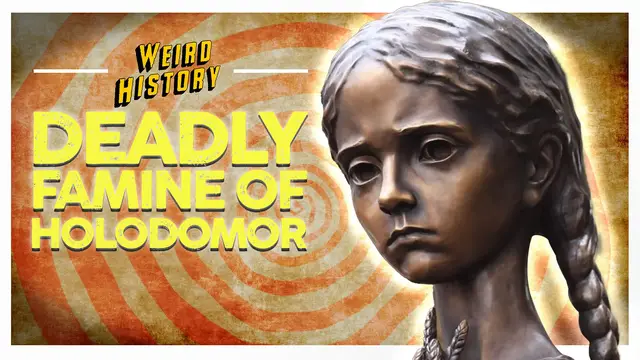
The Holodomor was a Soviet state-induced famine in Ukraine between 1932 and 1933. For nearly two years, Joseph Stalin starved Ukraine in the name of feeding the Soviet Union. Literal tons of food went to waste, and millions of Ukrainians died as a result. The Holodomor, or "death by hunger," was a little-known genocide that struck right before the Holocaust.
Show More Show Less View Video Transcript
0:00
Between 1932 and 1933, Joseph Stalin and the Soviet Union created a state-induced famine
0:06
in Ukraine. It became known as the Holodomor, which translates to death by hunger in Ukrainian
0:13
During that time, tons of food and lives went to waste as millions of people slowly succumbed
0:19
to starvation. If this doesn't sound familiar to you, well, that's by design
0:23
The engineers of the tragedy did their best to erase it from history, and total denial
0:28
of the event still persists, even in modern times. So today, we're uncovering the truth
0:34
about Holodomor, the man-made famine that claimed millions of lives, prepared to get mad at Stalin
0:41
Well, more mad, anyway. We don't need to convince you that Russia and Ukraine have a complex and
0:52
harsh history together. Ukraine is located right at the crossroads of Central Asia, Russia, Europe
0:58
and the Black Sea. While the people in these surrounding areas share various traits, culture
1:02
and history, they also share a never-ending battle to maintain their own nationality
1:06
Ukraine specifically has always hoped to enjoy autonomy from Russia. Meanwhile, Russia has always
1:12
hoped that Ukraine would stop trying to break away and come over to the Russian side of things
1:16
instead. Russia has a historic tendency to not play well with others and will invade and annex
1:22
any area they believe to be rightfully theirs, forcibly taking control of the Crimean Peninsula
1:26
from Ukraine in 2014, though most countries still recognize it as Ukrainian territory
1:32
Still, the annexation of Crimea started a long period of warfare between Russia and Ukraine
1:37
one that, as of early 2024, is still underway. The holodomor technically began in 1928, when Soviet Union leader Joseph Stalin introduced
1:51
the policy of agricultural collectivization. It started out as a consolidation of all Western privately-owned
1:57
Ukrainian farmland and livestock by order of the Soviets. Stalin's goal was to feed the industrial workers in the city
2:04
and sell the grain abroad to finance industrialization. But once agricultural collectivism was written up
2:10
in a 1933 issue of Pravda the official Soviet Union newspaper this policy seemed to turn into destroy Ukraine nationalism at all costs Pavel Postyshov one of the architects of the Holodomor
2:22
more or less confirmed this secret motive when he gloated about destroying nationalist deviationism
2:29
That's the thing with history's evildoers. They have a tendency to say the quiet part out loud
2:33
At some point during the early 1930s, Stalin decided the Soviets should get all the food
2:38
there was to be had and began taking what he wanted from Ukrainian farmers
2:43
Kind of like the Hamburglar, if he had a mustache and was the head of a Soviet war machine
2:48
If you were a successful farmer who resisted Stalin's collectivization policies, you might be called a kulak
2:54
which in Russian translates to something like tight-fisted. Apparently, you're a real scrooge
2:58
if you don't hand over all your food to the Kremlin. But in the eyes of the kulaks themselves
3:03
Stalin's unreasonable demands were nothing more than a return to serfdom. Because it seems that's more or less exactly what it was
3:10
But Stalin wasn't the type of guy who took criticism with humility and grace
3:14
Because of their objections and pushback, Soviet authorities branded the kulaks enemies of the
3:18
working class and began a coordinated campaign to destroy them. The idea was to carry out an
3:24
offensive against these steadfast farmers, break their resistance, eliminate them, and replace
3:28
them with communist government-owned farms, which were called kolhoses and sevkoses. Before long
3:35
Stalin had implemented his dekulakization policy, where Soviet authorities were free to take land
3:41
and food from these farmers. The lucky ones were shipped off to Siberia. The rest were left to
3:46
starve, striving to find refuge in other countries. That was made all the harder by the Soviet Union
3:51
blocking off their borders, not letting anyone in or out. In other words, the USSR created a
3:57
famine trap and then locked everyone inside. When the government comes in and takes all the food, then leaves people trapped with little recourse, things quickly become desperate
4:12
So people were forced to get creative with their meals during the holiday moor. Snacks known as weed loafs were not uncommon to see, but they were not as fun as they might sound
4:22
Composed of nettle leaves and other weeds the loaf was meant to sustain people as best it could which unfortunately was not very much To supplement people would boil horse hides eat manure or even their own excrement out of desperation And when that menu of horrors failed to suffice starving peasants would usually
4:41
turn on each other. That's right, many people resorted to the most extreme measures just to
4:47
stay alive. When you're starving, your brain isn't necessarily thinking of much more than
4:51
find food now. And it was not unheard of for parents to forsake their children and eat them
4:57
only to die of starvation themselves later. And while eating another person was still punishable by law
5:03
with over 2,000 people being arrested and charged during the Halle de Moor
5:07
the situation was so dire that black market human meat still became a commodity during the atrocity
5:18
The Halle de Moor was not a small-scale tragedy, despite its relatively unknown status and a greater zeitgeist
5:25
However, historians are divided on just how many people perished during this time
5:30
Some historians estimate around 3.3 million people died at the hands of the man-made famine
5:35
Others, such as the Director General of the National Museum Memorial of Victims of the
5:39
Holodomor, claim that the toll is probably closer to 7 million within the Ukraine border
5:44
and 3 million outside the border. If you want a real grim perspective, past figures have estimated the total death toll
5:50
somewhere in the neighborhood of 20.6 million people. Regardless of how you paint it, the resulting image isn't pretty
6:03
If you thought the Soviet Union and Joseph Stalin were the only villains in this story
6:08
we're glad you're still watching. Because the tragedy of the Halle de Moor continued well beyond the famine
6:13
After the Halle de Moor ended in 1933, the Soviet government knew they had messed up big time
6:18
and tried to suppress evidence of the famine and the state's involvement in creating it
6:22
This is a standard strategy of history's supervillains. Stalin banned the publication of the census data, which would prove the atrocity happened
6:30
And the Kremlin has never even acknowledged that such a genocide took place, calling it
6:35
a nationalistic interpretation. Another key strategy is that when caught red-handed, you simply deny you've been caught red-handed
6:42
Even former Ukrainian President Viktor Yanukovych claimed it was incorrect to refer to Holodomor
6:47
as genocide claiming Stalin policies contributed to the famine but the result was not deliberately engineered The policy in question was taking away all the food so it seems like Victor may
6:58
not have been splitting those hairs in good faith. And then we must head back to the United States
7:03
to meet Walter Durante, the New York Times Moscow correspondent during the Holodomor
7:08
who coined the term Stalinism. Although he worked for the New York Times, he was actually a puppet
7:14
for the communist dictator. When asked about the Halledomor, he brushed it off, calling it mostly bunk
7:19
and reminded everyone that omelets cannot be made without breaking eggs, which is a phrase almost exclusively used by villains
7:26
Durante was pressured into downplaying the famine and praised by Stalin for doing so
7:31
In 1934, he was given the Pulitzer Prize for his false reporting on the Halledomor
7:36
tarnishing both his legacy and the award. As of 2024, 34 nations recognize and classify the Holodomor as a genocide alongside the European
7:53
Union. Australia and Estonia were the first nations to contemporarily recognize the Holodomor
7:58
in this way, passing resolutions in 1993. Ten years later, Canada and Hungary joined the fray
8:05
followed by Vatican City in 2004 and Lithuania in 2005. Ukraine itself didn't even officially
8:11
recognized the famine as genocide until 2006, and the United States recognized the Holodomor in 2018
8:18
Better late than never. Meanwhile, in Ukraine, the fourth Saturday of November has been designated
8:23
a Holodomor Remembrance Day since 1998. While you probably won't find the holiday on any calendars
8:30
the day is used to reflect on the atrocities and to remember the victims of the genocide
8:34
Flags are flown at half-staff, and television stations limit the amount of entertaining
8:38
programming they show. Outside of Ukraine, Holodomor Remembrance Day can be observed all
8:44
over the world. In Canada, they even had an entire Holodomor Remembrance Week in 2008
8:49
And in 2009, U.S. President Barack Obama released a statement on the Holodomor Remembrance Day saying
8:55
that remembering the victims of the man-made catastrophe of Holodomor provides us an
8:59
opportunity to reflect upon the plight of all those who have suffered the consequences of
9:03
extremism and tyranny around the world. We hope that the remembrance of Holodomor will help
9:08
prevent such a tragedy in the future