Up next in 10



Many similarities exist among historical death traditions, but there is no single way to grieve, express loss, or celebrate a person's life. Whether it's how a group prepares a corpse, shows continued deference and care for a deceased loved one, or honors the legacy of a fallen hero, death rituals reveal a lot about living. As a result, the end of life has been met with cultural practices and religious rites through the ages.
Show More Show Less View Video Transcript
0:00
Like that pile of laundry in the corner of the room
0:03
death is something we're all going to have to face eventually. As a result, the end of life has been met throughout the ages
0:09
with elaborate cultural practices and religious rites, all of which reveal a lot about living
0:15
So today, we're unveiling some fascinating death rituals from throughout history. We've been dying to do this one
0:24
In anticipation of the mummification process, Elite members of the Ivadoi people of the Philippines imbibed large amounts of salt water before death
0:33
likely to empty their bowels and dehydrate them. Speaking of vowel emptying, Ivadoi mummies show signs of evisceration
0:41
which does not sound like the most relaxing final journey one could take
0:45
After the person's demise, their body was often set in a seated position to help with drainage
0:50
and may have even been placed over a fire to dry out. At some point, tobacco smoke was blown into the corpse's mouths
0:57
And then they were set in the sun to dry. The whole process could take up to one year
1:02
It's sort of like canning your own vegetables. It takes a lot of work and a whole lot of patience
1:07
But nothing beats that homemade feeling, whether tomatoes or bowel-evacuated mummies. Yummy
1:15
Every few years, the Tarayan people of Indonesia ritually exhume and cleanse the bodies of deceased loved ones
1:22
According to legend, the practice began with Pong Ramesek, a mythical hunter, found a body in the mountains and buried it in his own clothes
1:30
the least he could do. He was blessed with good fortune afterward, and as a result
1:34
the practice continues in the same spirit. Exhumed bodies are cleaned, left in the sun
1:39
and dressed again, while the remains of loved ones who have not been buried are preserved in
1:44
anticipation of the cleansing. Either way, the body will be part of the next matnene ritual
1:50
Because the Buddhist tradition holds that a body is nothing more than a vessel
1:54
there's no need to preserve human remains. You might as well just drag the carcasses into the mountains
1:59
and let the birds pick away at them. And that's exactly what they do
2:03
As part of the preparation for the non-burial, the body is cleansed and broken down into parts
2:09
Bones and flesh are separated. The former are crushed and the latter is diced
2:13
like you're making carrots for a fussy baby. These pieces are then transported to the mountaintop
2:17
during the early morning hours. Westerners call it sky burial, but Buddhists call it giving alms to the birds
2:24
It's not clear when sky burials originated, but they may be more than 10,000 years old
2:29
Hmm, maybe funeral homes will start offering it as a budget-friendly option
2:36
The mummification of an ancient Egyptian started with the removal of the person internal organs Priests trained as embalmers extracted the brain via the nostrils while they cut the abdominal cavity open at the side
2:49
The body was then emptied of pretty much everything but the heart. It was sort of like playing Operation, if the goal of the game were slightly different
2:56
The heart remained in place because Egyptians believed it was the locus of intelligence
3:01
and of a person's actual being. The stomach, lungs, liver, and intestines weren't the locus of anything
3:07
Those underachievers. So they were thrown in some jars and buried separately
3:12
Mirhat was the goddess of truth, justice, and order. And it was believed the gods Anubis and Thoth would weigh a person's heart against Mirhat's
3:20
feather to determine the quality of a person's life deeds in order for them to proceed to
3:24
the afterlife. It all gives an entirely new meaning to the idea of watching your weight
3:31
Smoke them if you got them. especially if you're one of the Anga of Papua New Guinea
3:36
who smoke the bodies of their dead. Although it's been technically illegal since 1975
3:41
the Anga prepare the bodies of the dead by scraping the corpse with rough plant matter
3:45
then placing it in a hut for at least 30 days. A smoky fire burns in the hut
3:50
while bamboo tubes drain the body of its fluid. It presumably smells awesome in there
3:55
The hot temperatures in the hut help dry out the body, and the formaldehyde in the smoke preserves soft tissue
4:01
According to the tradition, the entire process is necessary so the spirits of the dead don't
4:06
wander the landscape and disrupt hunting or agriculture. Boy, borrowing a smoke must be a whole thing
4:15
In Madagascar, the practice of famadean, or the turning of the dead, varies slightly by region
4:21
But generally speaking, it means retrieving a corpse from its tomb, redressing it, and
4:26
then reburying it. What's the point? Well, a key part of the ritual is rewriting the name of the loved one on the clothes and linens
4:33
they're reburied in, which ensures an individual is not forgotten. And it is admittedly hard to
4:38
forget someone after digging them up and undressing them. Famidean is also a time of celebration
4:43
when the links between the living and their ancestors are marked by dancing, which means when Oingo Boingo recorded Dead Man's Party, they were performing an anthropological
4:52
study? Native to the Amazonian rainforests, the Yanomami believe that after a person passes
5:00
their soul must enter another body in order to protect it until it transitions to the spirit
5:05
world. To facilitate this, the Yanomami carry out a ritual that turns human remains into food
5:11
eaten by the living. In other words, Charlton Heston would have hated this ritual. Called
5:16
endocannibalism the ceremony begins when the corpse is burned The ash and bones are then transferred to a pot where it is cooked with banana and eaten by all the deceased relatives The importance of capturing every part of a loved one body was highlighted when blood samples taken from several Yanomami
5:32
by researchers in the 1960s and 70s became a subject of contention
5:37
A spokesperson for the indigenous group accused the American scientists of stealing their blood
5:42
and failing to disclose that some amount of it would be used for testing. You really stepped in it, scientists
5:48
The death of a loved one in ancient Greece was generally marked by a three-part funeral
5:55
The first part, the prothesis, involved laying out the body. The second, the ekfora, was a funerary procession
6:02
And the third part was the internment of the body or cremated remains
6:06
Seems like a familiar process so far, right? Well, right after death, those tending the body
6:12
closed the mouth and placed a strap around the head to prevent the jaw from sagging
6:17
Then they cleaned and anointed the body with oil before dressing it for display in the individual's home
6:22
Once the body was spread out, mourners visited to pay their respects. Singing and lamentations were part of the event, and professional grievers were sometimes hired for the occasion
6:31
which sounds like a beginning of a quirky 90s rom-com starring David Schwimmer
6:35
Once at the gravesite, the body was either buried or cremated. Mourners then offered libations of wine, milk, oil, or honey
6:42
The importance of these refreshments was emphasized in the days that followed
6:45
with relatives continuing to bring them to the grave for ritual purposes
6:50
Hey, just because you're dead doesn't mean you don't still need to wet your whistle. Zoroastrianism is one of the world's oldest religions
6:59
largely based on the teachings of the prophet Zoroaster, also called Zarathustra, like the music from 2001 A Space Odyssey
7:07
The religion took shape sometime between 1500 and 1000 BCE. It emphasizes the struggle between good and evil in a world created by the god Ahura Mazda
7:17
the namesake of the Mazda car brand, though we're pretty sure Ahura doesn't own stock of the company
7:23
Once a person dies, their body is cleaned, dressed, and laid out for view. At that point, a ceremony known as dog sight takes place
7:31
And this is exactly what it sounds like. A dog is brought forward to look at the corpse
7:36
This isn't done just to alarm the dog. It's meant to determine that the person is actually deceased
7:41
After cleansing the area with fire, a priest prays and burns incense, and white-clad corpse
7:47
bearers remove the body to the top of what they call the Tower of Silence, where it's
7:51
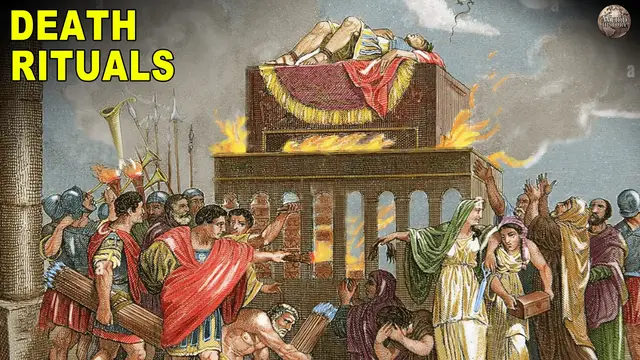
exposed to the elements and eaten by birds. Oof. During a Roman funeral procession, the corpse was transported through the streets for all
8:01
to see and people were expected to make some noise for their loved ones though throwing their hands in the air and waving them like they just don care was optional The procession path was typically surrounded by women screaming tearing out their hair
8:14
beating their chests, and carrying out other displays of grief. The women could be members of the deceased's family
8:20
but there were also professional mourners hired for the occasion, which might explain
8:25
some of the more outlandish theatrics. They were really trying to earn that paycheck
8:30
Musicians were hired as well because the level of noise indicated just how important the person was
8:35
Once the body was outside of the city boundaries, it was most likely cremated, although burial was also an option
8:42
At the grave or tomb, people gave eulogies, praising the individual and lamenting their passing
8:47
Afterward, a feast honoring the dead took place and could be accompanied by funerary gains
8:52
After all, since the deceased couldn't cheat death, maybe they could cheat at a final round of Monopoly
8:59
Members of the Haida Nation, many of whom live on and around the islands of the Haida Gwaii Archipelago, have occupied the area off
9:06
the coast of British Columbia, Canada for more than 12,000 years, which is way longer than British
9:12
Columbia, Canada has actually been there. When a prominent Haida individual passed, the tribe
9:17
erected a memorial or mortuary pole in their honor. At the top of the elaborately carved pole
9:22
sat a box containing the remains of the individual. One year later, the remains were
9:26
moved to another box and placed back atop the pole. With time, the mortuary poles would
9:31
decompose, a natural event that allowed the human remains to return to the earth and contribute to
9:37
the cycle of life. Few such poles exist today for this very reason, although several still
9:42
stand its gangway on Anthony Island. But out of respect, don't try to climb them
9:48
According to medieval Arabic traveler Ahmed bin Fadlana, who was portrayed by Antonio Banderas in
9:54
the film The 13th Warrior, when a Viking noble died, one of his family's slaves, usually a young
10:00
girl was asked to die with him. You would probably say, no thanks
10:05
But back then, there was usually a volunteer. The family then prepared everything the deceased
10:09
needed in the afterlife. Well, the doomed girl drank, sang, and rejoiced
10:14
The girl then ritually decapitated a chicken and slept with many of the individuals present
10:19
making the whole thing sound like a Black Sabbath show in the 1970s
10:22
After all that, an older woman representing the angel of death came forward to dispatch the chosen one
10:28
Both of the deceased, the girl and the noble, were placed in a boat atop a funeral pyre, which
10:33
was set aflame. Bin Fadlana asked why the burning was necessary, and purportedly learned it was to prevent the deceased
10:40
from being eaten by worms and insects. Rather, the burning sent them directly to paradise
10:46
without any layovers in worm and insectville, which does sound like a better itinerary