Up next in 10



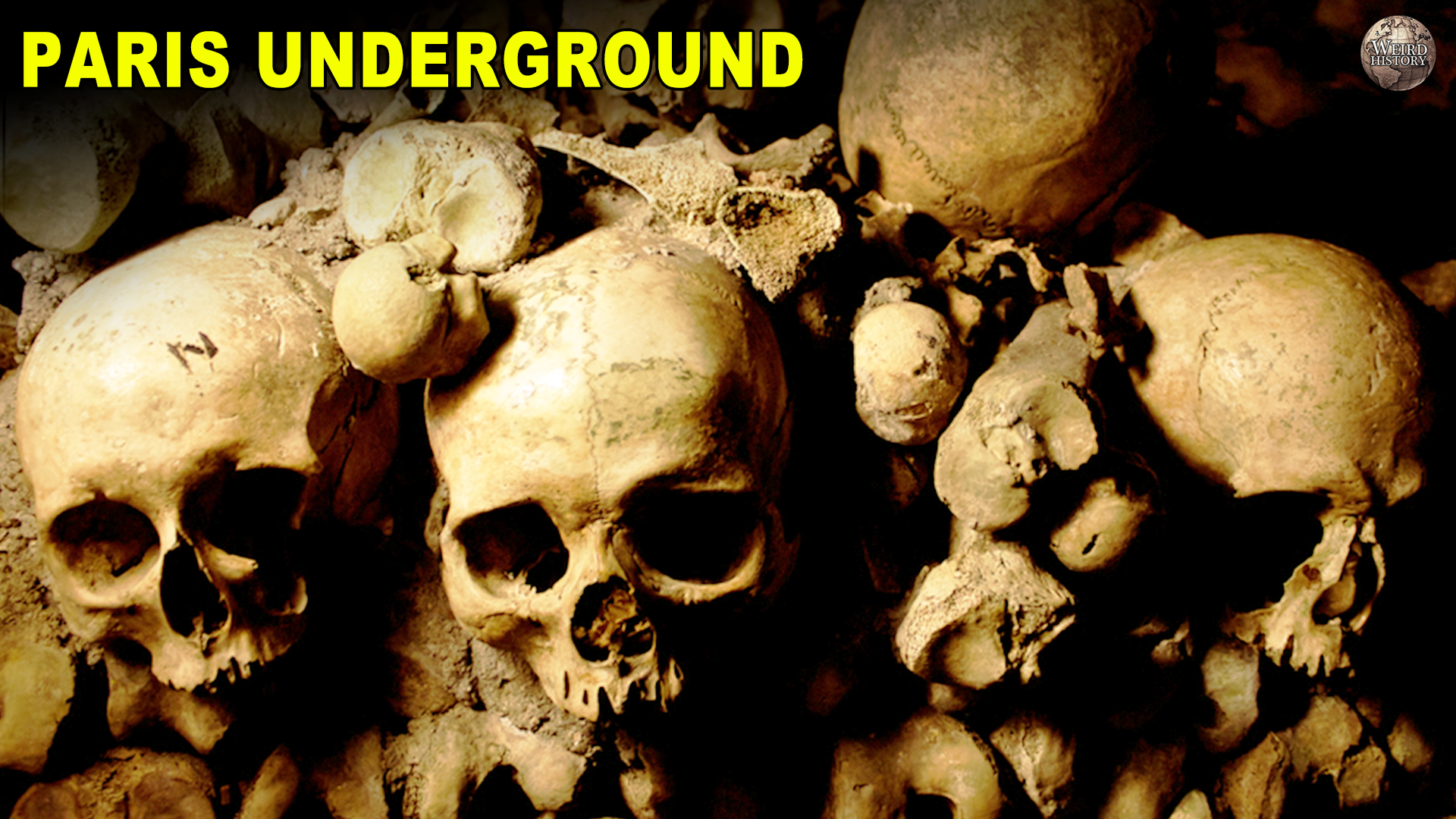
Beneath Paris's tree-lined avenues and broad boulevards, there lurks a labyrinthine world of tunnels, chambers, and ossuaries: the Paris Catacombs, which are made up of 200 miles of tunnels that have been attracting, terrorizing, inspiring, and hosting generations of Parisians.
Show More Show Less View Video Transcript
0:00
Paris is one of the world's most iconic and beautiful cities
0:04
It is a favorite tourist destination from around the world. But the romantic City of Lights also hides a dark secret
0:12
The city's underground catacombs, which are home to the skeletal remains of more than 6 million people
0:19
Not exactly the thing you want to hear before booking your flight. So, today on Weird History, we're exploring the creepy ossuaries beneath Paris and their unconventional history
0:29
Now, no reason to get catty. We're just talking catacombs. 200 miles of underground tunnels crammed full of human skeletons
0:41
sounds like something out of medieval times. That's the sort of thing you build in an era called the Dark Ages
0:48
But in fact, these tunnels were first converted into final resting places
0:51
for the city's dead in the late 18th century in an attempt to rid the city of rapidly overflowing cemeteries
0:58
Before that, they had served as a network of mines and quarries, built during the Middle
1:02
Ages to reach the rich limestone deposits beneath the city. These stones were then used to erect many of Paris' most famous and iconic buildings
1:11
Most of the mines were constructed by individuals without any kind of formal training or even
1:16
permission, and many were never clearly mapped or identified, which made occasional cave-ins
1:20
and collapses an ongoing problem. Due to the stable temperatures and humidity levels underground
1:26
from the 17th through the early 20th centuries, the mine shafts also housed several breweries
1:32
A number of extensions to the original cave network were even dug specifically for this purpose
1:38
allowing brewers to work underground and then easily transport their product to wait for customers above
1:43
This was not a one-off concept, but a thriving business. By the late 1800s, underground breweries
1:50
in just the 14th arrondissement alone were producing more than 22 million gallons of beer each year. The longest-lasting and most
1:57
famous of these brewers were known as Duménire and remained in operation through the 1960s
2:04
The tunnels also once housed a number of mushroom farms. A specific type of button mushroom
2:10
the champignon de Paris, became specifically associated with the catacombs. The construction
2:16
of the Paris Metro in the early 1900s ultimately forced growers to move their operations elsewhere
2:22
In the mid-1700s, many of the city's largest grave sites, such as the Holy Innocence Cemetery
2:28
along the Rue Saint-Denis, were becoming unsanitary due to the sheer number of corpses
2:33
interred there, frequently in mass graves dating back centuries. Heavy rains and basement wall collapses in 1780 made Holy Innocence essentially unusable
2:43
not to mention a public health and safety hazard demanding some urgent new solution The underground mines which were already being retrofitted and consolidated in in order to deal with the frequent street and home collapses seemed like the perfect place
2:57
to cram all the extra bodies. By 1786, corpses were being exhumed nightly
3:02
from cemeteries across the city and moved underground into the catacombs. Each night, covered wagons would remove bodies
3:09
from nearby graves and deposit them in a mineshaft leading down into the tunnels
3:14
near the Rue de la Tombe-Bissoire. The total process of clearing the city's most overcrowded burial sites and moving bodies
3:20
into the catacombs took around 12 years. Even though the term catacombs technically only refers to the part that has all the dead
3:28
bodies in it, it's now routinely used to refer to the entire network of mines and tunnels
3:36
Though it hadn't been their primary purpose, it wasn't long after the underground
3:40
ossuaries were completed that it became clear the public would have some kind of dark interest
3:45
in checking out these grim subterranean hiding spots. Among the first ever visitors to the
3:50
Paris catacombs was the future King Charles X. Back when he was still known as the Count of
3:56
Artois, in 1787, he actually organized a picnic down at the catacombs with some of his courtiers
4:02
and friends. By 1809, the catacombs were occasionally opened up for individuals to
4:07
explore, but only for important or prominent French citizens, and by appointment. At this
4:13
point, they were still just a large, disorganized dumping ground for dead bodies that had been
4:17
removed from Paris graveyards. Between 1810 and 1814, French politician and engineer Louis-Étienne
4:24
Éricard de Toury decided to do something about it and began arranging the bones into patterns
4:30
murals, and collages. He specifically intended to honor the victims of the September massacres
4:36
incidents of public violence that occurred during the French Revolution. In all
4:40
Thuris' designs incorporated around 1,200 skeletons out of a collection of several million
4:46
The list of important historical icons and royals who toured the site included German
4:50
statesman Otto von Bismarck, Austria's Emperor Francis I, Sweden's Crown Prince Oscar, and
4:57
Napoleon III. It wasn't until 1874 that a relatively small section of the tunnels were
5:03
opened to the general public as a museum and tourist attraction. Tourists exploring the
5:08
catacombs definitely want to stick with the well-traversed areas and large groups
5:13
as it's quite easy to get lost down there. In 1793, a porter from the Val-de-Grasse Hospital
5:19
named Philibert Asperot, entered the catacombs via a staircase in the hospital courtyard for
5:24
reasons unknown and was never heard from again. His decayed remains were discovered 11 years later
5:32
in a quarry gallery very close to an exit. He'd nearly made it. He was interred on the spot where
5:38
his body was found with a small tombstone noting the peculiar circumstances of his death That part of the catacombs near the Boulevard Saint isn open to the public anymore Sorry
5:49
Many visitors to the catacombs routinely wander down there on their own, as opposed
5:53
to with a formal tour group. These renegade individuals, known as cataphiles
5:58
access the tunnel via former sewer holes and other secret entrances, and in some cases
6:03
have left helpful navigation markers to guide one another around. Some of the tunnels actually have above-ground street names etched into the walls to prevent
6:12
cataphiles and explorers from getting too turned around. Trespassers in blocked-off sections of the tunnels risk a $77 fine if they run into one
6:20
of the police units that routinely patrol underground. National Geographic UK estimates the community could number in the hundreds of thousands
6:29
The relatively open, porous nature of catacomb access has led to a number of unexpected and
6:34
surprising discoveries over the years. Several artists, for example, have used the tunnels as particularly dramatic impromptu
6:40
galleries for their work. One anonymous street artist, going by the name of No Bad, was profiled by the New York Times
6:47
in 2014. He's decorated a number of the walls with paintings that glow in the dark
6:52
In 2004, police undergoing training exercises in the catacombs discovered a working movie
6:58
theater down there, beneath the city's famed Palais de Chaillot. In addition to a giant cinema screen and projection equipment, the cops found theater seats and a
7:08
collection of classic films, not to mention a fully stocked bar and restaurant. Obviously
7:13
the theater had working electricity to run the projector, but it also had three active phone lines
7:19
Authorities returned to the site a few days later to investigate further, only to find that it had been completely taken apart and removed. The only remaining clue was a
7:28
note reading, Do Not Try and Find Us. Not all catacomb-themed events are quite so mysterious
7:34
and obscure. The site has also hosted a number of unauthorized parties, raves, and events that
7:39
attract widespread attention and numerous attendees, despite being technically illegal. Every Halloween, partygoers descend into the tunnels for a themed event known as
7:49
Cat-Alloween. Despite the ongoing popularity of these events, you're never still entirely safe
7:55
wandering around unsupervised in a dark network of underground tunnels filled with skeletons
8:00
In 2011, three friends got lost in the catacombs while partying and drinking together
8:05
and were found only after 48 hours of searches. In 2016, a 45-year-old man suffered a fatal cardiac episode during a catacomb party
8:17
After descending a grand staircase into the catacombs themselves, Visitors are first greeted by a small exhibition explaining
8:25
their history and instructing anyone tall to watch out for occasional low ceilings This ante room is also filled with directional guides and other instructions that were etched onto the walls for the miners who once worked in the tunnels The next room is known as the Porte corridor and features a number of sculptures
8:41
that were originally constructed in secret by a quarry worker named Francois Descure
8:46
between 1777 and 1782. Descure would work on the project between shifts at the mine and during lunch breaks
8:54
using the same tools he was employing for his mining job and lighting the room with
8:58
torches for better visibility. The corridor is named after the Port Mayon fortress
9:03
on the Spanish island of Mallorca, which is depicted in one of de Cure's designs
9:08
The artist was gravely injured during a cave-in while he was carving out a new stairway
9:12
which would have made his artwork more accessible from the street, and he never recovered
9:17
After exploring de Cure's gallery, visitors then enter the ossuaries themselves, containing the skeletons of more than 6 million late Parisians
9:25
That's nearly three times the current living population of the city of Paris, which tops out at around 2.2 million people. Visitors are greeted by a
9:34
plaque that reads, Stop. This is the Empire of Death, but you know, in French. After inspecting
9:41
the bones, visitors climb 112 steps to leave the catacombs and return to street level
9:46
Naturally, this also involves exiting through a gift shop. During the World War II Nazi occupation of France, the catacombs provided Parisians with a handy
9:59
hiding place. Two doctors named Jean Talleyrak and René Soutel began mapping the tunnels in 1938
10:07
and handed the work over to French resistance leader Henri Roltenghi for use as storage or
10:13
hideouts. The Grand Mosque of Paris also took advantage of its location. Directly above an
10:18
entrance into the tunnels to serve as a hiding place for Jewish refugees fleeing the Nazi regime
10:24
Jews would wait in the catacombs until they could be provided with forged identity papers
10:28
en route out of the country. Some historians also have suggested that German occupiers may have also
10:34
made use of the catacombs to travel around the city, but without the benefits of a handy map
10:38
or a local guide. The tunnels have allowed for covert movement around the city during peacetime
10:43
as well. In 2017, thieves burrowed through the wall of one of the tunnels to access a private
10:50
wine cellar nearly 65 feet below the streets of Paris. More than 300 bottles of vintage Grand
10:56
Cru wines were taken at an estimated value of around 250,000 euros. The future could theoretically
11:04
hold even more surprising uses for the tunnel network beneath Paris. One Paris architectural
11:09
firm, known as Fieldwork, has started experimenting with the catacombs as a source of geothermal
11:14
energy due to their constant warm temperatures. Theoretically, they could be used to help regulate
11:20
temperatures throughout the city, naturally keeping homes in the area cool during the summer
11:24
and warm in the winter