Up next in 10



Have you ever wondered why the days of the week are named the way they are? Sunday and Monday are named after the sun and moon, which makes sense, but then we've also got Saturday, which is named after the Roman god Saturn. And then, just to shake things up, the remaining four days of the week are named after the Norse gods Tyr (Tuesday), Odin/Woden (Wednesday), Thor (Thursday), and Frigg/Freya (Friday). Just as many common phrases derive from outdated traditions, words associated with mythology are indelibly bound to our vocabulary. Here are some of the most intriguing examples.
Show More Show Less View Video Transcript
0:00
Just as many common phrases derive from outdated traditions
0:03
many common words derive their meaning through their association with ancient mythology
0:08
And we're not just talking about the days of the week or the names of the planets. As it turns out, there are some much less obvious ones
0:16
So today, we're going to take a look at common words with surprising mythological origins
0:22
Okay, time to take the words right out of antiquity's mouth. In Greek mythology, Arachne was a weaver who was so skilled at her craft that she challenged the goddess Athena to a weave-off
0:39
If you think that was a bad idea, well, Arachne could have used a friend like you
0:45
Among her many responsibilities, Athena was the goddess of warfare and handicrafts, which meant two things
0:51
She never lost a game of risk, and she did not back down from weave-offs with mortals
0:57
Depending on which version of the story you read, when the two were finished weaving their
1:00
tapestries, Athena was either jealous of how good Arachne's tapestry was or scandalized by how naughty
1:06
it was. Either way, she did not have a sense of humor about it. At the end of the story, Athena
1:12
tears Arachne's tapestry apart, and Arachne takes her own life in despair. It would have gone down
1:17
as the worst ending of a reality competition show ever, but Athena decided to be merciful
1:22
and turned arachne into a spider instead. Today, arachne is where we get the zoological term arachnida
1:34
Cereal is popular in modern times. Ceres, the Roman goddess of agriculture, is not
1:40
Poor Ceres, should have made a hit record. Ceres was the Roman version of the Greek goddess Demeter
1:45
and she presided over things like grain, crops, the harvest, and motherhood in general
1:50
Her name, which is ultimately derived from the Proto-Indo-European word for grain
1:54
is the root of the modern word cereal. In fact, cereal literally translates to of series
2:00
So she still has dominion over grains in the sense that she now dominates the cereal aisle at Food Lion
2:11
Frigg, who was associated with things like wisdom and foresight, was Odin's wife in Norse mythology
2:17
and Rene Russo in the Marvel Cinematic Universe. Because when religions go out of style
2:23
they become comic books. Frigg's name was recorded in a variety of spellings
2:27
and it is sometimes equated with Freya. But regardless of how you spell it
2:31
her name is the namesake of everyone's favorite day. Friday literally means Frigg's Day
2:36
appropriately the day of the week when everyone Frigg's off by around 4.30. It's a big deal to have a street named after you
2:47
Heck, if you get elected mayor or make enough westerns, they might even slap your name on an airport But imagine being able to say that music was named after you Not one particular song but the very concept of music itself That some serious bragging rights The closest we got is
3:03
Barry I Write the Songs Manilow. The word music is derived from the Greek word musiki, which
3:09
literally means art of the muses. As the goddesses of the arts in Greek myth, the muses were often
3:14
invoked by playwrights and storytellers as they began their tales. For example, such an invocation
3:19
can be found in the first line of the Iliad, which goes, Sing, goddess
3:24
The anger of Peleus' son Achilles, and it's devastation. So not only is all of music named after the muses
3:31
but they are constantly getting name-dropped. We get it, Homer. You met the muses at a party in Silver Lake last year
3:42
The Graces, also known as the Charities, were Greek goddesses that symbolized the good things in life
3:47
like beauty, charm, and being excellent to each other. The myths are inconsistent as to how many graces there are
3:54
but they're often grouped into a trio that includes Agliaia, or Splendor, Thalia, or Good Cheer
4:01
and Euphrosyne, or Mirth. Although that lineup presumably changed over subsequent albums and reunion tours
4:08
In some tellings, there's a charity named Karis, and in others, Karis is used as an alternate name for Agliaia
4:15
In any case, that's another point on the board for ancient goddesses influencing modern English
4:20
Uh, the language, not the band. Many astrologists will tell you that Jupiter is a lucky sign to be born under
4:31
because it imparts good fortune and joy, and because you're paying them money for good news
4:36
Whether or not you believe in astrology is up to you, but people in the past certainly did
4:40
Jovial used to be a word reserved only for those born under Jupiter's sign
4:44
It means of or relating to Jove, which is another alias of the god Jupiter
4:49
Over the years, jovial has evolved into a general term for anyone with a joyful, charming nature
4:54
Which is weird, because it seems like most myths begin with Jupiter being f***ed off about something
5:04
Tuesday means Kirste, and it's named in honor of the Norse god Tyr
5:09
Also called Tiw or Ziu, he is often associated with the Roman war god Mars
5:15
though his role in Germanic mythology is a bit murkier. Tiw is best remembered for letting Fenris, the wolf, eat his hand
5:23
Apparently, that was enough to get a day of the week named after you back then
5:26
Nowadays, you just get a show on TruTV. The word hypnosis means put to sleep, and it is derived from the name of hypnos
5:38
the Greek personification of sleep. Hypnos is the son of Nyx, the goddess of night
5:44
and the twin brother of Thanatos the god of death Thanatos was presumably the moody twin Hypnos even has three sons who bring dreams to all the beings and non of the Earth Morpheus to humans Islis to animals
5:58
and Phantasus to inanimate objects. Eh, kind of sounds like Phantasus got the short end of the stick there
6:05
What kind of dreams do you bring to a desk lamp? In Greek mythology, Echo was an ariad, or a mountain nymph
6:16
who loved the sound of her own voice. You know, like an ancient podcast host
6:21
Ovid writes that Zeus would get Echo to distract his wife, Hera, with long, drawn-out conversations and flattery
6:28
while he was out raising hell with the fellas. Of course, Hera inevitably found out
6:33
And she cursed Echo to only ever be able to speak the last words she'd heard
6:38
which is both cruel and inconvenient. In the end, Echo ended up praying for her life to end
6:43
Aphrodite granted the prayer. But she liked Echo's voice so much that she kept it around to haunt the Earth's hollow places
6:51
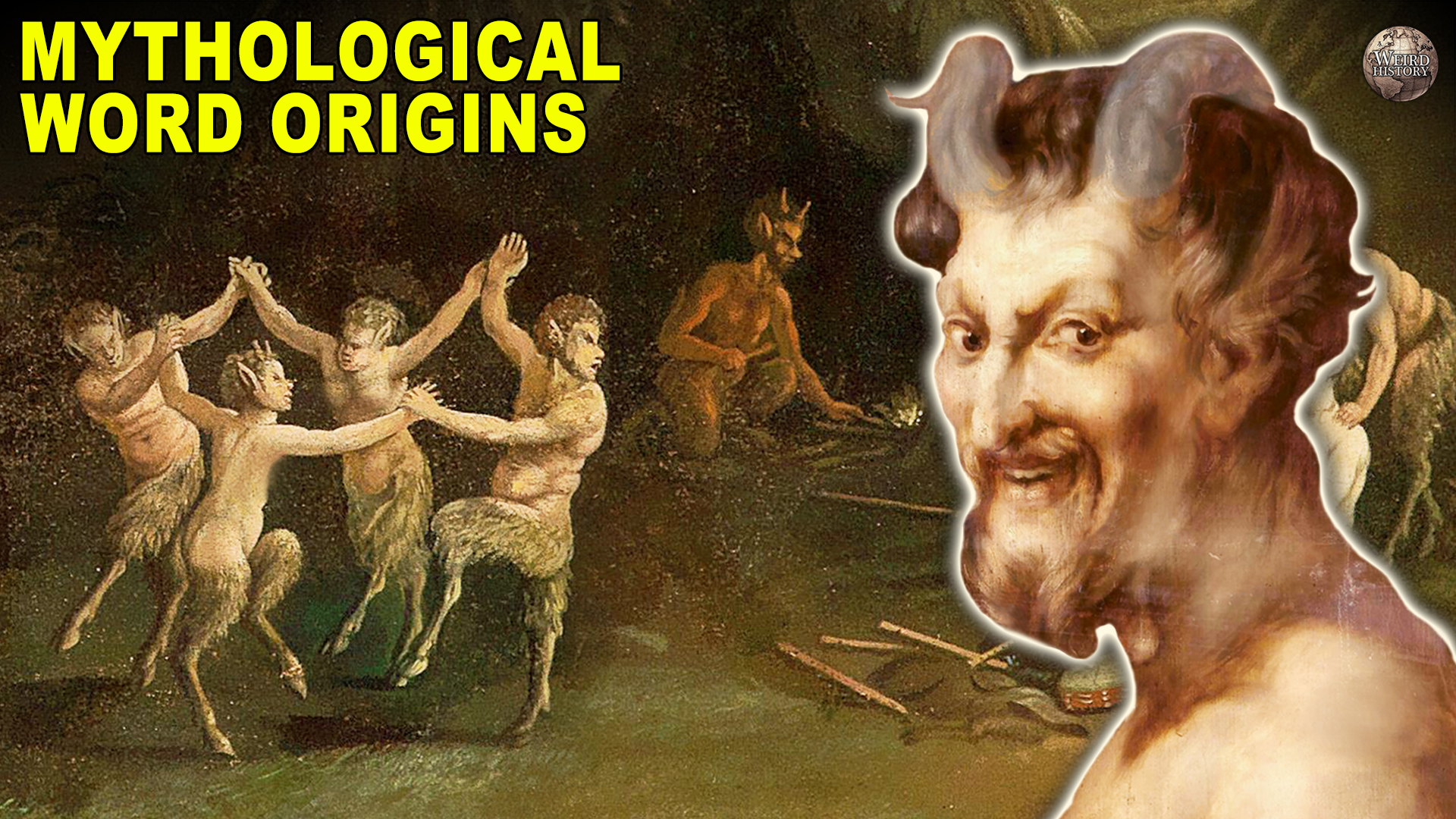
That's kind of creepy, Aphrodite. A horned god of the fields, Faunus was one of the oldest of the Roman deities
7:03
Often merged with the Greek god Pan, Faunus was the god of the fields, the forest, and the plain
7:09
which all sound like prime real estate. He had a counterpart named Fauna, and it's from the two of them that we get Fauna
7:16
the word referring to the animals of the Earth. On a similar note, flora, the term we use for a region's plant life
7:22
is derived from the name of Flora, the Roman goddess of flowering plants. Thursday is named for Thor
7:34
Judging by his appearance in the Avengers movies, Thursday is Thor's abday
7:38
which he clearly never skips. But if you only know Thor from the Marvel films, then prepare yourself
7:44
because the mythological version is a bit weirder. While he still gets into scrapes with Loki, the god of mischief
7:51
mythological Thor also has a sweet belt that doubles his strength. And the haft of his mighty hammer, Mjolnir, is actually so tiny he can't really hold it comfortably
8:01
I, uh, left that detail out of the movies. Friedrich Zertner experimented with opium in the early 19th century
8:14
believing that the active ingredient could be distilled for medicinal purposes. We imagine this got him invited to a lot of parties
8:20
which he probably didn't attend because he was too busy inventing morphine
8:24
which probably got him invited to even more parties. Zertner eventually planned to name the resulting solution Morpheus
8:31
but eventually decided to follow the medical standards for naming alkaloids and threw an I-N-E on the end
8:37
Morpheus is the Roman god of dreams and the patron saint of tiny sunglasses
8:42
According to Ovid, he's the son of Somnus, the personification of sleep which actually makes a lot of sense Morpheus liked to appear in people dreams in human form which is kind of like metaphysically sliding into someone DMs
9:00
The word martial, as in martial arts, martial law, court martial, martial Mathers, etc., is derived from the name of Mars
9:07
the Roman god of war and namesake of the fourth planet from the sun. In fact, martial literally translates to of war
9:14
Though he is often acquainted with a Greek god of war, Ares, the Roman Mars was far more revered
9:20
The Romans saw Mars as both a proud, valiant military leader and an agricultural guardian
9:25
Meanwhile, the Greeks saw Ares as more as the tempestuous spirit of battle
9:29
And, quite frankly, they were never that into him. As with Thor and Frigg, modern audiences are probably mostly familiar with Odin
9:43
as he appeared in the Marvel Cinematic Universe. But Odin has been around for a long, long time
9:49
In fact, archaeologists recently found an inscription on a gold disc that proves Odin was being worshipped as early as the 4th century CE
9:58
That is really old school. Or would that be Odin school? Odin is the father of the Aesir
10:03
and he's associated with a bunch of things like wisdom, sorcery, poetry, and war
10:08
Pretty eclectic range of interest there. His name in Old English is Woden
10:12
In Old Saxon, it's Wodan. In the Old High German, he's Wotan
10:16
So Wednesday just means Woden's Day or Odin's Day, the day when the Allfather orders pizza and watches the game
10:28
The name Saturday means Saturn's Day, and it's named for the Roman god of dissolution and plenty
10:34
So, you know, not a bad portfolio. Though the Roman pantheon of gods is generally ogous
10:39
with the Greek pantheon, Saturn's relationship to his son Jupiter is less adversarial than the one
10:45
shared by Zeus and his father, Cronus, in Greek mythology. Although you never would have guessed
10:50
that by looking at the famous Francisco Goya painting, Saturn Devouring His Son
10:54
which is a picture of exactly what it sounds like. When discussing matters of love, the Greeks didn't just use one blanket term
11:05
They realized one kind of love could be very distinct from another
11:10
so they were careful to use unique words to describe each one. For instance, philia is the kind of love you feel for your friends and family
11:18
Ludus is the playful, flirtatious love experienced by young people. Agapi refers to the selfless love one feels for their fellow humans
11:26
Pragma is the love felt between long-term couples. And philautia is love of the self
11:32
Eros named after the god of love and sex refers to passionate physical love that can be fun but
11:39
risky like rollerblading it's from this love that we get the word erotic and madonna's fifth studio album