Up next in 10



While most of us coasted through childhood in a veritable sugar haze, it turns out all the fruit punches, apple juices and colorful elixirs we were throwing back in the cafeteria didn’t always have our good health in mind. But how can drinks that taste vaguely like fruit be bad for us?
Show More Show Less View Video Transcript
0:00
Picture it, you're in middle school, and the morning has been dragging on
0:05
That lunch bell finally rings as you open up your snack box
0:09
After struggling to stay awake all morning, you reach for that manna from the heavens
0:13
and pull out a container that holds as much sugar as a half pint of ice cream
0:18
It's juice time, baby! While many coasted through childhood in a veritable sugar haze
0:24
It turns out all the fruit punches, apple juices, and colorful elixirs we were throwing back in the cafeteria didn't always have our good health in mind
0:33
But how can drinks that taste vaguely like fruit be bad for us? Well, today the juice is loose as we chug down all the lunchbox juices that were trying to kill us
0:44
Can someone open this for me? I always wind up bringing the straw. Ever since lemonade was introduced to Italy from the Middle East in the 16th century
0:57
people have loved the idea of sipping on juice. But aggressively sugary juice drinks that feature little to no fruit juice
1:03
didn't begin dominating the lives of children until the 1970s, and then all the way through the 90s and beyond
1:10
Studies have shown that the high sugar content, color dyes, and artificial sweeteners
1:14
present in many children's juice drinks have contributed to obesity, type 2 diabetes
1:20
hyperactivity, and of course, scores of dental cavities. The Food and Drug Administration has
1:25
strict rules about what is allowed to be called juice and what isn't. If a product wants to call
1:30
itself 100% fruit juice, that claim must be true. Anything less must be labeled as drink, beverage
1:38
or cocktail. And what's more, the actual juice percentage as well as any added ingredients have
1:44
to be clearly listed on the label. Seriously, you do not want to mess around with the juice police
1:49
Brands can sometimes circumvent these regulations by getting cutesy with their labeling
1:55
Like Sunny D, for instance, uses marketing that focuses on vitamin content and real fruit
2:01
imagery, while never actually claiming to be fruit juice. And in fact, the high sugar contents undermine any actual health benefits
2:09
And you'll find that's not an isolated incident in the juice biz. The originator of this juicy trend can be traced back to the late 19th century, when Thomas Bramwell Welch created a new process for pasteurization
2:22
This new process prevented grape juice from fermenting into wine, a process Welch hoped he could convince his local church to use as a substitute for communion wine
2:30
While that didn't end up panning out, his innovation was used to create Welch's Grape Juice Company in 1893, which struck purple gold during the temperance movement as a non-alcoholic alternative
2:41
Other brands would soon jump on this trend, like Mott's apple juice in the early 20th century
2:46
But it wasn't until the 1950s when Kool-Aid revealed its eye-catching Pitcherman commercial
2:51
that marketing firms had the aha moment of selling juice directly to children and they never looked back For the very best drink you ever made Despite the popularity juice drinks saw throughout the 20th century
3:04
pediatricians in the 1990s began pushing back against these sugary drinks, with parents joining the fray
3:11
By 1997, Americans were consuming billions of gallons of juice annually, and children under 12 were chugging more than their fair share
3:19
As childhood obesity and food allergies began to arise, the American Academy of Pediatrics asked families to tone down their sugary drink intake
3:28
especially with children under two. So while their heydays may have passed, we won't soon forget some of these lunchbox legends
3:38
Before it was Sunny D, 1963 knew the familiar bright orange beverage as Sunny Delight
3:44
According to their website, two Florida dads named Howard Dick and Phil Grinnell
3:48
saw what orange juice was doing and said, we can make it better
3:53
Using water, fruit juices, citric acid, sweeteners, sodium, and high fructose corn syrup
3:57
they made a drink they were sure kids would love. And while it was marketed as a healthier alternative
4:02
to soft drinks, in reality, it contains only 4% to 5% fruit
4:07
juice, while the rest is sugary syrup. Since it can't legally call itself fruit juice
4:12
Sunny D is technically classified as a soft drink. But whatever was in it, the kids went gaga over it
4:18
Sunny Delight gained massive popularity in the 1990s as advertising campaigns squeezed the airwaves with ads decrying normal drinks like OJ and Purple Stuff for that golden tangy Sunny D
4:31
Let's see, we got soda, Purple Stuff, oh Sunny D, alright! By 1998, Sunny Delight was one of the most popular soft drinks in the UK, second only to Coke and Pepsi in sales
4:42
So popular, in fact, that in 1999, a four-year-old girl's skin turned orange from drinking over 1.5 liters of it a day
4:50
As the years went on, so did the release of new flavors, such as orange strawberry, orange mango, orange peach, fruit punch, blue raspberry, lemonade, and orange pineapple
5:02
Sunny D saw multiple rebrands since its introduction, including replacing the word delight with a simple D
5:08
They saw a 30% rise in sales after their acquisition by Harvest Hill Beverage Company in 2017
5:14
After negative publicity in 2009, the drink was reformulated in the UK with 70% fruit juice and no artificial ingredients or added sugar
5:23
But perhaps its most successful reboot was when Sunny D introduced a vodka seltzer line in 2023
5:30
with their familiar orange taste, zero sugar, and a smooth 4.5% alcohol
5:35
And while it may not have your 100% daily vitamin C like the original, the lack of sugar
5:40
almost makes the vodka seltzer a safer option. By mid-century, young and old were enjoying
5:49
whatever kinds of juices they could get their hands on. With orange juice becoming more available
5:53
and more popular as the decade went on Niles Foster saw this and decided to take a crack at it on his own inventing Hi in 1946 and taking it to market the following year Initially only available in orange flavor
6:06
the drink was packaged in large 56-ounce steel cans that were coated internally with an enamel that prevented corrosion
6:14
This meant that Hi-C required no refrigeration before opening, which everyone agreed was probably fine
6:20
The original formula combined 10% orange juice concentrate with sugar, orange peel oil, orange essences, citric and ascorbic acids, with the Hi-C moniker meant to reference its high vitamin content
6:32
After test marketing the drink in 1947, Hi-C was launched nationally, starting out in the southern United States and expanding to California by 1949
6:41
The company was sold to the Minute Maid Corporation in 1954 and is now sold in various forms such as drink boxes, soda fountains, and drink mixes
6:51
Popular flavors during High Sea's rise to prominence were Original Orange, Grape, Apple, Cherry, Orange Pineapple, Pineapple Grapefruit, Florida Punch, and Peach
7:01
Specialty flavors were introduced such as Flash and Fruit Punch, Orange Lava Burst, and Torrential Tropical Punch
7:07
But we know there's a flavor that has been creeping up inside your brain since we uttered the words
7:13
High C. Ecto Cooler. Originally citrus cooler, the 1980s saw a rebrand of the drink to coincide with the cartoon
7:21
The Real Ghostbusters. Ecto Cooler was sold in the late 1980s and featured the cartoon version of Slimer on the packaging
7:28
a trend that would last until 2001 when the flavor was discontinued
7:32
It saw brief resurgences in 2016 and 2021, linked to the two Ghostbuster reboots
7:39
Though obtaining the limited supply of ectoplasmic elixir was a task in and of itself
7:48
In 1974, a company with the very inconspicuous name of the American Beverage Corporation
7:54
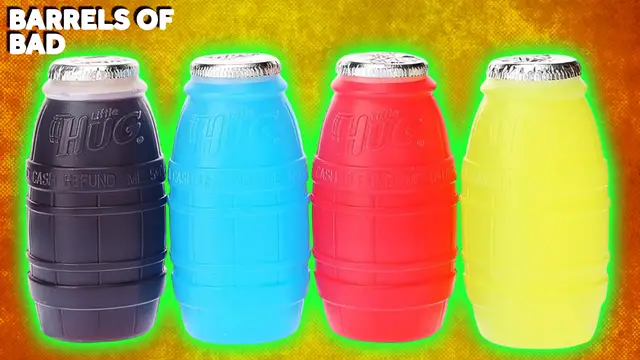
introduced the world to Little Hug Fruit Barrels. The ABC was already producing fruit drinks, ready-to-go alcoholic beverages, and cocktail mixers
8:03
But with their new 8-ounce barrel-shaped bottles with the foil caps, they created the first single-serve kids' drink on the market and really tapped into something great
8:12
A staple of family barbecues and birthday parties alike, Little Hugs featured all the finest flavors a kid could ask for
8:19
including lemonade, orange, fruit punch, blue raspberry, grape, kiwi strawberry, tropical punch, and cherry berry
8:28
All sized to fit perfectly in one of those blue plastic coolers everyone's parents seemed to have
8:34
There was just something about that barrel shape that made them as fun to hold as they were to drink
8:38
In March of 2015, the American Beverage Corporation sold the Little Hug brand to Harvest Hill Beverage Company for a whopping $55 million
8:47
Harvest Hill was also notable for obtaining both Juicy Juice and Sunny D
8:52
Like Thanos collecting the Infinity Stones Harvest Hill won rest until they have all the juices This acquisition saw a toning down of the overall sugar content in the beloved juice barrels and a renewed interest
9:05
in the brand overall. Little Hugs even sponsored multiple races at Roush Fenway Racing after
9:11
partnering with them in 2017. So you can watch a Hug-branded car hugging some serious turns
9:18
Little Hugs actually feature less sugar than competing fruit drinks, with a 2013 report
9:23
claiming up to 75% less sugar. However, the use of artificial sweeteners such as aspartame, sucralose, and acesulfine
9:32
potassium tend to give pediatricians pause. While these ingredients are approved by the FDA, they remain controversial regarding safety
9:40
especially for children. But those little barrels are just too hard to resist
9:47
A relative latecomer to the lunchbox juice game came into the scene guns a-blazin'
9:53
Only because their bottles could be used as a water gun after you finished the juice
9:58
Launched by General Mills in 1987 as a test for Denver markets, the boisterous General Mills beverage, Squeeze It
10:04
eventually became popular enough to expand nationwide, becoming one of the top-selling packaged juices in the U.S. in the early 90s
10:12
If the name doesn't ring a bell, the commercials definitely will to those who grew up in front of the TV
10:18
Each hourglass-shaped plastic bottle featured a different distinct character's face, each with their own lore and personalities
10:25
The massive marketing campaign introduced kids to Chuckle and Cherry, Smarty Arty Orange, Silly Billy Strawberry, Berry B. Wild
10:33
Rockin' Red Puncher, Mean Green Puncher, and Grumpy Grape, later renamed Galloping Grape after an attitude adjustment
10:41
And while the style is popular now, Squeeze It was notable for being the first fruit drink available in a squeezable bottle
10:47
Eh, somebody had to invent it. Despite the memorable commercials, the introduction of silly characters wasn't enough to make Squeeze It a lasting property
10:55
Sales began to decline in 1992 and continued steadily downward until they were fully discontinued in 2001
11:03
Part of Squeeze It's downfall may have been due to changing health trends of the time
11:06
where a drink with only 10% fruit juice and the remainder being balanced out by a considerable amount of sugar suddenly found itself abandoned on the store shelves
11:15
Parents apparently weren't thrilled with their children exceeding half of the recommended sugar intake in one goofy-faced bottle
11:21
Whatever the reason for consumers slowly squeezing out squeeze-its, General Mills made a valiant effort to keep the juices flowing
11:29
100% fruit concentrate versions were released in 1993, followed by special color-changing bottles in 1996
11:36
with a small tablet that could be dropped into the drink to magically change shades. shades additional partnerships with lifesavers and re-releases in 2006 and 2007 had fans hopeful
11:46
that the resurgence of squeeze it might be on the horizon but so far there are no plans to bring the
11:52
gang back for a reboot we'll never see how galloping great has evolved