Up next in 10



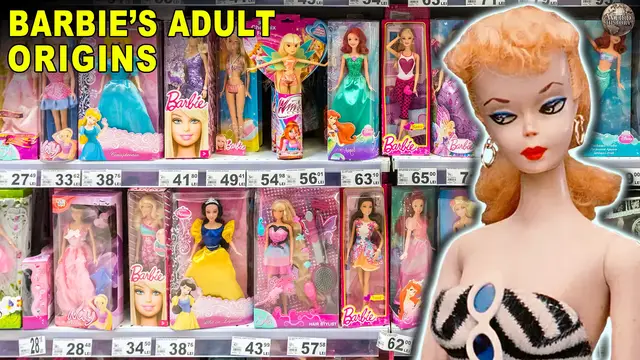
Young girls in America grew up with the squeaky-clean image of Barbie, but the truth is that the history of Barbie and Europe's Bild Lilli doll go hand in hand. Bild Lilli is a doll with heavy makeup, a fierce backstory, and a curvy body eerily similar to Barbie's and some have described her as "Barbie’s ballsy European precursor."
Show More Show Less View Video Transcript
0:00
Generations of young girls in America have grown up on the wholesome, inspiring image of Barbie
0:06
But what you might not know is that Barbie was originally based on the European-built Lily doll
0:12
a sexy trinket for adults that was anything but squeaky clean. So, today, we're going to take a look at how Barbie was originally based on an extremely risque German doll
0:24
Okay, time to call Ken and Skipper over to the Dream House and settle in for some weird history
0:30
Back in 1952, a German tabloid called the Bilt Zeitung
0:40
had a blank spot that the editors needed to fill. They called on cartoonist Reinhard Boitin to come up with something
0:48
And since quizzes about which Harry Potter character you are hadn't been invented yet
0:52
that something turned out to be a comic strip starring a character named Lily
0:57
Lily was a saucy secretary who moonlighted as an escort. Described as a post-war gold-digging buxom broad
1:04
who got by in life seducing wealthy male suitors, Lily received all sorts of expensive gifts
1:09
from her sugar daddies, which she loved to show off in the cartoons
1:13
The gifts, not the sugar daddies. She wasn't exactly the kind of character
1:17
you'd imagine becoming the most recognizable children's doll in history. Despite what you might assume
1:22
Lily was portrayed as witty, and her comic strip conversations were filled with zippy one-liners and clever comebacks
1:29
For example, while walking down the street in a bikini, she was stopped by a police officer who informed her that it was illegal to wear a two-piece swimsuit
1:37
She responded, Oh, and in your opinion, which part should I take off
1:42
In another issue, she covers her naked body with a newspaper and tells a friend
1:46
We had a fight, and he took back all the presents he gave me. That's kind of funny. Like, two and a half men funny
1:52
Her schtick was apparently the exact balm post-war Germany needed, because after a year
1:58
in the paper, Lilly became so popular that the decision was made to market her as a three-dimensional doll
2:04
Originally, the built Lilly dolls, as they were known, were never made for children to
2:08
play with. They were explicitly considered adult novelties and targeted at men who purchased them from
2:14
places like bars, tobacco shops, and adult toy stores. According to a brief history of the doll in Time magazine, men got Lily dolls as gag gifts at
2:24
bachelor parties, put them on their car dashboard, dangled them from the rearview mirror, or gave
2:29
them to girlfriends as a suggestive keepsake. You better know the girl you're giving that to
2:34
because that night is either going to be very fun or very, very not fun. The design of the doll
2:40
closely mirrored Lily appearance in the comic strip which included heavy makeup and an extra curvy figure The doll was targeted for grown men rather than young girls but a woman named Ruth Handler saw its potential
3:02
In 1956, Mattel co-founder Ruth Handler went on a trip to Switzerland with her daughter
3:07
Barbara. At that point, the German-built Lily dolls had become so popular that they were being
3:12
imported into the neighboring countries, and one of the dolls caught young Barbara Handler's eye
3:17
While you might be wondering what young Barbara Handler was doing at a bar, tobacco shop, or adult
3:22
novelty store, the truth is Lily had already grown quite popular with little girls, much more so than
3:28
she had ever been with adult men. Consequently, Lily had switched gears to become more of a child's
3:34
toy than an adult novelty item, a phrase that's just a longer way of saying toy. Lily was no
3:40
longer confined to seedy storefronts, and German girls of the 1950s had already discovered the joy
3:46
of fashion dolls thanks to her. By the time Barbara Handler saw her, Lily had become a
3:51
merchandiser's wildest dream. Not only did she have interchangeable outfits, Lily had accessories
3:57
houses, and furniture. Sounds kind of familiar. After Barbara bought the built Lily dolls to her
4:03
attention, Ruth Handler decided to purchase three of them and bring them home to show her husband
4:07
Elliot, who was also her fellow Mattel co-founder. Elliot, along with the Mattel board of directors
4:13
had previously been lukewarm on Ruth's pitches for an adult-bodied female doll for girls
4:18
but this time they saw dollar signs. The product gurus of Mattel were so inspired that Barbie was
4:25
on the shelves of American stores by 1959, just three years later
4:33
After purchasing her first three Lily dolls, Handler redesigned them with help from a man named Jack Ryan
4:44
who was a local inventor and not a dashing CIA intelligence yst
4:48
Despite their work retooling the character into a distinct new creation, Lily and the original Barbie still have a lot in common
4:55
at least as far as their physical appearances go. Their body shapes are very similar
5:00
with a tiny waist and a large, uh, investment portfolio. Both dolls also originally had eyes that glanced to the side
5:08
though Barbies would be changed to look forward in 1971. They both also have blonde hair
5:13
but Lily wears significantly more makeup than Barbie does, presumably because she was originally marketed to adults as opposed to children
5:20
Lily also has suggestively arched eyebrows, which the more wholesome Barbie does not
5:26
The other main difference is their feet Barbie has removable shoes whereas Lily feet were molded into the shape of stilettos and painted black Kudos to Handler and Ryan for realizing how much money there was to be made in
5:39
selling tiny, extremely losable doll shoes. Like all little girls in the 1950s, Ruth Handler's
5:49
daughter, Barbara, had a limited selection of toys to play with. It's hard to imagine now
5:54
given the virtually infinite selection of toys available to kids today. And many of those toys marketed to girls in the 1950s focused on being homemakers and mothers
6:04
Handler had the idea that girls should have more versatile and dynamic three-dimensional figures to play with
6:09
And based on the toys available today, it's pretty evident she was on to something
6:13
According to Handler, the entire philosophy behind Barbie was that through the doll
6:18
a little girl could become anything she wanted to be. To Handler, Barbie represented the fact a girl has choices
6:25
And while Lily certainly met the image of an independent woman, the decision was made to tone down the more adult aspects of her
6:32
In short, Barbie ditched her risque past and adopted a variety of careers
6:36
inspiring young ladies to grow up to become things like vets, dancers, and artists
6:41
Ruth Handler was excited about Barbie, and her vision was for Barbie to be a drastic departure from the normal toys for girls
6:48
In recent decades, Barbie's curvaceous figure has generated controversy among those who claim it sets unrealistic expectations for young girls and damages their self-esteem
6:59
And while it's easy to assume her buxom features were a remnant of built Lily's status as a sexy novelty, Ruth Handler claims retaining Lily's body shape was her idea
7:10
In Handler's opinion, young girls needed a toy that could help them imagine what they might be like in the future
7:16
She knew that her daughter was projecting her own dreams onto the life of her dolls
7:20
So Handler decided that if the doll represented a girl's future, that being the life of a young woman
7:25
then it should have a young woman's body as well. Otherwise, she worried it might give girls a different expectation
7:31
As Handler put it, if she was going to do a role-playing of what she would be like when she was 16 or 17
7:36
it was a little stupid to play with a doll that had a flat chest, so I gave it beautiful breasts
7:41
If only someone would do something about the unrealistic expectations set by street sharks
7:47
Biography-wise, Barbie couldn't be more different than the swinging secretary she was based on
7:52
Officially, her full name is Barbara Millicent Roberts. And according to some Barbie books published in the 1960s
7:59
she is the daughter of George and Margaret Roberts of the town of Willows, Wisconsin
8:04
That's a fictional town, by the way. Just saved you from wasting a whole afternoon in a rental car
8:08
However, another set of books from the 1990s had her attending the fictional Manhattan International
8:13
High School in New York City which is a hell of a commute She is putting a lot of miles on that dream car Barbie had a sister named Skipper twin cousins named Todd and Stacy and an on off relationship
8:25
with a guy named Ken Carson. Man, even for dolls, relationships are complicated
8:30
She also had a large, diverse circle of friends, including Teresa, Midge, Christy, and Steven
8:35
And she owns over 40 canonical pets, including a panda and a zebra
8:39
Barbie's menagerie is more impressive than Tony Montana's. She has a pilot's license and a fleet of automobiles
8:45
She's worked as a flight attendant, doctor, NASCAR driver, astronaut, and just about any
8:50
other profession you can imagine. Barbie now comes in over 22 skin tones, 94 hair colors, 13 eye colors, and 5 body types
8:59
Altogether, it means every girl can now see themselves in Barbie, no matter what they
9:04
look like, what they want to grow up to be, or which exotic animals they want to smuggle
9:12
On March 9, 1959, the date that is now used as Barbie's official birthday
9:19
Ruth Handler took Barbie to make her grand debut at the New York Toy Fair
9:23
The doll, which was billed as teenage fashion model, debuted in a black and white zebra-striped swimsuit with a top-knot ponytail
9:31
Fun and classy. She was available as both a blonde and a brunette
9:35
You'd think that someone would have told Handler, you can't just steal another company's product and sell it as your own
9:40
just because you found it in a different country. But apparently, no one did
9:44
Built Lily manufacturers Greiner and Hauser sued Mattel in 1961, claiming the toy manufacturer
9:51
had copied Lily to create Barbie, which they undeniably did. Even without knowing the story of Handler discovering the Lily doll in Europe and using
9:59
it as a template to design Barbie, when you look at both dolls side by side, it's pretty
10:03
damn obvious. So it's easy to see why Greiner and Hauser believe they had a case
10:08
Due to a whole lot of legalese we barely understand and won't trouble you with
10:12
the key part of the lawsuit involved Handler and Mattel violating a patent for the Built
10:16
Lily doll's hip joint. The whole thing could have stopped Barbie dead in her tracks
10:21
But as many problems are, this one was solved with money. The case was settled out of court two years later
10:27
And in 1964, Mattel bought the rights to Built Lily. How much did Mattel pay for the copyright and patent rights that would allow them to
10:34
create a multi-million dollar cultural icon? $21,600, about the price of a Mini Cooper
10:41
Meanwhile, Barbie grossed around $1 billion in sales per year over the past decade alone
10:47
If you're very quiet and listen closely, you can hear somewhere in the world
10:51
a room of built editors cursing in German. And with that purchase, Mattel let
10:56
Lily and her sordid history fade into the past, hoping that her connection to Barbie would be forgotten
11:02
Mmm, nobody tell them about this video, OK