Up next in 10


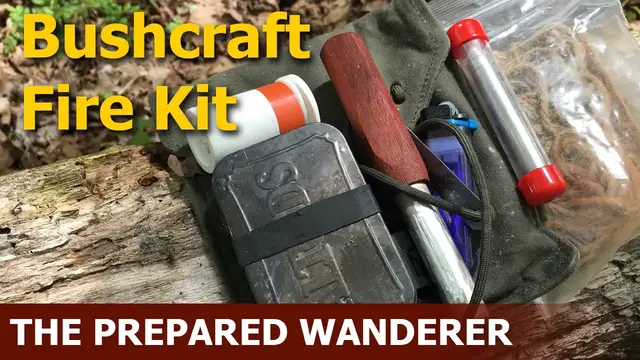
Taking a closer look at my Bushcraft Fire Kit. What I carry and why. I demonstrate my fire steel, pocket bellows and some home made tinders I carry.
Please visit these links below:
Amazon Store:
https://www.amazon.com/shop/influencer20170928757?listId=G2KB0QXOLW6D
ORDER Patches and Stickers!
https://www.etsy.com/shop/thepreparedwanderer
FACEBOOK GROUP:
https://www.facebook.com/groups/1835005976546722
INSTAGRAM:
prepared_wanderer
Blog
https://wanderingoutdoors.com
#preparedwanderer #bushcraft #survival
Show More Show Less View Video Transcript
0:00
🎵 Music ���
0:25
🎵 Music ���
0:37
Alright guys, so I was asked to go in a little bit more depth on my fire kit and what I carry
0:44
and kind of the uses of some of the components of it. And we went through some of this stuff on my last video about what's in my bushcraft backpack
0:55
But today we're going to look at this stuff a little bit closer. So the first thing we're going to look at today is this fire steel
1:08
And I believe this is a Strike Master. It's a little bit different than most fire steels
1:13
It has the big fat ferroceum rod, kind of like the LMF Army steels
1:21
But it also has a magnesium rod on it. And the handle itself is a hardwood
1:29
I believe it's made of poddock. And this is actually something you can shave down and use as tinder as well
1:35
So, you know, it's kind of a 3-in-1 tool. And what I really like about it more than anything is I really like the size of the handle
1:45
The smaller fire steels I have more difficulty with. You know, when you get them down into your tinder pile and you start striking them
1:52
because they're so short and my hands are big, I end up pushing my hand down into the pile and messing stuff up
1:59
And even if I do the pullback method where you're pulling the fire steel back towards you
2:05
because of the shortness you don't get as many strikes. They're as long as a strike with a longer fire steel
2:11
And actually I would like to get a longer fire steel. I'm looking at, I'd like to get a 5 or 6 inch, you know, half inch diameter, 3 quarter inch diameter rod
2:19
I think the bigger ones are even better. But this is what I have right now, so I'm going to start messing with this
2:24
And we'll see how this works. So the first thing I want to try is I want to try the magnesium scrapings on this fire steel
2:34
Typically the dones in the military issue, magnesium scrapers are a lot harder
2:41
And they don't scrape as easy. This one, as you can see, is really taking off scrapings easily
2:54
When you get these in a pile, the theory is that you're going to hit it
3:04
And it's going to burn hot. And I think the magnesium burns at something like over 5,000 degrees
3:09
Of course that was a real quick flash in the pan because everything is blowing away. So I'm just building a little bit of a brace here
3:29
So we're going to get magnesium. And I'm rotating the bar around so I don't get a big wear spot in one spot
3:38
So I don't get a big wear spot in one area. We're going to do some of the wood. OK
4:04
And then what I'm going to do is once I hit this, it's going to go. And I'm going to put my grass over it, and that's going to be where I'm going to start my fire
4:17
I'm moving around to get some oxygen in it. Some of my smaller sticks and debris
4:39
So that worked pretty well. Now the other tool I carry in my fire kit is this pocket bellows
4:58
And really what it does is it forces air into areas that you can't get to
5:06
So I put this down the small end down into it. I'm able to add oxygen to the fire
5:19
And I don't have to get my head or my mouth close to the fire when breathing all the smoke
5:34
One of the simplest and easiest ways to get a fire going
5:39
The problem with when you say, well, a BIC is the best way, you know, a lighter
5:44
Lighters are great. But the thing is, you know, you have to hold them underneath your source
5:51
And that gets to be difficult. It's hard on your hand. You know, the mechanism ends up getting hot because you're holding the flame a long time
6:03
So if you can have something that you can hit with a spark and then walk away and let it do its work for you, that's a lot easier
6:16
And these are easily made at home just with standard 100% cotton balls and petroleum jelly that you just kind of rub into the cotton balls and stuff them into a container like that
6:29
The great thing about this is hit it with one spark. It goes
6:36
You know, it's resisting the wind. The wind's not really affecting it
6:42
I'm going to put my brakes back up. Get some of the smaller stuff on top
7:06
Make sure I'm not choking it out. I want to give it oxygen
7:12
There. That's going to burn for a while. You know, and this took no..
7:22
This took very little, let me say, very little wood preparation to do this kind of fire
7:27
It's basically found twigs, dead grass. And I've got something going. To be more sustainable, I'm going to want to spend some time
7:38
I want to process some wood down. I want to get to the dry center by batoning and splitting and doing feather sticks and all that and working through my different sizes of wood
7:49
But for a quick fire where you need to get warm, you're cold, you're out, and you have a few things on you in your fire kit, this is a way of doing it
7:59
Very simple. Doesn't have to be a big production and it works
8:13
The last thing that I brought that's in my kit is a flint and steel kit
8:19
And flint and steel is one of those things that you have to practice
8:29
And my kit has, this particular one has a very small fire steel
8:35
It was gifted to me. I have some tinder tabs. I have char cloth, fat wood, a piece of chaga, and of course my flip pieces
8:47
Then I also carry some more fat wood and some, there's some punk wood in there and there's also jute twine
9:00
So it gives me a couple different options if like the tinder in the area is really marginal and I can't find enough to make a really good tinder bundle
9:10
I can do that with the jute twine that I brought