Up next in 10


How did one betrayal reshape the American Mafia forever?
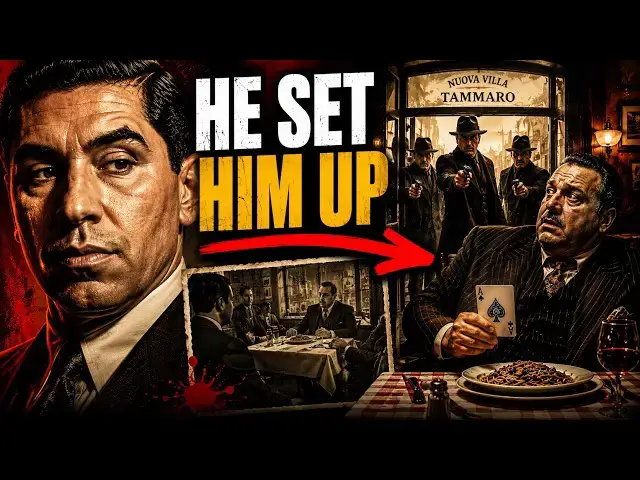
In 1931, New York's most powerful Mafia boss, Joe Masseria, sat down for lunch with a man he trusted. Minutes later, he was dead.
This documentary tells the story of the Castellammarese War, the bloody conflict that transformed organized crime in America and led to the creation of the Five Families.
Discover how Lucky Luciano, Joe Masseria, and Salvatore Maranzano fought for power, how betrayal changed the course of Mafia history, and how the Commission became the foundation of the modern American Mafia.
Featuring:
• Lucky Luciano
• Joe Masseria
• Salvatore Maranzano
• Vito Genovese
• Meyer Lansky
• Frank Costello
• Bugsy Siegel
This is the true story of the war that built the New York Mafia.
#Mafia #LuckyLuciano #FiveFamilies #TrueCrime #CrimeHistory #AmericanMafia #MafiaDocumentary #OrganizedCrime #HistoryDocumentary #CastellammareseWar
Show More Show Less View Video Transcript
0:00
April fifteenth, nineteen thirty-one. Coney Island, Brooklyn.
0:05
Joe Masseria sat in a back booth at Nuova Villa Tammaro , finishing a plate of linguine.
0:13
He had come with a man he trusted. A man he had promoted, protected, made rich.
0:20
That man was Charlie Luciano .
0:23
They played cards after lunch. Masseria won three hands.
0:28
Then Luciano excused himself — walked to the restroom.
0:33
And in the seconds that followed, four men entered the dining room.
0:38
Masseria was hit six times.
0:40
The restaurant owner found his body slumped forward, a single ace of spades — according to
0:47
newspaper legend — still in his hand.
0:50
The man who had controlled every Italian racket in New York for nearly a decade was dead
0:57
before the dishes were cleared.
1:00
But this was not the beginning. This was the end.
1:03
The war that led to that table had been burning for almost two years.
1:08
And it had consumed more than sixty lives — though the exact number remains disputed.
1:14
Some accounts place it higher.
1:17
Others acknowledge that not every killing during that period was connected to the conflict.
1:24
What is not disputed is this — the Castellammarese War remade the American Mafia.
1:30
It destroyed the old bosses. It created the Commission.
1:34
And it handed control of organized crime in America to a generation of men who would hold it
1:41
for the next forty years.
1:43
This account draws from court records, federal investigations, and published historical
1:48
sources.
1:54
To understand why the war started, you have to understand what both men carried with them.
2:01
Not just ambition. Not just violence.
2:04
Something older — a system of obligation that did not translate cleanly onto American
2:10
streets, but never fully disappeared from them either.
2:14
Joe Masseria arrived in New York around nineteen-oh-three, part of a wave of Sicilian
2:21
immigrants who settled on the Lower East Side.
2:24
He was not a planner. He was not subtle.
2:27
What Masseria understood was force — crude, direct, effective.
2:32
By the early nineteen twenties, after surviving an assassination attempt that left him with
2:39
bullet holes in his coat and a reputation for being unkillable, he had consolidated enough
2:45
power to call himself the Boss of Bosses.
2:49
The title was not ceremonial. Masseria demanded tribute. He demanded loyalty.
2:55
And he demanded something that would become the structural fault line of the entire war.
3:02
He demanded that every Italian criminal organization in New York answer to him personally.
3:09
Not to a council. Not to a shared agreement. To him.
3:13
And five hundred miles to the south, in a small Sicilian coastal town called Castellammare
3:20
del Golfo , there were men who had grown up under a different set of rules — men who
3:26
understood hierarchy but rejected the idea that one man could own everything.
3:32
Among them was Salvatore Maranzano .
3:37
Maranzano was not a street criminal. He had studied for the priesthood.
3:42
He read Julius Caesar in the original Latin and reportedly modeled his organizational
3:48
thinking on the Roman military — legions, captains, soldiers.
3:52
He arrived in the United States in the mid-nineteen twenties, already networked into the
3:59
Castellammarese clans that had been sending men to Brooklyn, Buffalo, and Detroit for years.
4:06
What made Maranzano dangerous was not his education. It was his patience.
4:12
He did not challenge Masseria publicly.
4:15
He built quietly — alliances, loyalties, supply routes — until his network was too large to
4:23
be absorbed.
4:24
Masseria noticed.
4:26
By late nineteen twenty-eight, the demand came — Maranzano's people would pay tribute to
4:33
Masseria, or they would be treated as enemies.
4:37
Maranzano's response was not recorded in any surviving document.
4:42
But the consequence was clear. The men from Castellammare del Golfo chose war.
4:55
The first killing connected to the conflict is generally traced to late nineteen twenty-nine
5:02
or early nineteen thirty — depending on the source.
5:06
What followed was not a single dramatic confrontation. It was something slower and uglier.
5:13
Men disappeared. Bodies surfaced in vacant lots, in parked cars, in the East River.
5:19
Some were Masseria loyalists. Some were Maranzano allies.
5:24
Some were men who simply chose the wrong side of a street at the wrong hour.
5:30
Gaetano Reina , a Bronx boss aligned loosely with Masseria, was shotgunned to death in
5:37
February nineteen thirty.
5:39
His murder is considered one of the war's early turning points — because Masseria replaced
5:46
him with a man named Joe Pinzolo , and the Reina faction saw the move as a humiliation.
5:52
Pinzolo himself was dead within months. Shot in a rented office on Broadway.
5:59
The pattern was consistent. Masseria would place a loyalist. The loyalist would be killed.
6:06
The killing would generate another round of retaliation.
6:10
Historian Selwyn Raab described the conflict as less a traditional gang war than a slow
6:17
grinding campaign of attrition — one in which the advantage shifted gradually, almost
6:24
imperceptibly, toward Maranzano's side.
6:29
The reason was structural. Masseria's power was centralized.
6:34
When his captains fell, the organization weakened from the top.
6:39
Maranzano's network was distributed — Castellammarese clans in Brooklyn, upstate New York,
6:46
Buffalo, and Detroit could operate independently even when leadership was disrupted.
6:53
But the war's true cost was not strategic. It was human. Families were shattered.
6:59
Men who had worked together for years turned on each other. The paranoia was corrosive.
7:06
Joseph Bonanno , who served as one of Maranzano's key lieutenants during the war, later
7:12
described the atmosphere in his nineteen eighty-three memoir.
7:17
We lived like hunted animals. Every knock on the door could be the last.
7:23
The records that survive — police reports, newspaper accounts, later grand jury testimony —
7:30
suggest the war produced somewhere between forty and sixty casualties.
7:35
The true number is unknown because not every body was found, and not every killing was
7:41
reported.
7:42
What the files do not show is almost as significant as what they do.
7:47
For nearly two years, the New York Police Department treated the killings as isolated
7:53
incidents.
7:54
No conspiracy investigation was launched. No coordinated response was organized.
8:00
Whether that reflected genuine ignorance, institutional indifference, or something more
8:07
deliberate is a question that historians have never fully resolved.
8:16
By mid-nineteen thirty, both bosses believed they were winning. Both were wrong.
8:21
Because the men who would determine the outcome were not loyal to either of them.
8:27
Charlie Lucky Luciano was, on paper, one of Masseria's most trusted captains.
8:33
He ran gambling and bootlegging operations worth hundreds of thousands of dollars a year.
8:40
He had access. He had Masseria's ear.
8:43
But Luciano was also the product of a different New York — one in which Sicilians,
8:49
Neapolitans, Calabrians, Jews, and native-born Americans worked together when the money was
8:56
right.
8:57
He had come up alongside Meyer Lansky , Frank Costello , and Benjamin Bugsy Siegel .
9:04
The old-country tribalism of Masseria and Maranzano did not describe the world Luciano
9:11
operated in.
9:12
It constrained it.
9:13
Ran the whole operation across ethnic lines, across boroughs, across the kind of boundaries
9:20
that men like Masseria considered sacred.
9:24
And here is the part that the traditional narrative tends to simplify.
9:29
Luciano did not simply switch sides.
9:32
The evidence suggests something more calculated and more patient.
9:39
Multiple accounts — including Bonanno's memoir and later federal testimony — indicate that
9:46
Luciano opened a back channel to Maranzano's camp sometime in early nineteen thirty-one.
9:53
The message was simple. Luciano would deliver Masseria. In exchange, the war would end.
10:00
But the message had a second layer, one that Maranzano reportedly did not hear clearly
10:07
enough.
10:08
Luciano was not offering allegiance. He was offering a transaction.
10:14
He would remove Masseria. But he had no intention of kneeling to Maranzano either.
10:21
Vito Genovese , Albert Anastasia , Joe Adonis — these were the men in Luciano's circle, and
10:28
they understood something their elders did not.
10:32
The future of organized crime in America was not a kingdom with one boss.
10:38
It was a corporation with a board.
10:41
The war had made that clear. One man claiming absolute authority was the disease.
10:48
Not the cure.
10:49
So Luciano did what neither Masseria nor Maranzano had imagined anyone would do.
10:55
He conspired against both of them — simultaneously.
11:07
The first betrayal came on April fifteenth, nineteen thirty-one.
11:13
Luciano invited Masseria to Nuova Villa Tammaro, a restaurant on the Coney Island
11:20
waterfront.
11:21
It was a place Masseria liked — quiet, familiar, run by a man whose cooking he trusted.
11:28
They ate. They played cards. Masseria was relaxed. Then Luciano left the table.
11:35
The gunmen — reportedly Vito Genovese, Albert Anastasia, Joe Adonis, and Benjamin Siegel —
11:42
entered the dining room and opened fire.
11:45
Masseria was struck multiple times. He died on the restaurant floor.
11:51
The ace of spades detail that appeared in newspaper coverage has never been confirmed by
11:58
police records.
11:59
It may be apocryphal.
12:00
But the killing itself is documented — police arrived to find Masseria dead and the
12:07
restaurant empty except for the owner.
12:11
Luciano, who returned from the restroom after the shooting, told police he had heard
12:17
nothing.
12:18
Nobody was ever charged.
12:22
With Masseria dead, Maranzano moved quickly.
12:25
He called a meeting — some accounts place attendance at several hundred — and declared
12:32
himself Capo di tutti capi , Boss of all Bosses.
12:36
He reorganized the New York underworld into five families, each with a boss, underboss, and
12:43
a hierarchy of captains and soldiers.
12:46
The structure itself was not the problem.
12:50
In fact, the five-family system would survive for decades.
12:55
The problem was Maranzano's next move.
12:58
According to multiple sources — including later testimony by Mafia turncoat Joseph Valachi
13:04
before a Senate committee in nineteen sixty-three — Maranzano compiled a list of men he
13:11
intended to eliminate.
13:12
The names reportedly included Luciano, Genovese, Costello, and several others whose
13:19
independence threatened his new regime.
13:22
Valachi testified that Maranzano had contacted a non-Italian contract killer — widely
13:29
believed to be Vincent Mad Dog Coll — to carry out the murders.
13:34
Maranzano was out to get Luciano first. Then Vito. Then the others.
13:40
But Luciano's intelligence network was better than Maranzano's discipline.
13:46
On September tenth, nineteen thirty-one — less than five months after Masseria's murder —
13:52
four men posing as federal agents entered Maranzano's real estate office on Park Avenue.
13:58
They flashed badges. They ordered everyone against the wall.
14:03
Then they stabbed and shot Salvatore Maranzano.
14:07
He died in his own office, surrounded by the trappings of legitimacy — lease documents,
14:14
business cards, a crucifix on the wall.
14:17
The man who had modeled himself on Caesar met a Roman end.
14:27
Here is what most accounts get wrong about the Castellammarese War.
14:32
They frame it as a conflict between two bosses. Masseria versus Maranzano.
14:38
Old guard versus old guard, with the young turks waiting in the wings.
14:44
That narrative is clean. It makes for good storytelling.
14:49
But the record suggests something colder. The war did not end because one side won.
14:55
It ended because a third faction — Luciano's faction — decided that the very idea of one
15:02
supreme leader was the vulnerability.
15:04
Not the solution.
15:06
Within weeks of Maranzano's death, Luciano convened the first meeting of what would become
15:13
the Commission — a governing body composed of the bosses of the major families in New York
15:19
and several leaders from other cities, including Chicago's Al Capone organization.
15:25
The Commission had no chairman. No Boss of Bosses. Disputes would be mediated.
15:31
Territory would be negotiated.
15:33
War — the kind that attracted press and police attention — would be avoided.
15:39
It was, in the most precise sense, a system designed to prevent the conditions that had
15:45
caused the Castellammarese War in the first place.
15:49
And it worked. For decades.
15:53
The myth that followed Maranzano's death is worth examining.
15:58
A widely circulated story — repeated in dozens of books and documentaries — holds that on
16:04
the same night Maranzano was killed, dozens of old-line Mafia bosses across the country were
16:11
simultaneously assassinated in a coordinated purge known as the Night of the Sicilian
16:17
Vespers.
16:18
The historical evidence for this mass purge is thin.
16:22
Historian David Critchley , in his two thousand and eight study of the Castellammarese War,
16:28
found no documentation supporting a nationwide wave of killings on that date.
16:34
Some researchers have traced the claim to a single sensationalized source that later writers
16:40
repeated without verification.
16:43
What did happen was more gradual and more strategic.
16:47
Over the weeks and months following Maranzano's murder, certain old-guard figures were
16:53
removed, retired, or marginalized.
16:55
But the wholesale slaughter described in popular accounts appears to be, at minimum,
17:01
significantly exaggerated.
17:03
The absence of evidence is not proof of absence.
17:07
But the silence in the archival record — no police reports, no contemporaneous newspaper
17:13
coverage of a national purge — is difficult to reconcile with the scale the myth describes.
17:22
Luciano's Commission endured for more than fifty years.
17:26
The five-family structure Maranzano had designed — and Luciano had inherited — remained the
17:33
framework of organized crime in New York until the Mafia Commission Trial of nineteen
17:39
eighty-five and eighty-six, when federal prosecutors under Rudolph Giuliani used R-I-C-O
17:45
statutes to convict the heads of all five families.
17:50
The math of the Castellammarese War is simple enough. Two men claimed absolute power.
17:56
Both died for it.
17:58
The man who won was the man who understood that the title itself was the target.
18:05
Luciano never called himself Boss of Bosses. He never needed to.
18:10
The structure he built — quiet, distributed, resistant to the kind of ego that starts wars —
18:17
did not require a throne.
18:20
But that structure had its own cost. The Commission did not eliminate violence.
18:26
It regulated it. The murders continued — they simply required approval.
18:31
The betrayals continued — they simply needed a vote. What Luciano built was not peace.
18:38
It was management.
18:40
And the men who sat on the Commission for the next five decades understood something that
18:47
Masseria and Maranzano never did.
18:49
Power is not the man who holds it.
18:52
Power is the system that allows someone else to take his place without destroying
18:58
everything.
18:59
That lesson was written in blood in Coney Island and on Park Avenue.
19:04
And the system it produced would outlast every man who built it. The war ended.
19:10
The structure survived.
19:12
Whether that was progress or something else entirely depends on how you define the cost.
People & Society