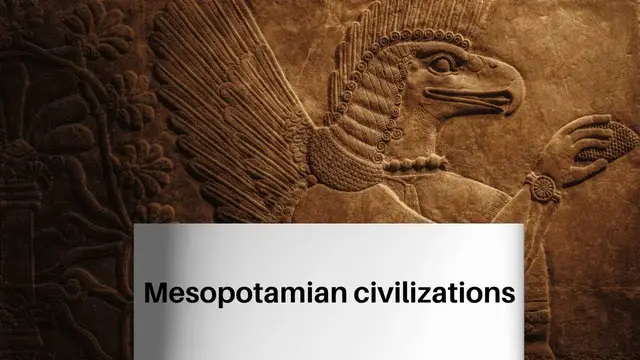

Mesopotamian civilizations
Aug 29, 2023

Mesopotamian civilizations: Flourishing; Unveiling the Rich Tapestry of Ancient Societies, Innovations, and Legacy
Mesopotamian civilizations: Flourishing; Unveiling the Rich Tapestry of Ancient Societies, Innovations, and Legacy
Introduction
The Mesopotamian civilization stands as a testament to human ingenuity and resilience, flourishing in the region known as the "land between the rivers" – the Tigris and Euphrates. With a history spanning thousands of years, this remarkable civilization emerged as a cradle of innovation, governance, and cultural development. From the emergence of city-states and the invention of writing to monumental architectural achievements and complex legal systems, Mesopotamia has left an indelible mark on the course of human history.
Geographical and Historical Context
Mesopotamia, situated in the present-day region encompassing modern Iraq, parts of Syria, and Turkey, was an ideal location for the rise of a sophisticated civilization. The fertile floodplains of the Tigris and Euphrates rivers facilitated agricultural prosperity, contributing to the establishment of settled communities. The earliest settlements date back to around 6000 BCE, gradually evolving into city-states by 3500 BCE.
The Birth of Urban Centers and Governance
The city-states of Mesopotamia, such as Uruk, Ur, and Babylon, emerged as hubs of economic, political, and cultural activity. These city-states developed complex societies marked by hierarchical structures and varying degrees of centralized governance. Temples, known as ziggurats, dominated the urban landscapes, serving as religious and administrative centers. Theocratic rulers often held power, representing the link between the divine and the earthly realms.
Innovations and Achievements
The Mesopotamians were pioneers in various fields, leaving an enduring legacy that continues to influence modern civilization. The invention of writing, exemplified by cuneiform script, was a monumental achievement. Initially used for administrative purposes, cuneiform evolved into a medium for recording literature, history, law, and religious texts.
The Code of Hammurabi, one of the earliest known legal codes, is a testament to the sophistication of Mesopotamian legal systems. Engraved on a stele, this code outlined a comprehensive set of laws and punishments, reflecting societal norms and class distinctions. It laid the foundation for subsequent legal traditions.
Architectural Marvels and Engineering Feats
Mesopotamia's architectural prowess is evidenced by its awe-inspiring structures. Ziggurats, terraced pyramid-like temples, were constructed to honor deities and demonstrate the power of city-states. The Hanging Gardens of Babylon, considered one of the Seven Wonders of the Ancient World, showcased the advanced irrigation systems that allowed the lush gardens to flourish in an arid region.
Trade and Cultural Exchange
Mesopotamia's strategic location facilitated extensive trade networks that connected it to distant lands. The abundance of resources like timber, metals, and agricultural products attracted merchants from neighboring regions. This exchange of goods also led to the cross-pollination of ideas, resulting in a rich tapestry of cultural diversity.
Religion and Cosmology
Religion played a central role in Mesopotamian life, with polytheistic beliefs shaping daily activities and societal structures. Deities represented natural forces, and rituals were performed to ensure favor from the gods. Temples were not only places of worship but also centers of economic and political power.
Enduring Influence
The legacy of Mesopotamia reverberates through the ages. The writing system paved the way for the development of alphabets and scripts used in subsequent civilizations. Legal concepts established in the Code of Hammurabi laid the groundwork for modern legal systems. The architectural innovations of ziggurats and intricate irrigation systems foreshadowed advancements in engineering and urban planning.
Conclusion
The Mesopotamian civilization stands as a remarkable chapter in human history, marked by its innovative spirit, architectural marvels, legal systems, and cultural achievements. As the cradle of urbanization, governance, and sophisticated societies, Mesopotamia's legacy continues to inspire awe and admiration for the ingenuity of those who once thrived in the land between the rivers. The enduring influence of Mesopotamia serves as a testament to the indomitable human spirit's ability to shape its destiny and leave an indelible mark on the annals of time.
#mesopotamia #mesopotamian
Show More Show Less