0:10
Hello friends in Padua, we asked
0:12
ourselves what we could share with you
0:14
for this World Pasta Day on October 25,
0:16
2026, and we decided to take you to
0:18
Artusi, one of the iconic pasta
0:20
factories in our province. Let us go
0:23
and discover together how the supply
0:25
chain of a pasta factory in our local
0:26
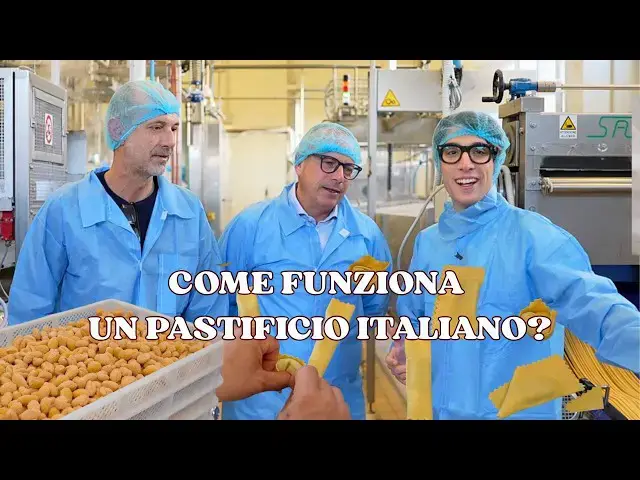
area operates. Let's go. I have been
0:34
joined by the two Artusi brothers, who
0:36
today will tell us about and show us
0:38
what their business is really all about
0:40
. Let me introduce them to you. Enrico
0:43
>> Buasere. Hi everyone. Who's
0:45
>> leaving? Hi Nicolò, thank you for
0:46
being here at Pastificio Artusi. We
0:49
were founded in 1998 and began
0:51
producing fresh pasta with a very clear
0:53
idea: to incorporate the territory into
0:56
our pasta, as well as the raw materials
0:58
we use. We are very happy to create
1:01
filled pasta every day that truly
1:03
reflects the territory. That's why we
1:06
use a lot of Asiago and Piave cheese,
1:08
we only use Italian wheat, and eggs
1:11
from free-range hens. In reality, we
1:13
will be Artusi's Italian pasta factory.
1:15
In fact, it is a special attention that
1:17
you rightly seek and put into the
1:19
product and then let me say that it is
1:22
>> Of course, because you know having the
1:25
Made in Italy label is a very important
1:27
label, especially for pasta which is a
1:29
symbol of our culture, of our tradition
1:32
and therefore for us it is essential
1:34
that there are raw materials that are
1:36
100%Made in Italy. Also because perhaps
1:39
it is too easy to put the Made in Italy
1:41
label on certain products these days,
1:42
so when it is really like this with a
1:44
certain amount of attention it is even
1:45
more beautiful. I imagine. Many Made in
1:47
Italy products are made in Italy
1:49
because they are produced in Italy, but
1:51
the use of Italian raw materials makes
1:53
it truly Made in Italy.
1:55
>> Enrico asked me, or rather I would like
1:57
to take this opportunity to thank you
1:58
because we organized this event
1:59
yesterday, so thank you for your
2:02
>> asked me before starting what I should
2:03
say. I would say that you have said
2:05
enough about everything at the first
2:07
>> if I may Nicolò I would like to spend
2:09
a few words about the blue crab because
2:11
you know that we were the first in
2:12
Italy to take this threat and we have
2:17
transformed it into an opportunity. We
2:19
placed it inside a ravioli because blue
2:20
crab meat is a pulp, it is called
2:22
sapidus, what does that actually mean
2:24
for us in this context? Flavorful. And
2:26
so for us it was essential to take this
2:28
raw material and transform it into an
2:29
opportunity. It is true, it is a threat
2:32
, it is a scourge that is really
2:34
bringing the fishing industry to its
2:36
knees, especially in the Polesine
2:38
lagoon. However, we are moving forward
2:41
with the idea that it can also become
2:42
an opportunity for the same fishing
2:44
industry because today they are
2:46
suffering greatly and so we can find a
2:47
new product, a new alternative and
2:49
honestly I can tell you if you haven't
2:51
tried it, it has an aftertaste that is
2:53
very similar to lobster. Our ravioli
2:55
has five ingredients, so ricotta made
2:58
from Italian milk, blue crab meat,
3:00
Sorrento lemon, PGI, salt and pepper,
3:03
>> We could have already said it all, it's
3:05
>> Well, I haven't tasted this, but I
3:07
agree with you that important
3:09
opportunities can be derived from
3:10
certain threats or theoretical threats,
3:12
especially in supply chains and
3:14
ecosystems of this type, so you are
3:15
doing well to enclose them in your
3:17
pasta and make them accessible to
3:19
everyone, in my opinion.
3:20
>> Exactly. Well, I have to let you taste
3:23
>> miss this. I miss this. I'm very
3:25
curious. Let's move on to production,
3:27
I'm curious. Sure, sure. Let's go,
3:33
>> trained ourselves properly to enter the
3:35
laboratory and now we'll have them tell
3:37
us directly, because those who probably
3:39
know the entire process better than you
3:42
, what happens from when you receive
3:44
the raw material to the finished
3:46
production and the shot to packaging.
3:49
As you can see, here we have Bigoli
3:52
>> great symbol of our tradition, a
3:54
>> great symbol of Padua. As you know, it
3:57
was found in a manuscript in Padua in
4:00
1604 and the pasta maker Bartolomio
4:02
Abbondanza was the first in Padua to
4:05
make bigoli al Torchio. So this product
4:08
is a must-have in a Paduan heritage
4:10
factory and it is a much-loved product.
4:12
>> How long does it take you to conceive
4:14
of a new product, considering both the
4:15
development of the recipe and the
4:16
actual production process? It might
4:19
work on the first try, or you may need
4:21
to perform 10 or even 15 laboratory
4:23
tests to make the final result look
4:25
practically near-perfect.
4:27
>> Sure. We have created some very
4:31
innovative fillings, but not always.
4:34
>> No, no, it's true, also because it is
4:37
not always easy to find a match with
4:39
people's palates, given how large the
4:41
market is and the subjectivity of the
4:43
palate, which I always remember,
4:45
everyone has their own opinion and
4:47
thoughts regarding flavors. Another
4:49
important point to add is that you are
4:51
not only present within the Italian
4:53
territory, so many recipes, as you were
4:54
telling me earlier, also have to be
4:56
adapted to the market. This is also
4:58
part of marketing, after all.
5:00
>> You know that Made in Italy is loved
5:02
all over the world, it is known all
5:04
over the world, but of course the
5:06
recipes must have the characteristics
5:08
of Italian culture, which must also
5:09
reflect what the European customer
5:11
wants, because we work all over Europe,
5:13
all the way to Hong Kong. For better or
5:16
for worse, you need to research the
5:18
tastes because in my opinion it is
5:20
right to maintain Made in Italy and
5:22
therefore be able to adapt the recipes
5:24
to the local foreign market while
5:25
maintaining the Italian tradition and
5:28
>> We have reached the last step, namely
5:30
the pallet. Now we have to move and say
5:33
goodbye to you, otherwise we too will
5:34
end up in some temperature-controlled
5:36
refrigerator along with the production.
5:39
Thank you for the tour; I adore these
5:40
things, and I enjoyed having the
5:42
opportunity to browse and discover so
5:43
many details regarding this specific
5:45
production. We were also able to pass
5:47
on and share some things with them. All
5:49
that remains for us to do is meet at
5:51
the table, sit down, comfortable, and
5:53
enjoy. Thank you, everyone. Enjoy your