Up next in 10


Let’s be honest, dieting for fat loss can be tough, and one of the main reasons is hunger! Utilising strategies that minimise hunger is crucial for adherence throughout a fat loss diet and in this lecture our Sports Nutritionist Jackson summarises some evidence-based hacks that are bound to help you in your fat loss journey. The influence of food viscosity, chewing food (would you believe!) and food palpability on hunger are all covered.
//Creative Commons Attribution Licence video (Reuse allowed)
Show More Show Less View Video Transcript
0:00
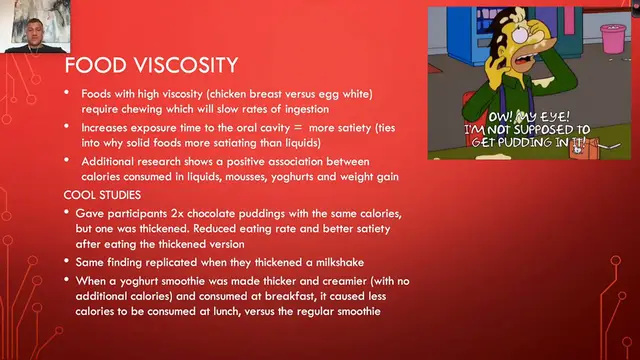
So we mentioned food viscosity which is again sort of how thick our foods are
0:11
Now the viscosity of something is known to impact how filling it is. So foods
0:21
with high viscosity, so like quite thick and solid things like chicken breast
0:26
they tend to require more chewing and basically slows the rate of ingestion
0:33
Something less viscous could be like egg white. We basically need less chewing and
0:38
the rate of ingestion can be quite fast. Foods with high viscosity which require
0:43
chewing, that increases the exposure time to the oral cavity, which we just said
0:48
enhances satiety further. And I think this is probably very similar to, as we
0:55
said, why solid foods can be more satiating for liquids because basically
0:59
when you're consuming liquid calories, the exposure time to the oral cavity is very short. Additional research has also shown that there is a positive
1:09
association between the calories consumed in liquids, mousses, yogurts with weight gain. So what that means is the more calories people consume from
1:22
liquids, mousses and yogurts, things that aren't very viscous, the higher their
1:27
chance of consuming more calories leading to weight gain. So a couple of
1:32
cool studies, three cool studies actually, which highlight this point. In one study they gave participants two chocolate puddings that had the exact
1:42
same amount of calories and macros but they thickened one of them. I guess they
1:47
would have just had to whip it or something like that. Because it was
1:51
thicker, it reduced the eating rate, so basically the time of ingestion and that
1:57
led to better satiety compared to when they just ate the non thickened version
2:04
They replicated this same finding using a milkshake. So basically they took a
2:09
milkshake and then they just made it thicker with no extra calories and the
2:13
thicker version was more filling. And then just finally with a yogurt smoothie
2:19
they made it thicker and creamier. I don't know how they made it creamier with no
2:23
extra calories but they did. When they consumed the thicker version at
2:28
breakfast it caused them to consume less calories at lunch compared to when they
2:34
consumed the non thickened and non creamed version. So chewing, what sort of
2:42
role does chewing have on our satiety response? Now I'm sure some people
2:48
can relate to being on contest prep or being in sort of the final stages of a
2:53
fat loss phase and just basically inhaling some of your meals when you're
2:58
really hungry and about six mouthfuls. That's probably not a great idea when
3:05
you're in a fat loss phase. So in this 2011 study they provided the
3:10
participants with an unlimited pesto pasta lunch on three occasions. So they
3:16
could eat as much as they wanted but on the first occasion they had to chew each
3:22
mouthful 10 times before they could swallow. On the second occasion they had
3:27
to chew 35 times before they swallowed and on the third occasion they could
3:31
just chew as much as they wanted. Now during the high chew condition, so when
3:36
they had to chew 35 times each mouthful, participants ate significantly less than
3:42
the other two conditions but they still felt just as much satisfied or satiated
3:46
So if you're in the tail end of a fat loss phase and hunger is high and
3:51
calories are low, taking more chews per mouthful may help with adherence by
3:57
providing more satiety. Food variation, this one you can come at it from a
4:04
couple of angles. So like there's benefits from consuming quite a varied
4:10
diet and those benefits include reducing the likelihood of nutritional deficiencies because you're basically consuming a highly varied intake of
4:23
different food sources with different macro and micronutrient profiles. We also know that consuming a highly varied diet can be linked with improved gut
4:37
health or gut bacterial diversity but there are also downsides to consuming a
4:44
very varied diet. Some of these include that your, this is more for those physique
4:51
athletes, it can mean that sort of monitoring your day-to-day weight movements becomes a lot less predictable and therefore that makes it harder to
5:00
make accurate calorie or dietary adjustments when they're required. But there's also a downside that applies specifically to fat loss phases which I
5:11
want to discuss. So again 2011, 2011 was the year for satiety studies clearly. So
5:20
all participants were allowed to eat as much macaroni and cheese as they desired
5:24
One group attended the mac and cheese session once per week for five weeks and
5:30
they were called the weekly group. Whereas the other group attended the session five times per week for one week and they were called the daily
5:37
group. In the daily group participants ate the most during the first session
5:43
and then intake progressively decreased each day after that. But in the weekly
5:49
group who just came in once per week the amount that they ate each session was
5:53
pretty much mostly the same. So what does this tell us? Well it tells us
5:58
that it's probably smart to reduce the variation in your diet or even adopt a
6:03
meal plan during a cut as you'll be less likely to overeat and people clearly eat
6:09
less of a food when they have it a lot. So I don't think you need to keep a low
6:16
food variation all year long because obviously you're going to be missing out
6:22
on those benefits we talked about at the top. But on the 12, 15, 16 week fat loss
6:27
phase I think it's just going to take a load off your struggles with managing
6:34
hunger if you keep to quite a short list of regular foods that you consume day in
6:40
day out. Food palatability, so how nice our food tastes. And this
6:50
sort of ties in nicely with what I was talking about with the flexible dieters
6:54
They are notorious for fitting in lots of nice tasting treat or junk style
7:03
foods. And again this looks really cool on Instagram and from people looking at
7:08
the outside they might think that the diet looks really easy because
7:13
they're fitting in all these foods that taste really nice. But the nicer your
7:19
diet is, which is sort of ironic, the nicer your diet is can actually make it
7:27
even more difficult to stick to as I'll show in this study. So they provided the
7:34
participants with their favorite food and told they could eat as much as they
7:38
wanted but just in five minutes. Then in a second testing session about a week
7:43
later they were provided with the same calories and macros that they consumed
7:49
during that pleasurable feeding session but this time it was served up in the
7:53
form of a non pleasurable blend of bread, milk and butter. Now this is where things
8:00
get kind of bit wacky and this is where sort of my head starts to spin a little
8:06
bit. So ghrelin, our hunger hormone, was higher so we were more hungry and CKK
8:13
which is one of our satiety hormones was lower during the pleasurable
8:19
feeding session. So what this is telling us is that when we had the really nice
8:24
tasting foods afterwards and during we were hungrier and less satiated but it
8:32
wasn't just a psychological thing it wasn't just like all this food tastes so good I want to eat more of it. This is actually going on on a hormonal level. So
8:40
the impacts of how nice our food tastes actually has the ability to impact our
8:46
hunger hormones. So the practical application of this during a cut it is
8:55
smart to stick to the less palatable foods because it's gonna be less likely
9:00
that you will overeat them and and some derivatives of that and this is sort of
9:06
blown up in the last I guess five years on the back of the flexible dieting and
9:11
if it fits your macros clan. You probably want to stay away or limit the low
9:19
calorie sweeteners or the Walden Farms or the 18 ingredient protein pancake
9:25
creations because although you might think okay this is gonna make my meals
9:30
taste a lot nicer with minimal less calories it's probably going to make
9:36
your diet even harder to stick to in the long term just because your hunger
9:41
becomes more difficult to manage based on the fact that when the foods taste
9:47
really nice our hunger hormones are gonna spike and our satiety hormones are
9:52
gonna be lower. Hey guys Martin here from JPS and unfortunately that's all we have
9:57
time for today this was a snippet from a Hunger Hacks lecture which is part of
10:02
our education portal. If you want to know more about the portal see the
10:07
description below and stay tuned for next week's video
Beauty & Fitness
Weight Loss
Cooking & Recipes
Health Conditions
Eating Disorders
Nutrition
Special & Restricted Diets
Healthy Eating