Up next in 10


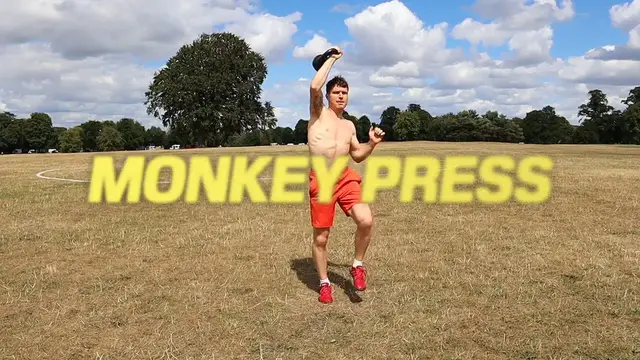
One of my favourite Kettlebell exercises for full body coordinated power and core strength.
The Monkey Press!
//Creative Commons Attribution Licence video (Reuse allowed)
Show More Show Less View Video Transcript
0:00
What's good YouTube
0:01
It's Tim here and today I want to teach you the monkey press
0:14
So maybe now you can see why it's called the monkey press. I know it looks a little bit funky
0:18
So I'm just going to break it down a little bit and share a few reasons why I really like this move and then I'll explain how to do it afterwards
0:23
So for me, the monkey press, if you think of any pressing move from the shoulder, normally
0:28
you've got things like strict press, right? Whether you've got a barbell or a kettlebell, where you're trying to focus very locally
0:34
on the shoulder muscle. Then you've got a thing like a push press where you use a bit of bounce from the legs
0:40
to start the movement off towards the shoulder, just to give it that little bit of a start
0:43
of motion. Now for me, this is the next step beyond that. Not only will you use the legs, but we're also using two halves of the body mixed with
0:51
rotation to generate some force to get the press to go. We separate the shoulder and the hips and we've got some core involvement here
0:59
We're learning to control the core and drive from the core. So I consider this more functional than a normal press or even a bent press because
1:08
we can run this through a locomotive filter because we've got this contralateral motion going
1:14
When we walk, we walk like this. With the monkey press, it's that exact same functional pattern happening within the core
1:20
of the body between the shoulders and the hip. In some ways, I consider this a type of sophisticated strength training
1:26
Yes, you can go local and do local strength. I think that's great. That's one end of the spectrum
1:30
Now I want to go to the other end of the spectrum where we use the whole body as one system
1:36
as one unit to make things happen. So we've got counter levers with the other arms
1:41
We've got the obliques getting involved. We've got the lats. We've got lengthening out of one side, getting full range of motion out of that side by getting
1:49
full contraction on that side. So it's a really whole body system movement
1:57
So I'm going to give it a go. All right. Now to start off with you, I'm going to get used to the coil action of the body without
2:03
a weight or maybe use a light weight if you want to begin. But I'll just demonstrate it without a weight
2:07
I'm going to put all my weight on my left leg so that I can lift my right leg off
2:11
So to do that, I'm having to sit into that hip. My left side is lengthened so my left shoulder is lifted and my left hip is driving down
2:19
So there's this length on that one side, which means my other side is shortened
2:25
So my right shoulder is going to my right hip and my right hip is kind of leaning forwards
2:29
a little bit. So I'm in this kind of, you can imagine I'm racked here
2:34
And then what we want to do is up steering almost this 180 line north to south with the
2:41
forearms here. Not quite though. And then I'm going to drive down with my right leg as I press up with my right arm
2:50
And along with that, I'm going to use my left elbow to drive down and compress using my
2:55
left oblique. And as I do that, that left hip is going to come and so the weight is going to swap from
3:00
my left side long to my right side. And you can see, it's almost like crawling or climbing a ladder, this kind of action
3:08
which relates to running and locomotion. So grab a light weight if you want to now
3:15
Racked, driving through with the knuckles. And really let it sit on the hips
3:20
A normal kettlebell, shoulders level like that. You might be used to that, right
3:24
You might be used to a push press. I mean, look, what's the arm do when we're doing a press
3:31
Do we do that? Naturally, people do that. Just instinctually, that feels better to balance
3:37
Now if we just lean into that, what's instinctual, what's balanced, if I allow the kettlebell
3:43
to sink in and I allow that leg to lift up. Now I've got two free limbs
3:49
You can imagine shot put, right? So I've got these two free limbs, which I can use now, free as counter levers
4:00
So this arm can swing down to the earth with gravity and this leg can stamp in
4:04
So kettlebell's in my right hand, but my right leg's off the floor
4:08
So this side's my short side and this side's lengthened. I've got really nice pelvis tucked here as well
4:15
Really good strength going off in the lower back and in the abdominals here
4:20
Elbow comes down, heel goes down, and I drive up. Now I'm balanced on the other leg
4:25
I've got a free hand and a free leg. If I've got the last mango and someone still wants it, I can still fight them off, right
4:34
So another beautiful thing here, when I'm able to balance like this, the weight is then
4:40
through my bones as much as possible. I'm not putting torque at an awkward angle through the joints
4:46
I'm stacked on the bones. I've got freedom to move with these limbs
4:50
Look at the length. We're getting full range, learning to lengthen that whole right side
4:55
You could even come up onto the ball of the foot if you want to get even more length
5:00
And I'd say just hang out in the beginning, hang out at the end of each position and really
5:05
reach through it. That feels so nice. And you've got your lateral line going off
5:09
From the fascial slings, you've got your lateral line, and we're coming down
5:13
So we're using the spiral line, cross body, and the lateral line, both working together
5:19
to make this happen. Another good way to practice it that I'd advise is maybe with your eyes closed as well in
5:26
each position and just feel around for what feels balanced. Feel can I move my body
5:34
Can I create any tension anywhere that will take weight off of a hot spot
5:38
So for me, I'm not arching the back like that. Tucking the pelvis under really helps support and set the weight so it's stacked neatly
5:47
through the leg. And as we come down, we lower it, exhale
5:55
See the opposite arm wings up. This is just, it's more comfortable here than here
6:00
Once you practice it a little bit, it feels the most intuitive. That's the weird thing about it
6:04
In the beginning, it can feel counterintuitive until it becomes more intuitive than what
6:08
you used to do. See the cogs? Cogs happening
6:21
Really fun move to try. I'd say try it slowly, explore the positions, try it with your eyes closed, try it with
6:29
a mirror, and finally try it with a step up. This is where you feel the rubber meets the road, where the cookie crumbles
6:37
So if it's in my left hand, my left leg is on the step
6:43
And as I drive down with the left leg, I drive down with the right elbow
6:49
I'm really like Superman punching to the sky. And there you really feel the cogs of the body
7:00
This jumping leg take off, you're getting strong through the jumping leg
7:05
You're really loading the outside of that hip because we're coiled on that side
7:11
We're properly loading the leg. We're not just neutral in the middle. We're going to the end range
7:16
We're feeling the edges of our body and using it the way it was designed
7:22
Jumping leg take off, punch, throwing, shot put. Incredibly functional. In the beginning especially, I would say really get used to the technique
7:34
Get used to the positions at the start and at the end and the transition in between
7:38
Get used to using the body as a full system so that it's not just coming locally
7:42
We're using the global network of the body. Then as you get better at it, you get more comfortable, maybe do three sets, build the
7:48
weight each set as you go. Do some with a step up
7:52
Maybe do all three sets on a step up. That felt really good. Maybe do one set with your eyes closed, one set with a mirror, one set with a step up
7:59
After three or four sessions, no doubt you'll be walking up the stairs and you'll feel that
8:04
explosive power coming from your legs. Thanks for watching guys. If you like this video and you like this type of content, please let me know in the comments
8:10
and I'll make more videos like this on other types of kettlebell patterns using the same
8:14
biomechanical advantage of the coiling core. If you want to learn more from me and about the biomechanics that I've got to teach, well
8:20
I've got the school of biomechanics. I'll link that down below. Other than that, I'll see you in the next video
#Beauty & Fitness
#Outdoors
#Extreme Sports
#Individual Sports
#Bodybuilding
#Fitness Equipment & Accessories
#Yoga & Pilates
#Other