Up next in 10

Business Advice for Small Business Owners Friday Finances ep 7 @jarrettcarpenter
Aug 20, 2024

Business Advice for Small Business Owners Friday Finances ep 7 @jarrettcarpenter
Show More Show Less View Video Transcript
0:00
Hello everyone. This is Grant and Jared of More Than Blockchain, and we're here to talk about
0:07
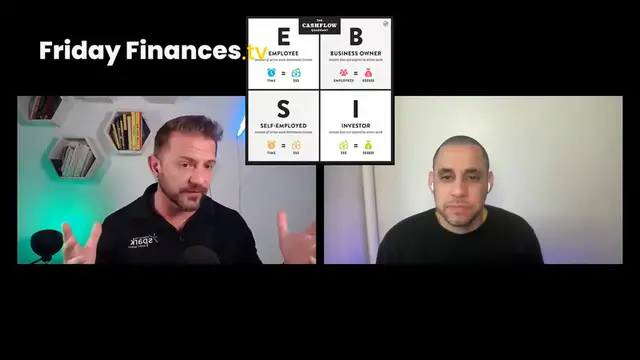
financial freedom. In the last few episodes, we covered the cash flow quadrant, which we highly
0:12
recommend you pick up the book by Robert Kiyosaki. We spent some time and talked about the
0:17
employee quadrant and the benefit of spending time in the employee quadrant because we think
0:23
there's a lot of shame around being an employee, but if you do it right, you can come out ahead
0:27
And then in our last one, we talked a bit about the pros and cons
0:30
but some of the nuanced advantages of self-employment. And today, we're here to talk about the business owner
0:37
Have you spent, Jared, any time as an actual business owner? So I have, but it's been very brief in my life
0:47
I got some funding back in 2015. I went down to Guatemala
0:51
I started a business. And I left that business in about 10 months
0:55
I left for a bunch of different reasons, which we could probably get into another episode
0:59
We talk about building businesses and choosing your partners and just making businessy decisions that are different from other relationship decisions
1:08
But yeah, that was the only time we kind of had an employee or employees
1:12
They were more like partners, but we were the ones at the end of the day. My partner and I were the ones at the end of the day, which got the funding and we're on, you know, on the note, on the contract
1:21
So that's it, you know, it was a really brief stint. I'm not sure, and I guess I'll say this, and then we'll get into your experience
1:30
I'm not sure in the future if I will ever be in a business, be in the business owner again
1:36
We'll just see. I think, and we'll get into this on the next episode, but I think I see myself more
1:41
it as an investor in businesses rather than a business owner myself
1:46
But there's a season for everything. And this is exciting because the employee is the quadrant that I am in that you are not in
1:54
but the business owner is the quadrant that you are in that I am not in
1:58
So what has been your experience as a business owner? Well, the first experience that I wish everyone would hear
2:06
and as I've been doing with each of these episodes, I try to get the most, what I feel like is the most important lesson at the front
2:12
in case you got to bail. The most important thing is if you don't have employees doing the work
2:19
you don't have a business. Quit using that term. I used to say I started my first business in 2001 with a web production company
2:29
We racked up something like 12 or 14,000 in debt or an American Express card and promptly went out of business because we didn't know what we were doing
2:38
And in hindsight, I should have only called that self-employment. And to your point, real quick, this is the second point I want people here
2:46
And that is, if you're thinking about a business, you need to know why you want to be a business owner
2:51
If you're doing a drop shipping company, you might be doing self-employment
2:56
You might be an investor. You're not a business owner. The defining factor is that you have employees doing the work for you
3:05
And I've gone now over the last eight or nine years, I've had moments where employees are doing everything
3:12
And I am truly spending days, not many days, but several days back to back where I don't actually have to do the business
3:21
I'm either working on future stuff or marketing stuff. I'm always working on my empire
3:26
So I've always kind of been involved in the business. I have never, though
3:31
I have a business partner who borrowed our brand, started early on
3:36
We kind of licensed partnered on that business, but I view that more as an investment than a business owner
3:44
And there's even definitions on debt incursion. So to be honest, there's a rise in solopinorship
3:51
based on the IRS and more and more quote unquote business owners are realizing can I just be a more highly leveraged self And there pros and cons because managing people is the top skill of being a business
4:07
owner and people be getting sick of people. The reasons you mentioned for leaving your venture in Guatemala
4:16
the reasons you listed were people reasons primarily. And there might have been other like market factors, but more often than not
4:23
people want to get out of being a business owner for people reasons. Sometimes it's clients
4:28
They don't like their clients. They don't like the type of clients they've begun attracting or they don't like
4:33
something interacting with employees or and that means they haven't successfully handed
4:37
that all. They're not good delegates and I would be the first to admit. I am not a great operator
4:45
And I only know that now because I've been a business owner for so long. I'm a killer
4:50
I have a high skill for sales, a high skill for sales, a high skill for. self-employment. But that's kind of my experience to date of there's benefits. If you can unlock
4:58
that, though, there's massive benefits. And honestly, that's where the leverage comes in
5:04
Like when you see enterprises and people dream about being Elon and all these different people
5:09
these people have mastered something about systematizing a scaled business. And that's the other
5:16
factor for businesses. An earmark of that, it has all the possibility of true scale and not just
5:22
scale. Again, you could build a drop ship company and go from selling $100 a week to $100,000 a week
5:30
That's still not what we consider scaling. To be honest, scaling is more scaling systems
5:38
scaling people, not just scaling SaaS sales or drop ship sales. It's a different factor
5:45
So that's my current experience, but you know, pros and cons. What are pros and cons that you can
5:50
imagine what were some of the benefits you had as being a business owner for the stint you were
5:55
well i think one of the benefits is that you get to call your own shots uh you get to make decisions
5:59
really quickly we've all been in organizations or companies where you sit there and you're like
6:03
they're not doing this right how do i get them to do it right maybe you find the way you talk to the
6:07
right people you have the right meetings they just don't want to change their opinion when you're a business owner you can move really really quickly and people will hate me for this maybe but like
6:15
iwan musk when he wants to do something at twitter he just gets a couple people in the room and then he makes
6:19
the call. And that's how it happens. So I think that that's a pro, but I think one of the cons
6:25
and I'm going to call my buddy out in not in a bad way at all. I actually think he's one of the
6:30
hardest working people I've ever been around. He runs a subcontracting construction business
6:36
essentially. I don't want to out him too much. But he has had employees in the past. And I don't
6:42
really think that they've ever understood what it takes to run a business. And they, some people will
6:47
learn from him and then they will leave and try to do their own thing and that's totally fine. Like that's the way that that's the, that's how construction works honestly many times
6:55
But I don't think they realize that when he says you have to be there at seven and I get there at
7:00
seven and for years off and on when I was unemployed, I would work with him
7:04
I would go carry cinder blocks and carry bags of concrete because I just was needing money
7:09
honestly, so I could take from my E as the employee and put it into the eye so I was feeling
7:14
okay. Yeah. But, you know, you work from seven to about 4 p.m. in the afternoon
7:19
but people don't realize he's up at 4.30 or 5 loading the truck. Yeah. And when he gets home
7:24
he doesn't just get home and then take a shower and he's just tired. No, he's probably working
7:28
until six or seven or eight or nine at night doing proposals, doing spec work, going over taxes
7:34
getting his receipts in order, doing all of this work. And yeah, he's starting to automate it
7:38
with QuickBooks. And he has a family member that helps him out on the book side. But I don't think that
7:43
I think one of the cons is you know if you going to have the responsibility and the accountability to be able to make the calls quickly at the top you also are going to have to be working hours that no one is going to see and that people are never really going to respect because they haven been there I think to be a pure business owner and to have people underneath you is a very rare thing in this world It rarer than people think because you are literally describing a self
8:10
How so? If he is working late hours to write invoices and proposals just because you have employees
8:17
doesn't mean you're a business owner. It's when employees are doing all of it
8:23
Yes. Yes. Yes, he has both. He has both. Well, he has both. During the day, he has employees
8:28
And I'm just saying, you know, on nights and on the weekends. So it's definitely a mix of both
8:32
It's not a pure business owner. It's not someone that shows up every quarter to talk to the board or whatever
8:38
And then doesn't see, doesn't even know, doesn't even have a relationship with the CEO or the C suite
8:43
No. I'm talking about more like the small business owner probably, which is I think a little bit more palpable
8:49
palatable for many people who are listening to this. Yeah. But yeah, but I do think that those are the con
8:55
When it, when it, the con is that you're probably going to work hours or do things on that are, like you're going to, you're going to take on more responsibility and more accountability
9:05
So if you mess up, it's a much bigger butterfly effect. Whereas if it messes up, it's okay
9:12
If the business owner messes up, it could be catastrophic. So you for getting the ability, this is also just what I've seen to getting the ability to be able to call the shots
9:21
you know, with great power comes great responsibility. A little Spider-Man quote for everyone out there
9:27
We call it the responsibility reward balance. Everyone wants reward, but they don't want the responsibility
9:33
But they're a molecule that you cannot separate. If you want reward, you have to first articulate
9:40
I am taking the responsibility. You're totally right. And few people get that unless they have been a business owner uniquely
9:49
because like I mentioned, a lot of the things he does in the morning
9:53
and in the evening sound like he switched back to the self-employed hat. But during the day he's got the business owner hat on
10:00
And when you have employees, they'll gripe about things. And you're dealing with these ethical dilemmas of
10:09
do I share with them? The ish I had to put up with just to put food on their table
10:16
And there's those dilemmas that occur quite often. And as we're talking about this, someone could even think about a Mark Zuckerberg or an Elon Musk and go, well, wait, Elon at Twitter doesn't sound like a business owner
10:28
He sounds like a self-employed. And you're absolutely right. There are moments where he acts like a business owner, but the better example in Elon's world is Tesla
10:37
Can he walk away from Tesla to work on Twitter? And it's still function, SpaceX
10:44
And it's like, yeah, they're pretty significant. and what we call that is Operation Vacation
10:51
And I know it sounds fancy, but you are a business owner. If you can give your cell phone to your employees for four weeks
11:01
and something's been marketed, something's been sold, something beens produced and delivered
11:06
something Ben's collected on, and then the team improved themselves. And we call that MSPBA
11:12
And if that could have happened in a four-week period and they didn't consult you in that process
11:18
You would have won the business owner merit badge in my book
11:24
And you said it earlier, though. That is rare. And I don't even think I've done that yet
11:30
Not purely. We took some time. There's been moments where we're like, this is in
11:35
And I was still doing huddles and check-ins, but I wasn't doing the work. I wasn't coaching the work
11:40
There were moments where I might do that for four days or a week and a half
11:44
but I still haven't done it for four weeks, honestly. Honestly. It difficult and it becoming seemingly unnecessary for financial freedom That where I wanted to go I think you said it on I not sure it was at the beginning of this episode or I think it was the end of the last episode
12:05
for the self-employed, but that the idea of the solopreneur is really the thing
12:10
Like I said, I believe on this episode that I don't really ever want to be a business owner
12:16
because I don't think I have to. I think I can leverage, you know, I could probably pay $3 or $400 of SaaS products
12:22
chat, GPT, premium. and just basically offer, basically be self-employed to a point where I'm so leveraged
12:30
And instead of using humans to leverage that, I can use tech to leverage that
12:35
And I also think that this goes back to the cash flow quadrant that, you know, Kiyosaki came up with this a long time ago
12:41
And I don't think he thought about the kid who's sitting in his basement and is going to have
12:46
a couple of VAs in the Philippines to do customer service. And he's going to have some other people, you know, he can hire someone off
12:53
Fiverr to do this. He can use Canva to do pretty good graphic design. He can get a website for
12:58
little to know nothing with card. He can put all this together and sell a product. And like you said
13:04
maybe make $100,000 a month. Then maybe he doesn't want to, as you said, the key thing about
13:08
being a business owner is the managing of egos, right? It's the managing of human beings
13:13
Human skills. I was the soccer coach for many years, college soccer coach for about four years
13:17
And the best soccer coach is you don't even have to know anything about soccer. I mean, yes
13:21
it helps, obviously. But you just need to manage the egos and make sure that the team is moving
13:26
forward. When they win, there's balances when they lose, and they just keep moving forward
13:30
So I think it's probably similar for a business owner, but I think we're at a good point
13:35
where we should transition and just say, what's one big takeaway from being a business owner
13:41
that is different and more leveraged than all the other quadrants? Each quadrant has its pros and cons
13:51
but each quadrant has the skill that's necessary. And for example, in the self-employment
13:59
you could have a technician skill and not be good at QuickBooks
14:03
and not be good at delegation, but still get compensated extraordinarily well
14:08
which I think is my recommendation to most people. In business ownership
14:14
you have got to have your eye on delegating and systemization. Or you have to have your eye on cultivating that skill
14:24
So let's say you say, I'm going to become a business owner for a season in order to see the importance and get the experience I need
14:33
to develop the ability to manage and delegate successfully. People do it all the time, but they do it poorly, how to do it well
14:41
And then the other side is how to, it's people in process. That's what we say, the two piece
14:45
People in processes and how to make those synchronized. Because then you could walk away from that venture, do it for yourself
14:51
or advise other people to do it or whatever. Or go back into employeehood as an employee and apply that awareness as an entrepreneur
15:01
and get that skill. So to me, you can't get that skill in many other places
15:06
So to me, the biggest takeaway is I do think people should do it
15:10
It's not the first thing I advise. In fact, if anything, I try to dissuade people from
15:14
doing it when they have the entrepreneurial urge to quit calling it a business
15:19
Let's do something with self-employment instead. But if you want to learn how to delegate people and how to create successful processes
15:28
putting that together is humongous. That's my takeaway. I love it. Let's transition here
15:34
And we will see everyone in the next episode where we're going to talk about the final quadrant
15:38
the investor quadrant. Yeah. And for all the other quadrants, for the E and the S
15:44
and our overall thoughts in the cash flow quadrant. Go ahead. Check the links in the notes here on the episode
15:50
And we will see you next episode. Thanks so much, everyone. See you
Business Finance
Venture Capital
Finance
Financial Planning & Management
Small Business