live_tv
Livestream Starting Soon
00
Hours
:
00
Minutes
:
00
Seconds
Up next in 10

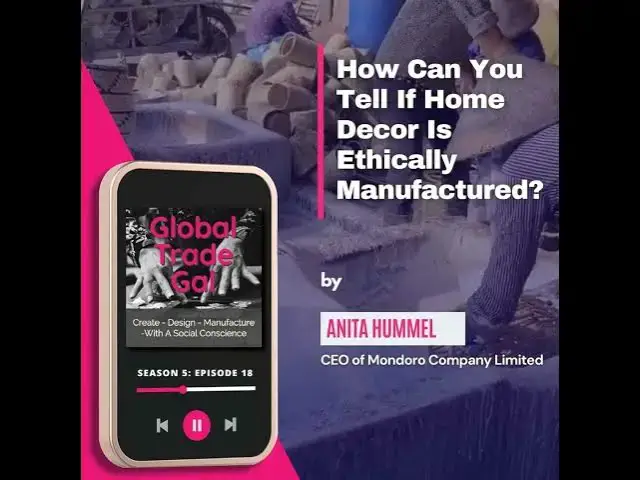
In today’s conscious consumer landscape, ethical manufacturing is no longer just a buzzword—it’s a growing standard that sourcing agents, retailers, and wholesalers must prioritize. More consumers want to know how products are made and who is making them, pushing companies to build transparent and responsible supply chains.
In this episode, Anita discusses what ethical manufacturing really means for the home decor industry and how companies like Mondoro put these principles into practice. You can read more by clicking here (https://mondoro.com/what-is-ethical-home-decor-manufacturing/) .
#GlobalTradeGalPodcast #HomeDecorManufacturing #EthicalManufacturing #SustainableLiving #SupplyChainTransparency #ConsciousConsumerism #ResponsibleSourcing #HomeDecorTrends
Support the show (https://www.paypal.com/globaltradegal)
Show More Show Less View Video Transcript
0:01
[Music]
0:07
hi this is Anita the global trade gal
0:10
today I want to talk a little bit about
0:12
ethical sourcing and exactly what does
0:14
ethical sourcing mean you know right now
0:17
in the global supply chain there's a lot
0:19
of these sort of like buzzwords and one
0:21
of the buzzwords that's out there is
0:23
ethical sourcing or ethical
0:26
manufacturing and what exactly does
0:28
ethical manufacturing mean and why
0:31
ethical factoring can matter well
0:33
ethical manufacturing home decor can
0:36
ensure fair labor practices in other
0:39
words but when we talk about fair labor
0:41
practices it doesn't mean that nec fair
0:44
labor or or the price that the cost that
0:47
somebody earns per hour in a country
0:50
like the United States or Europe needs
0:52
to be the same as somebody let's say in
0:54
India or Vietnam or even China it means
0:57
that somebody has a you know a safe and
0:59
clean working environment the
1:01
manufacturer can support some type of
1:03
environmentally sustainable production
1:06
promotes community well-being you know
1:08
when you go into a lot of these
1:10
factories in Asia you know you you might
1:12
look at some of these ladies that are
1:13
there you know weaving or doing other
1:16
types of work and there might be some
1:18
people say like "Oh I feel so sorry for
1:20
them how terrible that they need to do
1:23
this." But for them it might be "Wow I I
1:26
love being here because I have a
1:28
community this is sort of like my
1:29
community." and they you know sometimes
1:31
they're you know they're doing
1:32
production and other things and they're
1:34
sitting around there talking and maybe
1:36
gossiping or you know other things like
1:38
other people would do maybe in another
1:40
type of factories and for them this
1:42
could be their community this could be
1:44
their place where they feel they belong
1:46
it could be you know a factories uphold
1:48
strong governance and compliance
1:50
standards so all that has to do with
1:52
ethical sourcing and you might ask well
1:54
why does ethical sourcing matter let's
1:56
talk about what it means to be unethical
1:59
unethical practices could mean that you
2:01
know somebody's working in an unsafe
2:03
working environment you know unfair
2:06
wages or exploitative labor
2:10
child labor or forced labor and
2:13
environmental pollution and waste now I
2:16
can say that we in all of our factories
2:19
check and make sure there is no child
2:21
labor no exploitative labor or no slave
2:24
labor and you know today in Asia you
2:28
know I I really don't see that in most
2:30
of the good factories at least at the
2:32
factories at the level that we work at
2:34
in home decor and home furnishing you
2:37
know part of it could be that we're
2:38
working in a medium to high-end industry
2:41
and so because of that you know price is
2:43
important yes but quality is also very
2:46
important and so since quality is
2:48
something that's very important to us
2:50
that that means that we have to have
2:52
labor or we have to have people who know
2:54
what they're doing basically that if I'm
2:57
going to have somebody doing finishing I
2:59
need somebody who knows how to finish a
3:01
product and that will not be a child or
3:05
that will not be a slave labor so a lot
3:07
of the factories that you go in you know
3:10
in Asia today I at least have not found
3:13
this with you know child or slave or
3:15
exploitative labor um going on because a
3:18
lot of the factories require somebody
3:19
with some skill they need people that
3:22
have the skills that they require
3:24
especially in today's world of
3:26
manufacturing where machineries are
3:28
taking over more and more manufacturing
3:31
they need people who know how to run the
3:32
machineries they need people that can be
3:34
safe around the machineries they want to
3:37
ensure that their production is going to
3:39
continue where I think you find a lot of
3:42
the exploitative or unethical labor is
3:46
in areas or places where price is
3:49
extremely sensitive where somebody has
3:53
you know knocked down the price so low
3:55
on an item because they need to buy it
3:58
so cheap that the only way that the
4:01
manufacturer can really make it work is
4:04
through using this type of labor maybe I
4:07
believe in a good world that's doesn't
4:09
exist but I believe that a lot of the
4:11
managers of the factories they want
4:13
people working in their factories where
4:15
they're not going to have problems
4:16
because they don't want to have problems
4:17
with their production you know whenever
4:19
you have problems with your production
4:21
it kills a factory or kills the
4:24
manufacturing so they want to have the
4:26
labor in there that knows exactly what
4:30
they're doing they don't want to have
4:32
the people in there who don't know what
4:34
they're doing or who are going to not be
4:38
efficient not be effective they
4:40
essentially do not want people in there
4:41
who are going to mess up their
4:42
production cost them money and cause
4:45
problems so you might ask well you know
4:48
how do we my company Muro how do we
4:51
assume that the factories we work with
4:54
are you basically using ethical
4:56
manufacturing
4:58
practices at Muro in case you haven't
5:01
been listening we are b specialized in
5:03
home decor and home furnishing the first
5:06
thing we do is we conduct on-site
5:09
inspections my team and I are in the
5:11
factories we are actively in the
5:14
factories checking production It is just
5:17
part of what we do we a lot of times for
5:20
many of our products we may even inspect
5:22
you know 100% check everything because
5:24
of the fact that we're medium to
5:26
high-end we need to make sure what goes
5:28
out is correct we maintain open dialogue
5:31
with the workers we talk directly to the
5:33
workers we know many of the workers we
5:36
know who they are we we talk to them you
5:38
know in fact when we have a lunch break
5:41
my inspector and others might be over
5:42
there smoking a cigarette and playing
5:45
chess with the workers so you know they
5:47
know the workers on a friendly basis so
5:50
they know what is going on we have our
5:52
factories and others understand that we
5:54
prohibit child labor in or forced labor
5:57
on all of the operations that we work
5:59
with and they all understand that we
6:02
make sure there's a safe working
6:03
environment and we try to encourage all
6:08
any manufacturers we work with whether
6:10
it's submanufacturers vendors others to
6:12
be environmentally conscious wherever
6:15
possible and I should say that now in
6:17
Asia especially in countries like China
6:19
Vietnam and other places the environment
6:22
has become a huge issue in fact if you
6:25
go to China and you even come to Vietnam
6:26
there's a lot of electric vehicles here
6:29
electric vehicles more than probably you
6:31
know in places like the United States
6:33
the reason is because pollution is bad
6:35
they understand the pollution is bad so
6:37
the government cracks down on
6:39
environmental issues because they know
6:41
that this is a problem that they need to
6:44
have to deal with you know ethical
6:46
sourcing doesn't stop just at the
6:47
factory gate we believe in contributing
6:49
to community and wherever we can we try
6:51
to contribute to the factory the
6:53
community and work together with the
6:54
factory through charitable and other
6:56
type of organizations
6:58
ethical doesn't have to necessarily mean
7:00
expensive and that's one of the things
7:02
is but for us it means that a quality
7:04
product and as I mentioned before that
7:08
really most manufacturers need to have
7:11
skilled people in their factories
7:14
especially those that are dealing with
7:15
medium to higher end and as I've said
7:18
before and I'll repeat it again the main
7:20
problem is when that happens with child
7:22
or forced or other labor is where
7:25
somebody's going in and saying to
7:27
somebody you know there some a factory
7:29
says "Well I can only produce this for
7:31
let's say you know $3." And the then the
7:34
company's saying "Well I can only buy it
7:35
for $1.50." So you do whatever you need
7:37
to do and then the factory gets greedy
7:40
they get hungry they want to take the
7:41
order maybe it's a really large order
7:44
and so then they resort to some
7:46
unethical practices and I point this out
7:49
because a lot of times these problems is
7:52
on the buyer as well as the supplier in
7:55
other words if the buyer is pressing the
7:58
supplier for something which is
8:00
unreasonable and just cannot be done and
8:04
then the supplier gets greedy because
8:06
they really want to have that business
8:09
then they resort to unethical practices
8:12
i've written a blog post on this and
8:14
it's called what is ethical home decor
8:17
manufacturing we'll put a link in the
8:19
description you should we welcome you to
8:21
be able to read this and to understand
8:23
more about this also understand that you
8:26
know really when it comes to ethical or
8:28
unethical or when we talk about things
8:30
like child labor you know you can't
8:32
really all the time just put the blame
8:34
exactly on to the supplier because a lot
8:37
of times as I mentioned before it could
8:39
be the buyer making unreasonable demands
8:42
and I say this because of the the fact
8:45
that I have seen this myself in Asia or
8:47
heard about this myself in Asia where
8:50
somebody has put an you know a demand
8:52
upon a supplier that they just couldn't
8:54
do because it was just completely
8:56
unreasonable but then they got greedy
8:59
and said well look if I get slave or
9:02
prison or child labor then I can be able
9:05
to do it but if you're dealing like we
9:07
are in medium to higher end we need to
9:10
have skilled workers because of the fact
9:12
that we do not want to have quality
9:15
issues so we ensure that we have skilled
9:19
workers in there can that do the quality
9:21
of the product we require this is Anita
9:24
from Global Trade Gal thank you so much
9:25
for listening we hope that this has
9:27
given you a kind of a bit of a different
9:29
perspective on you know ethical sourcing
9:31
and some of the issues of maybe just the
9:33
global supply chain itself if you've
9:36
enjoyed this we hope that you'll
9:37
subscribe and that you'll leave us a a
9:40
rating give us a thumbs up we'd honestly
9:42
we'd love to have you be part of our
9:44
community because we appreciate you our
9:47
listeners
9:49
[Music]
#Home & Interior Decor
#Green Living & Environmental Issues
#Ethics