Up next in 10



Fossils are a fascinating record of life on Earth. In this episode of The List Show, you'll learn interesting facts about fossils, such as: How do scientists determine dinosaurs' colors? And why did one man pay $10,000 for a piece of counterfeit feces? In this episode of The List Show, Erin answers those questions and more as she discusses 26 Facts About Fossils.
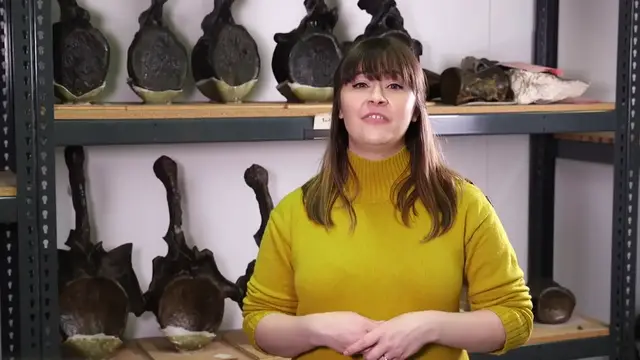
Lovers of dinosaur facts and paleontologists-in-training will want to watch. This episode, filmed inside The Big Bone Room at the American Museum of Natural History, features insider info from Senior Museum Specialist Carl Mehling and enough giant penguins to fill out a basketball team (and, possibly, your nightmares).
In case you forgot, The List Show is a trivia-tastic, fact-filled show for curious people. Subscribe here for new List Show episodes the first and third Wednesday of each month: https://www.youtube.com/channel/UCpZ5qUqpW4hW4zdfuBxMSJA?sub_confirmation=1
For more fossil fun and dinosaur facts, check out article, The 10 Coolest Dinosaur Discoveries of 2014: https://www.mentalfloss.com/article/60851/10-coolest-dinosaur-discoveries-2014
Don't miss a video! Subscribe NOW: https://www.youtube.com/@MentalFloss?sub_confirmation=1
About Mental Floss:
Mental Floss is where curious people come for trivia-tastic information. Mental Floss produces lists of fun facts, debunks common misconceptions, and tells untold stories from history, science, culture and more.
Website: http://www.mentalfloss.com
Twitter: http://www.twitter.com/mental_floss
Facebook: https://facebook.com/mentalflossmagazine
Copyright Notice: This video and YouTube channel contain dialog, music, and images that are property of Mental Floss. You are authorized to share the video link and channel, and embed this video in your website or others as long as a link back to this YouTube Channel is provided.
2025 Mental Floss
26 Facts About Fossils | Mental Floss
https://www.youtube.com/@MentalFloss
Show More Show Less View Video Transcript
0:00
Did you know that parrots used to be three feet tall
0:02
Hi, I'm Erin McCarthy, editor-in-chief of mentalfloss.com. In 2019, a paper published in the journal Biology Letters described the fossil of a parrot that
0:11
lived somewhere around 16 to 19 million years ago. The bones were originally found in 2008, but they were misidentified as an eagle because
0:18
you know, no one assumed there'd be a parrot that big. The bird, believed to be about 15 pounds, is now affectionately referred to as Squawkzilla
0:25
And that's just the first of many facts about fossils that I'm going to share with you today
0:30
You may have noticed that we're not in the studio today
0:40
We're in the big bone room at the American Museum of Natural History, where more than
0:44
a thousand fossil bones are stored. Which brings me to my next fact. Only two hundredths of a percent of the museum's roughly 462,000 vertebrate fossils are on
0:53
public display. Most of them are stored in behind-the-scenes areas like this, and used for research purposes
0:58
by paleontologists around the world. I'm here with Carl Melling, Senior Museum Specialist at AMNH, and he's brought one of his favorite specimens to show us
1:05
This is the beak bone of a triceratops from about 66 million years ago
1:09
It might not be obvious, but a beak is a growing tissue and needs to be supplied with blood during the life of the animal
1:14
And the rough surface shows the vascularization, or where the blood vessels were, that were underneath the beak that fed the living tissue of the growing beak
1:22
So that's how it was oriented in life on the upper beak, and we call it the rostral bone
1:26
Fossils are generally defined as the preserved remains, traces, or imprints of an organism
1:32
The common definition also requires that it be 10,000 years or older. When we think of fossils, most of us probably picture animal bones or teeth
1:39
These are known as body fossils. But there are also trace fossils, which are evidence of an animal's behavior
1:45
Things like footprints, nests, and even poop. Shout out to YouTube commenter Amtra1778 for knowing about trace fossils
1:51
The word fossil can be traced to the Latin term Fossus, which means dug up
1:55
That was also fossil's original meaning when it emerged around the 1600s
1:59
It began to mean preserved remains in 1736. It's not always easy to determine what a fossil used to be
2:05
Microfossils are fossils of bacteria or pollen or other things that you can't study with the naked eye
2:10
In 2017, paleobiologist J. William Schaaf and a team published a paper about the microfossil
2:15
microbes that he found in the early 90s. Schaaf claimed these rocks showed evidence of microbes from 3.46 billion years ago, which
2:22
would have made them, at that time, some of the oldest fossils ever found. Not everyone
2:26
was convinced. Some said the so-called fossils were just minerals that happened to look like
2:30
biological specimens. Schaaf and his collaborators worked for almost 25 years to prove that the rocks contained
2:35
the right carbon isotopes to have once been microbes, and their 2017 paper provided what
2:40
some in the field felt was compelling evidence, using Raman spectroscopy to yze the specimens
2:45
in question. Skeptics remain, though, including scientist Dave Wasey, who had issues with both the accuracy
2:50
of the methods Schaaf used and with the peer review process which led to the paper publication Wasey for his part was part of the team that discovered evidence for a different microfossil that once claimed the title of the oldest discovered fossil
3:01
It's not unusual for this kind of work to take a long time. In fact, even procuring the fossils can feel endless
3:07
For example, in 1989, William Zinsmeister found the fossil of an estimated 15-ton, 40-foot-long
3:12
elazimosaur, which is a plesiosaur that basically looks like a sea monster
3:16
But he found it on Seymour Island in the Antarctic, and as you might imagine, excavating
3:20
in the Antarctic isn't easy. Teams could only work for a few weeks out of the year and only when they had the financial resources. Excavation wasn't complete until 2017
3:29
But lest you think fossil finding is a modern phenomenon, humans have been discovering and
3:32
using them since very early in our history. At least one member of the Homo heidelbergensis
3:37
species, one of our ancestors from hundreds of thousands of years ago, created an axe that
3:42
prominently featured a fossilized sea urchin. People found fossils throughout history and didn't
3:46
really know what they were, which might help explain some ancient mythology
3:50
The ancient Greeks believed in Cyclopes. One popular explanation why? Around that area
3:55
ancient elephants once roamed. The empty space in their skull where the trunk would go, when
3:59
found by an ancient person, might have looked like the perfect spot for a single eye
4:03
There are many stories of people finding the large bones from creatures like mammoths and
4:07
interpreting them as having once belonged to giant humans. In 1712, Puritan minister Cotton
4:11
Mather, of Salem Witch Trial fame, stated in a letter to the Royal Society of London
4:16
that parts of a mastodon skeleton were evidence that there were giants in the Americas
4:20
and that those giants were taken out by the flood described in the Bible. People eventually started figuring fossils out, though
4:26
The first identified dinosaur fossil belonged to a megalosaurus. An array of its bones, including a large lower jawbone, were found around 1815
4:33
But it wasn't until 1824 that William Buckland published an article describing their previous owner as a reptile or, quote, great fossil lizard
4:41
A few decades later, an Archaeopteryx fossil was found, which contained both feathers and teeth, an unusual combination
4:47
Thomas Henry Huxley, certainly inspired by Charles Darwin's recently published On the Origin of Species
4:52
was the first to claim that dinosaurs and birds were relatives. In 1985, this fossil made headlines again when British astronomer Sir Fred Hoyle
4:59
and five other scientists claimed that the fossil, then sitting in the British Museum of Natural History, was a fake
5:05
that the feathers were pressed into the stone in modern times. But the museum has since proven those accusations false
5:10
Because this fossil was preserved inside limestone, there are two matching halves to it. Technology can show that the halves are identical
5:17
which wouldn't be possible if it were man-made. It wasn't until 1996 that the fossil of a non-avian
5:22
dinosaur was found with feathers. This was Sinosauropteryx. The feather impressions, also called dinosaur fuzz, contained preserved melanosomes, which helps determine what colors
5:31
certain dinosaurs were. Experts believe that Sinosauropteryx had a red and white tail
5:36
They've also found that the Ancheornis had black and white feathers with some red on its head
5:40
The ichthyosaur had dark skin. Unfortunately, this method can't be used for all dinosaurs
5:45
Some colors like yellow are produced through different pathways and they harder to identify In 2019 paleontologists published a paper about the proverbial day the dinosaurs went extinct Working in Hell Creek Formation in North Dakota they discovered fossils of fish which were
5:58
part of the 75 percent of the Earth's plant and animal species wiped out that day
6:02
Hell Creek is about 2,000 miles from where the asteroid struck that caused this destruction
6:06
And yet, the researchers claimed that it led to big enough waves in this particular river valley that many fish became buried under sediment
6:12
even had rock, which had supposedly rained down from the sky, in their gills. This research isn't
6:17
a sure thing, though, and some geologists argue that Hell Creek could have experienced these
6:21
geological changes without it necessarily having to do with that asteroid. I mentioned trace fossils
6:26
earlier, which are a great way to learn about how extinct animals behaved. Studying fossilized
6:31
feces, also known as coprolite, is an important part of paleontology, and some people are just
6:35
fascinated by it. For instance, in 2014, a collector bought a 40-inch coprolite at an auction for over
6:41
$10,000. That may have been a mistake. It came from a formation in Washington State where similar
6:46
items have been studied and were actually just the mineral ciderite. And I have to say, if you're
6:51
buying counterfeit poo for $10,000, it might be time to hand over the family credit card
6:55
This next blurb had some pretty hard to pronounce words, so we're going to have Carl help us out
7:00
Sometimes fossil finders have a little fun with their discoveries. In 1985, Australian scientists
7:05
discovered the fossil of an ancient python in Riversley, Queensland, Australia, which they named
7:09
Monty Pythonoidis riverslyensis. Despite the apparent connection to the British comedy legends
7:14
the official explanation for the name claimed that it was because, quote, it was found on a small hill or monte and was broadly like present-day pythons
7:22
Hmm. Sadly for us comedy fans, it was later renamed Morelia riverslyensis
7:28
Thanks, Carl. In 2014, a species from 19 million years ago was discovered
7:33
It was a mammal, related to the hippopotamus we know today, and it had large lips
7:37
So one of its discoverers, Ellen Miller, named it the Jagmerix naida, or Jagger's water
7:42
nymph, after none other than McJagger. You certainly heard of Lucy, who lived 3.2 million years ago and was found in 1974
7:50
At the time of her discovery, she was the earliest and most complete skeleton of an ancient hominin
7:55
Donald Johansson was the first to see her bones in Ethiopia, and that night, his team
7:59
was listening to a Beatles cassette when one of them suggested her name, inspired by the
8:03
song Lucy in the Sky with Diamonds. For the record, we now have remains of much older hominins than Lucy
8:08
In 2018, we learned about an exciting mammalian relative that reproduced more like a reptile
8:13
than a modern mammal. Researchers Ava Hoffman and Timothy Rowe found the skeleton of a Kay Wellzie that was buried
8:18
with at least 38 offspring, which is considerably more than modern mammals have in a litter
8:23
Thank goodness. Another exciting fill-in-the-gap discovery was Panthera blythea in 2010. This was the skull of a big cat, a relative of the snow leopard, which showed that big
8:32
Big cats actually lived around 6 million years ago, earlier than previous fossil evidence had indicated
8:37
It also shows that big cats evolved in Asia when it had been thought that they had evolved exclusively in Africa
8:42
Another interesting type of fossil is fossilized resin or amber In the 1990s scientists found a mosquito that had sucked on dinosaur blood which they were able to use to extract dinosaur DNA and
8:53
just kidding. That's not the fact. That's the plot of Jurassic Park. Anyway, many trees contain resin, which can turn into fossils
8:59
and when there are critters inside, we can learn about their ancient lives, too. For instance, in 2017, a paper was published showing that ticks used to suck the blood of dinosaurs
9:07
Scientists already knew that ticks existed back then, but figured they went after other animals
9:12
But fossilized amber was found containing a tick from 99 million years ago holding onto
9:16
a dinosaur feather. Fossil records can demonstrate the incredible diversity of life on our planet, like the
9:22
fact that some crocodile relatives were actually herbivores. A different crocodilian was only 20 inches long and so mammal-like that it was named
9:29
Cat Crocodile. We need to get that Jurassic Park technology ASAP so I can adopt one of those cat crocodiles
9:35
I think I'd name it Sparkles. In 2011, construction worker Sean Funk found the skeleton of a 110-million-year-old dinosaur
9:42
at a work site in Alberta, Canada. This borealapelta was a victim of what experts call bloat and float
9:48
The animal dies, which causes it to bloat with gases, then floats through the water until
9:52
it loses that gas and sinks. But 1.5 tons of dinosaurs sinking causes quite the disturbance
9:58
So this borealapelta got covered in sediment, preserving it amazingly. The Bone Wars took place in the late 19th century
10:05
Many paleontologists were rushing to identify and name a bunch of dinosaur species, including
10:09
notably, Edward Cope and Othniel Marsh. Marsh named the Apatosaurus in 1877 and the Bronosaurus in 1879
10:17
Then in 1903, paleontologist Elmer Riggs officially stated that this was the same genus, so the
10:22
Bronosaurus was an Apatosaurus, because the first to be named keeps its name
10:27
But then, in 2015, a 300-page study was published that examined 81 sauropods
10:31
Though it wasn't the original intention of the study, it concluded that the Apatosaurus
10:35
and the Brontosaurus are indeed different enough to be considered separate animals
10:39
It claimed, amongst other differences, that the Brontosaurus has a higher, thinner neck
10:44
Not every paleontologist subscribes to this distinction, though. Fun fact, as we were discussing the Bone Wars, Carl told us that AMNH actually houses the
10:51
majority of Edward Cope's specimens. This one is around 150 million years old, and it's part of the pelvis
10:57
You know, the butt bone. Finally, we started with a large bird, so let's end with one
11:01
In 2018, a fossil of the Crossvalia waiparensis was discovered in New Zealand
11:06
This prehistoric penguin lived between around 56 and 66 million years ago
11:10
And based on the skeleton, researchers determined that it was about 5'3'' tall, which is taller
11:16
than me. The amazing thing? That doesn't even make it the tallest penguin predecessor in history
11:21
Paleodyptes klikowsky could have been 6'5". Now I can't stop thinking about a basketball team made up of penguins
11:28
And maybe we'll let Squaxilla be the point guard. Our next episode is about things we learned in 2019
11:33
Leave your favorite scientific or historic discovery of the year in the comments for a chance to be featured in that episode
11:38
That will go up on December 18th. Make sure to subscribe here so you don't miss it
11:42
We'll see you then
education