Up next in 10



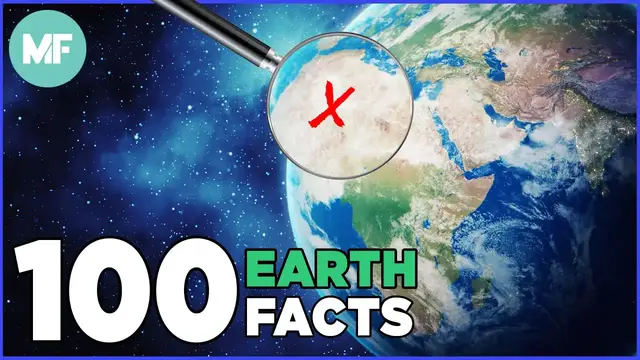
Facts about Earth can touch on geology, biology, and astronomy, among many other subjects. The surprising Earth facts in this episode of The List Show will hopefully give you a little more appreciation (and many more fun facts) about our planet.
Erin (@erincmccarthy) shares a whole lot of facts about the planet Earth, from the etymology of the word earth to weird gravitational anomalies (and the reasons behind them). You'll learn which type of organism makes up the majority of life on Earth, and which planet inspired albums by Joe Walsh and Marvin Gaye (hint: it isn't Mars).
In case you forgot, The List Show is a trivia-tastic, fact-filled show for curious people. Subscribe here for new List Show episodes the first and third Wednesday of each month: https://www.youtube.com/channel/UCpZ5qUqpW4hW4zdfuBxMSJA?sub_confirmation=1
Don't miss a video! Subscribe NOW: https://www.youtube.com/@MentalFloss?sub_confirmation=1
About Mental Floss:
Mental Floss is where curious people come for trivia-tastic information. Mental Floss produces lists of fun facts, debunks common misconceptions, and tells untold stories from history, science, culture and more.
Website: http://www.mentalfloss.com
Twitter: http://www.twitter.com/mental_floss
Facebook: https://facebook.com/mentalflossmagazine
Copyright Notice: This video and YouTube channel contain dialog, music, and images that are property of Mental Floss. You are authorized to share the video link and channel, and embed this video in your website or others as long as a link back to this YouTube Channel is provided.
2025 Mental Floss
100 Facts About Earth | Mental Floss
https://www.youtube.com/@MentalFloss
Show More Show Less View Video Transcript
0:00
Did you know that the Earth is the only planet in our solar system that doesn't get its
0:03
name from Greek or Roman mythology? Hi, I'm Erin McCarthy, editor-in-chief of MentalFloss.com
0:09
Earth derives from the Old English aiorthe, meaning ground, soil, dry land
0:14
The same term was also used to differentiate between our domain, the underworld, and the heavens
0:20
Keep in mind, this was before our modern conception of planets. The fact that we needed a way to refer to our planet before we even really figured out
0:27
what a planet is probably helps account for the murky history around the word
0:31
It's impossible to say who first used the word Earth, or one of its antecedents, to refer
0:35
to the astronomical entity that is the Earth. One usage probably just bled into another as our scientific understanding expanded
0:42
And those two facts about the word Earth's sorta unsatisfying etymology are just the
0:46
first of 100 facts about Earth that I'm going to share with you today. So where are we? Other than my living room, that is. Earth is in the Milky Way galaxy
1:03
the third planet from the Sun in our solar system. According to NASA, it takes about
1:07
eight minutes for light from the Sun to reach us on Earth. That means that the light being
1:11
emitted from the Sun right now will reach my window later in this video. Physics is weird
1:16
We're about one astronomical unit away from the Sun, and that's not some great coincidence
1:21
Historically, an astronomical unit was just the average distance from the Earth to the
1:25
It gave scientists a shorthand for communicating distances. New York to California? About .00003
1:32
astronomical units. See? Easy. If you want to look at things on Earth at a slightly more manageable scale, you should
1:39
get out a map. Maps have been around for a long time. The oldest surviving maps are thousands of years
1:44
old. There's thought to be a map of the stars found in the Lescaux Caves of France that
1:48
dates back to 14,500 BCE. There might also be a map of local landscape features of what
1:55
is now the Czech Republic carved into a mammoth tusk that dates back to 25,000 BCE. I say
2:01
might be because it can be a bit tricky when looking at millennial old carved tusks to
2:05
differentiate between abstract drawings and intentionally plotted maps. But there are proponents of the 27,000 year old tusk map. Jigsaw puzzles were originally just chopped
2:14
up maps. When they were invented around 1760, they were used to teach kids about geography
2:20
fitting the various countries together in order to make a map of the world, or more commonly
2:25
Europe. The earliest surviving map of the world is the Babylonian world map, which dates back to
2:29
the 6th century BCE. The clay tablet contains a labeled depiction of the known world, centered
2:34
around the Euphrates River. It's currently housed in the British Museum. The Babylonian world map
2:39
wasn't very accurate, but even modern maps aren't perfect. Far from it. The common map we all
2:45
probably have in our heads is based on the Mercator projection. This map preserves the shape of land
2:49
masses, but stretches the area of regions closer to the poles. It's been the standard model of maps
2:54
for centuries, but it's mainly beneficial for sailing, not accurately depicting the
2:58
relative size of objects. Because of the size distortion of Mercator projections, certain
3:03
countries like Greenland are depicted as being massive. Picture Greenland in your head right
3:08
now. It's almost the size of Africa, right? Well, in reality, Greenland is about the size
3:12
of the Democratic Republic of the Congo. About 14 Greenlands could fit inside of Africa
3:17
Thanks to YouTube audience member Melissa Burton for commenting about the distortions
3:21
in common maps. Our next episode is all about the real origins of urban legends. If you
3:26
know one, drop it in the comments below for a chance to be featured in that episode
3:29
The Mercator projection inflates the apparent size of Antarctica to such a degree that most
3:33
publishers choose to cut it off, which often results in world maps with Europe near the
3:38
vertical center. The equator can end up about two-thirds of the way down the map, even though
3:42
being in the middle of the world is kind of the equator's thing. Some see an implicit
3:47
political statement arising from these distortions. When Boston public schools decided to stop
3:51
purchasing Mercator projection maps for their classrooms, an official framed it as part
3:55
of an effort to move past what they said was a view that is very Eurocentric
4:00
A more full-throated criticism comes from Mary Ann Franklin, professor of global media
4:04
and politics at Goldsmiths, University of London, who said that distorted projections
4:08
like Mercator's quote, underpin the ongoing Anglo-Euro-American presumption that the world belongs to them and pivots around these geocultural axes
4:17
In the case of the Boston Public School System, they decided to start purchasing maps based
4:21
on the Gal-Peters projection, which offers a more accurate depiction of size and area
4:26
It has its own drawbacks, though, as it distorts the shapes of continents
4:29
Some cartographic historians, like Professor Matthew Edney at the University of Southern
4:33
Maine, favor the Eckert-Ford projection, which preserves proportionality without distorting the shape of continents as much as the Gal-Peters
4:40
The fact is, there are some basically insurmountable obstacles when attempting to perfectly represent
4:44
a three-dimensional planet in two-dimensional space. If only there were some kind of globe-shaped device
4:51
The first known globe is said to have been created in about 150 BCE by a philosopher
4:56
named Crates of Malus in Cilicia. The idea of a spherical Earth was considered around 500 BCE by Pythagoras, but if anyone
5:04
thought to create a globe at the time, the evidence has been lost to history
5:07
A century and change later, the Greek philosopher Aristotle was clear that the Earth wasn't flat
5:13
He wrote about how moving from north to south meant seeing different stars in the sky, the
5:16
result of a changing horizon which wouldn't occur on a flat Earth
5:20
Aratosthenes used observations of how high the sun rose in two different Egyptian cities
5:25
along with some relatively simple math, to create a rough estimate of the Earth's circumference
5:30
Despite his rather crude methods, his estimate was in the right ballpark
5:34
That was more than 2,000 years ago. The oldest surviving globe was created in 1492 by a German astronomer named Martin Beihem
5:42
The globe, named Erdipfüll, which literally means Earth Apple, is an important piece of
5:46
history that documents our simultaneously broad and limited understanding of the Earth
5:51
It contains a myriad of errors, including a couple of mythological islands throughout
5:55
the Atlantic Ocean. But give Beihem a break. He didn't have Google Earth to fact check
6:00
Another of the oldest surviving globes, the Hunt Lennox Globe from around 1510, is also
6:04
one of the few historical appearances of the phrase Hicsunt Dracones, or Here Be Dragons
6:09
The Latin phrase appears below the equator off of Asia, which might be a reference to
6:13
the Komodo dragons in the Indonesian islands. In 1519, Spanish explorer Ferdinand Magellan departed Spain with five ships and demonstrated
6:21
that the globe could be circumnavigated, laying to rest any lingering doubt about its shape
6:26
Magellan died during the voyage, and of the five ships, only one completed the circumnavigation
6:31
During the 18th and 19th centuries, it was considered somewhat fashionable for middle-class
6:34
men of the world to carry around a pocket globe, which is a tiny two- to three-inch globe
6:39
that fits right alongside your pocket watch. On the other end of the spectrum, the largest globe in the world is called Urtha, coming
6:45
in with a diameter of just over 41 feet. It was developed by the DeLorme Mapping Corporation and is now housed in an atrium in Yarmouth, Maine
6:53
Guinness World Records awarded it the title of largest revolving globe in the world in 1999
6:57
Urtha still holds that record today. And while globes can represent the planet in interesting ways, it's hard for them to
7:04
compare with the majesty of actual photographs of our planet made possible by advances in technology
7:09
On February 14, 1990, NASA's Voyager 1 spacecraft took a picture of the planet from roughly
7:14
four billion miles away. It depicts the Earth as little more than a speck in the universe
7:19
It was taken at the behest of Carl Sagan, who later wrote about it as, quote, a mote
7:23
of dust suspended in a sunbeam. He called it the pale blue dot
7:28
Earth has also proven to be quite the muse for musicians. Marvin Gaye's 1971 hit Mercy Mercy Me was about ecological conservation
7:35
Joe Walsh made an entire album, Songs for a Dying Planet, about it
7:39
In 2015 Paul McCartney Sean Paul and Natasha Bedingfield among others recorded Love Song to the Earth an all composition to raise awareness for climate change Artists have also taken inspiration from the earth in more high ways namely from
7:53
Google Earth. Belgian-born artist Miska Henner uses satellite images as the basis for works like 51 U.S
7:59
military outposts, which features photos of supposedly low-key military installations. Not only has Earth been a favorite subject of artists, it's also been a favorite art material
8:08
The conceptual art movement in the 1960s and 1970s brought with it a style known as land
8:12
art or earth art, which used soil, rocks, sand, and other humble materials to create pieces
8:18
One of its major figures was Robert Smithson, who actually created pieces out in nature
8:22
like Spiral Jetty, made out of earth and basalt. One of the most spectacular earth artworks is Celtic Horse in Slovakia, a 330 foot by
8:30
330 foot geoglyph, otherwise known as a stone sculpture. the artist Andrew Rogers has created over 50 geoglyphs, working in 16 countries and all
8:39
seven continents. Earth has also been a rich source for science fiction. Jules Verne's
8:44
Journey to the Center of the Earth, which was published in 1864, illustrates the hazards
8:49
of descending into the Earth, where the book's protagonists encounter Jurassic Sea monsters
8:54
Perhaps less influential is the criminally underappreciated and objectively bad 2003 film
9:00
the core, which features Stanley Tucci as part of a motley crew going to the center of
9:04
the Earth to set off a series of nuclear bombs because...reasons. If we were to make our own informational journey to the core, we'd start at the crust
9:12
Or, actually, we'd start about 4.5 billion years ago, when the Earth was a more or less
9:17
uniform ball of hot rock. Where does that 4.5 billion figure come from
9:21
Well, the Earth is thought to be about 4.54 billion years old, plus or minus about 1 percent
9:27
After all, what's 50 million years or so between friends? That number is the result of observation, radiometric dating, and a bit of educated guesswork
9:35
Scientists sometimes look for the oldest rocks they can find here on Earth, and yze the
9:39
radioactive isotopes within them to determine their ages. Rocks at least 3.5 billion years old have been found on every continent, and zircon crystals
9:48
in Western Australia can be dated as far back as 4.4 billion years ago
9:52
One problem with this method is that plate tectonics can destroy and recycle some of the
9:56
its oldest rocks, making them less useful for aging the planet. Thankfully, we have a near neighbor, the Moon, that has not been disturbed by plate tectonics
10:05
and therefore has many more ancient rocks to collect. Astronauts collected some of these moon rocks back in the 60s and 70s, some of which were
10:12
eventually dated to between 4.4 and 4.5 billion years ago. Our current best estimate for the Earth's birthday, henceforth known as Earth Day, which
10:20
won't be confusing for anyone, comes from synthesizing a number of different data points
10:25
Radiometric dating of meteorites gives us an idea of when the solar system formed, and
10:29
yzing the composition of different isotopes of lead here on Earth helps researchers determine
10:34
how much time would be required to get to these particular compositions
10:38
The resulting estimate, that Earth is 4.54 billion years old, is offered with a relatively
10:44
high degree of certainty, but questions remain. We're not sure how quickly the Earth formed, for example
10:50
A study published in February 2020 by researchers at the University of Copenhagen suggested
10:54
that the Earth formed in about 5 million years, decidedly faster than previous estimates in
10:59
the tens of millions of years. The study's authors suggest that the planet formed through
11:03
the accretion of cosmic dust, rather than through a series of random collisions between
11:07
celestial bodies. 5 million years might still sound like a lot of time, but if you map the
11:12
roughly 4.6 billion year history of the solar system into a single 24-hour cosmic day, then
11:17
the Earth's formation, in the researchers' understanding, took only about 1.5 minutes
11:21
of that cosmic day. After about 500 million years, the Earth had heated to the melting
11:26
point of iron, about 2800 degrees Fahrenheit. This period of super-hot temperatures were
11:31
kind of like the planet's adolescence, a period of volatility that helped it become
11:36
the Earth we would eventually know and love. The high temperatures facilitated greater
11:40
movement of Earth's rocky, molten material. Buoyant materials like water, silicon, and
11:46
oxygen tended to float to the surface, forming the planet's early mantle and crust. For
11:50
For the first two billion years of Earth's existence, though, there wasn't any atmospheric
11:54
oxygen to take in. At some point, cyanobacteria used the energy from sunlight to make sugar out of water and
12:00
carbon dioxide. You might know that process better as photosynthesis. Cyanobacteria produced oxygen as a waste product
12:08
Science still isn't sure why cyanobacteria grew from single-celled to multicellular organism
12:13
and began to produce oxygen in amounts sufficient to fill the atmosphere, but they did, resulting
12:18
in what's been dubbed as the Great Oxidation Event. Without the Great Oxidation Event
12:22
we wouldn't have had the Cambrian Explosion, an evolutionary benchmark that saw a bonanza
12:27
of life-forming, including cordates, which include vertebrates, and many hard-bodied animals like brachiopods that lived in shells. It's known as an explosion even though it
12:36
may have taken up to 20 million years. Fast forward a few hundred million years to today. The Earth's exterior has cooled and
12:43
is now divided into two different types, continental crust, which averages between 18 and 30 miles
12:48
thick, and oceanic crust, which averages 2 to 4.5 miles thick. It's composed mostly of igneous rocks
12:55
and it contains all known life in the universe. And that's a lot of life. Scientists have identified
13:01
about 1.2 million species of plants and animals, but by some estimates, that leaves another 7.5
13:07
million species on the planet still to be discovered. Some estimates predict that we
13:11
have even more work to do, pegging the number of total species on the planet in the neighborhood of
13:15
1 to 6 billion. That estimate comes from a group of scientists at the University of Arizona, Tucson
13:21
who published a piece in the Quarterly Review of Biology back in 2017 which suggested that
13:26
bacteria could make up 70 to 90 percent of species on Earth. When it comes to biodiversity
13:31
Earth is still very much an undiscovered territory. For all that diversity, it's estimated that humans
13:36
and farm animals make up an astounding 95 percent of all vertebrate land animals
13:41
with wild vertebrate land animals representing just 5% of the total. That's one reason why a lot of scientists believe we're facing an environmental crisis
13:49
We consume a lot of Earth's natural resources. Between 25 and 40% of all energy captured by plants
13:56
is used by humans and livestock. So what are the dominant species on the planet
14:00
Humans? Well, maybe in terms of resources, but in terms of sheer numbers, over 80% of known species
14:07
over 1 million are insects. If you've ever had ants invade your living space
14:11
face, you're probably not surprised. Ants, however, don't bring the numbers when it
14:15
comes to sheer population density. The columbula, or shrimp-like springtail, is an insect relative
14:20
and a very tiny .25 to 10 millimeters in size. Roughly 10,000 of them can be found in just
14:26
one cubic meter of soil. Depending on the location, that number can grow to 200,000
14:31
Chances are that the next time you're standing on solid ground that's not paved over, you're
14:36
standing over a lot of springtails. If you want variation in subspecies, consider the
14:41
beetle. Scientists have named over 400,000 species of the insect so far, with more certainly
14:47
on the way. That means between one in three or one in five described life forms on the
14:51
planet is a beetle. And while we're talking biodiversity, you should know that there are three different
14:56
types. Genetic diversity is the different genes in individuals. Species diversity speaks
15:01
to the differences between populations of species and between different species. And ecosystem
15:06
diversity is the variety of habitats and processes occurring in a given setting. The next time
15:10
you pop a prescription or over-the-counter drug to alleviate a headache or other malady
15:15
consider raising your glass of water to biodiversity. Most of the drugs developed in the past century were derived from plants, bacteria, and fungi
15:21
Willow bark gave us aspirin, and in 2018 there were reports about a new potential antibiotic
15:27
from the soil of a churchyard in Ireland that according to the BBC has long been a folk remedy Just four crops maize rice and soybean responsible for two of the world food supply To reduce carbon footprints researchers are hoping to rely more on 7 other crops that
15:43
humanity has farmed in the past. Maybe one day you'll be making pancakes with moringa leaves instead of flour
15:49
Colombia is thought to be the most biodiverse country on the planet by area, with 1 in every
15:53
ten species of flora and fauna found there, including more species of birds and orchids
15:58
than anywhere else. Its many ecosystems enable this diversity. In fact, you could hike from
16:03
a desert to a tundra in Columbia in just a few days. Whoa, we're halfway there. Whoa, living on planet Earth
16:13
That's good. No, you don't think so? All the plants and animals we've mentioned are found on the Earth's crust, which is also
16:22
where you'll find the Earth's oceans. Despite what you might have learned in middle school
16:26
there are actually five major oceans. The Atlantic, Pacific, Indian, Arctic, and Southern Oceans
16:31
Most countries now recognize the Southern or Antarctic Ocean as a unique major ocean basin
16:36
but it's still pretty common for some sources to only recognize the first three or four
16:40
There are even some who only recognize one world ocean, but in the words of our fact checker, and I
16:45
quote, they're really annoying. Either way, the oceans are truly Earth's treasure. No, literally
16:51
It's estimated that there are roughly 20 million tons of gold in the ocean waters. And no, not
16:56
buried in a sunken pirate ship, like literally in the water. Tiny gold particles that, when added
17:01
all together, would have a value of roughly 1.1 quadrillion dollars. You know, if the sudden
17:06
discovery of 20 million tons of this stuff didn't completely torpedo the market. You can't reasonably
17:11
sift for it, unfortunately, because one liter of water contains about 13 billionths of a gram of gold
17:16
The Atlantic Ocean is home to the biggest waterfall in the world. Yes, you heard that right—an underwater waterfall. The Denmark Strait is home to a
17:24
waterfall below the Atlantic that has a drop of over 11,500 feet. The cold water coming from the
17:30
east is more dense than the warm water from the west, so when they meet, the cold water drops down
17:36
creating a massive waterfall. The Atlantic is also home to the Mid-Atlantic Ridge
17:40
a massive mostly underwater mountain range that spans around 10,000 miles. For context
17:45
The Andes are about 4,300 miles long. The most remote place in the world is in the Pacific Ocean
17:51
Known as Point Nemo, it is the place that is farthest away from any land. The closest islands
17:56
are over 1,600 miles away. It's so remote that at certain times, the closest humans to this point
18:01
are astronauts aboard the International Space Station. In 1992, over 28,000 rubber duckies
18:07
were accidentally dumped into the Pacific Ocean. Making lemonade out of the situation
18:11
Oceanographers tracked where the ducks wound up to better understand the water currents
18:15
The duck sightings continued through the mid-2000s. The Indian Ocean has gone by a handful of names over the years
18:21
landing near its current name in the 16th century, when it went by Oceanus Orientalis
18:26
Indicus, or Indian Eastern Ocean. It was also known as the Western Oceans by Chinese explorers
18:32
There's an almost entirely submerged continent hiding in the Indian Ocean. The Kergalan Plateau
18:37
is about 3,000 kilometers to the southwest of Australia and is the result of the Kurgelen
18:41
volcanic hotspot, probably forming around 130 million years ago. The Arctic Ocean is the smallest of the oceans, but that doesn't mean it's easy to explore
18:50
The first scientific expedition to the central Arctic didn't occur until the 1890s, thanks
18:54
to a Norwegian explorer named Fridjof Nansen, who, incidentally, would go on to win the Nobel
18:59
Peace Prize in 1922 for his work with refugees. Walruses are primarily native to the Arctic
19:05
Ocean, though they're also found in the Atlantic and Pacific. Their tusks seem to serve a mostly
19:10
social purpose in mating displays and shows of dominance, but they've also been known
19:14
to use the ivory protuberances to, in the words of the National Oceanic and Atmospheric
19:19
Association, quote, haul their heavy bodies up onto the ice. The Southern Ocean is recognized
19:24
by many governing powers. It is not, however, recognized by the National Geographic Society
19:29
who have the Atlantic, Pacific, and Indian oceans extending to Antarctica. Despite being
19:34
a pretty cold and uninviting place, the southern ocean is home to a bounty of wildlife. Penguins
19:39
whales, orcas, seals, and colossal squids call this place home. Did I say wildlife? I meant sea
19:44
monsters. Even deep oceans are found on the Earth's crust. But if we go a bit deeper, we hit the
19:50
mantle. It's solid like the crust, but also contains softer rocks that can move over the course of
19:55
millions of years. Activity in the mantle plays a key role in plate tectonics. More on that later
20:01
A couple more cool mantle facts for all my mantle heads out there. The temperature in the mantle can
20:06
range from around 1000 degrees Celsius to 3700 degrees. As you might expect, it generally gets
20:12
hotter the deeper you go. There's even a term for this change, geothermal gradient. Basically
20:18
each kilometer you drop in the crust, the average temperature will rise about 25 degrees Celsius
20:23
For Americans, that's an increase of roughly 1 degree Fahrenheit for every 70 feet you go down
20:28
It's slower in the mantle, rising around half a degree Celsius per kilometer, until you get near
20:33
the core, when the rate of increase picks up again. You have to descend about 3,000 kilometers from
20:37
the Earth's surface to end up in the core. That's only about the distance between London and the
20:42
Norwegian archipelago Svalbard, which is home to the Svalbard Global Seed Vault, which we talked
20:47
about in our episode All About Forbidden Places. The point is, we're really not that far from our
20:52
planet's super-hot core. And I mean hot. Caltech geochemist Paul Asimov told Popular Mechanics
20:58
quote, within uncertainty, the temperature at the center of the Earth is the same as the temperature
21:03
at the surface of the Sun. That's roughly 10,000 degrees Fahrenheit, which, amazingly
21:08
is nearly as hot as my living room gets while filming these episodes of The List Show
21:13
Given the temperatures and pressures involved, direct observation of the Earth's core is
21:17
impossible—unless, of course, you're Stanley Tucci in a ship made out of unobtainium. So how do
21:22
geologists make inferences about it? Dr. Ken Rubin, professor in the Department of Earth Sciences
21:27
at the University of Hawaii addressed precisely that question in the adorably very Web 1.0
21:32
website Ask an Earth Scientist. First he says, quote, We know the overall density and mass of the Earth, based on measurements
21:40
of how the Earth perturbs the orbits of other planets and the moon. Basically, you can't put the Earth on a scale to get its mass, but you can use our understanding
21:48
of gravity to come up with a pretty darn good estimate. With hat tips to Isaac Newton for his law of gravity, and Henry Cavendish for determining
21:55
the so-called universal gravitational constant. The Earth has a mass of roughly six sextillion
22:01
metric tons. Its volume, incidentally, is around one trillion cubic kilometers. That
22:06
sounds pretty big, but it all depends on what you're comparing it to. Around a million
22:11
Earths, for example, could fit inside the Sun. Perhaps on one of those Earths? I'm
22:15
filming this inside our air-conditioned studio. Dr. Rubin explains that some other pieces of evidence help tell us about the overall
22:23
chemical composition of materials on Earth, such as yzing chondrites. Chondrites are
22:28
a type of meteorite thought to be essentially unchanged since their formation at the beginning
22:32
of the solar system. Rubin explains that we can look at information like this to create
22:36
what is essentially a balance sheet of materials of all elements that should be found on Earth
22:42
then observe which chemical elements aren't in the crust or mantle. By process of elimination
22:47
geologists reason that these elements must be found in the core. Additionally, the existence
22:52
of Earth's magnetic field tells us there must be a high concentration of metal in the
22:56
Earth's core. Specifically, metal that can remain liquid even under very high pressures
23:01
The available evidence and common sense inferences allow us to assume the Earth's core is primarily
23:06
iron, with a smaller amount of nickel alongside a lighter element, such as oxygen or sulfur
23:12
Here an interesting fact about the Earth magnetic field It can flip If you could stand in the same location facing the same direction hundreds of thousands of years apart a compass would actually tell you you facing north at one time and south at another In fact geologic evidence suggests that about 170 of these polarity reversals have occurred
23:30
over the last 76 million years. A recent study published in the journal Nature Communications suggests that these polarity
23:36
reversals can happen considerably faster than once thought, though considerably faster is
23:41
obviously a relative term. You're still talking tens of thousands of years
23:45
The Earth is not a sphere. Its shape is more accurately, if still imperfectly, described as an oblate spheroid
23:53
That just means it's a bit squashed at the poles and bulges at the center
23:57
A variety of forces, from plate tectonics to tides to weird anomalies in gravity, mean the planet isn't a perfect oblate spheroid
24:04
But the phrase does indicate a warping in shape compared to a sphere that gives us a much better picture of reality
24:10
This warping in shape is due to the rotation of the Earth and the centrifugal force it creates
24:14
Geologist Vic Baker at the University of Arizona in Tucson compares it to spinning a ball of silly
24:19
putty, though he notes that, quote, Earth's plasticity is much, much less than that of the
24:24
silicone plastic clay so familiar to children. By the way, if anyone from the Silly Putty Corporation
24:30
is watching, the silicone plastic clay so familiar to children is just a dynamite rebranding opportunity
24:36
staring you in the face. The less than perfectly spherical shape of the earth means that, when
24:41
standing at sea level, you're actually closer to the center of the Earth at the poles compared
24:45
to the equator. About 21 kilometers closer, in fact. The greater the distance between
24:50
the center of mass of two objects, the lower the gravitational force between the objects
24:55
Alongside the forces that are bulging the planet, this means that the force of gravity
24:58
on an object is generally greater at the Earth's poles than at the equator. So you'd actually
25:03
weigh a teeny bit less in Ecuador than you would in Antarctica. It's worth pointing out
25:07
that your mass would stay the same. We're referring specifically to weight, which is
25:11
basically a way of saying the force of gravity on an object. There are other factors that
25:15
come into play, though. Higher altitudes bring you further from the center of the Earth
25:20
so your weight decreases a little bit in a high-flying airplane, for example. The altitude
25:24
you gain from being on a mountain has a more complicated relationship to gravity. Yes
25:28
the altitude brings you farther from the center of the Earth, but the mountain itself provides
25:32
an additional source of gravity. And the density of the Earth's crust in a given location
25:36
plays its own role in your weight, mountaintop or otherwise. Gravity actually varies throughout the planet for a number of reasons
25:43
One of the biggest variations is observed in Canada's Hudson Bay region, where the average
25:48
resident weighs about a tenth of an ounce less than they would in an area with a more
25:52
typical gravitational force. GRACE, a joint research project by NASA and the German Aerospace Center, offered an explanation
25:58
for the relative paucity of gravity in Hudson Bay, identifying two contributing factors
26:03
Tens of thousands of years ago, a giant ice sheet covered the area, depressing the Earth's
26:08
crust and forcing mass away from the depression. This means that there's less mass underneath you in Hudson Bay, and therefore less gravitational force
26:16
Additionally, convection 100 to 200 kilometers beneath the surface of the Earth likely plays
26:21
its own role. It's thought that convection currents drag the continents down and lower the gravitational
26:27
force of the area. The GRACE researchers estimated that the impact of the ice sheet could account for 25 to 45
26:32
percent of the drop in gravity at Hudson Bay, with the rest being attributed to convection
26:36
currents and tectonic movement. The constant, if quite slow, movement of tectonic plates has far-ranging effects on the planet
26:44
They can give rise to entire islands, like Hawaii for example, which is actually a series
26:48
of volcanoes. Plate tectonics can also cause earthquakes. For instance, two plates collide, pressure builds up
26:55
When the plates eventually break loose, the pent-up pressure can result in tremors that
27:00
are undetectable without instrumentation or in a massive natural disaster. The largest earthquake ever recorded with reliable instrumentation is 1960's Valdivia
27:08
earthquake in southern Chile. It was measured as a 9.5 on the Moment Magnitude Scale. It's
27:14
like the Richter scale, but more on that distinction we'll have to wait until our episode about
27:18
misconceptions in the geosciences. The Moment Magnitude Scale is logarithmic, meaning the massive Chilean quake released
27:24
almost 8,000 times more energy than San Francisco's devastating 1989 earthquake, which registered
27:30
as 6.9. We're now 88 facts in, and the air conditioner has been off in my apartment for two hours
27:36
Seems like as good a time as any to discuss weather. Weather and climate are not the same thing
27:42
Think of weather as a single data point, telling you about a moment in time, and climate as
27:46
a collection of data points. Climate is the trend of weather patterns
27:50
Spoiler alert for planet Earth, the trends aren't great. weather phenomena, though, can be truly fascinating. In 1991, a tornado carried a
27:59
canceled personal check from Stockton, Kansas to Winnetoune, Nebraska. That's about 223 miles
28:05
Talk about a bounced check. No, sorry. Though it's never been properly studied, it's also possible
28:10
for lightning to form a terrifying bouncing ball. It's not a very well understood process
28:16
but science historians speculate that there are mentions of the phenomenon as early as 1557
28:21
Humans are basically at the mercy of weather, but that hasn't stopped us from trying to gain
28:25
the upper hand. From ancient Greek mythology to modern religious prayers, summoning specific
28:30
weather patterns has been a recurring goal for some human beings. For example, the Berwick
28:35
witches of Scotland attempted to use black magic to sink the ship of King James VI of Scotland by
28:40
summoning storms. Or at least that's what they were accused of. There are some modern attempts
28:45
to control the weather, the most common being cloud seeding, a process that attempts to change
28:50
the precipitation and clouds. This is done either to promote rainfall or to suppress fog, for
28:55
airports, for instance. It often uses chemicals such as silver iodide or dry ice to do this
29:01
Its effectiveness is debatable. Unfortunately, modern attempts to modify the weather have been
29:06
used for dark purposes as well. For example, Operation Popeye was an American military tactic
29:11
to promote rainfall in Vietnam, which would prolong the monsoon season and therefore disrupt supply
29:16
lines. Since then, weather warfare has been banned by the UN under the Environmental
29:21
Modification Convention. Earth's atmosphere is a complex and beautifully layered shield from the nightmare that is outer space. Here's a fact for each main layer of the atmosphere
29:30
The troposphere is the lowest layer of Earth's atmosphere, extending from the surface to
29:35
on average, about 12 kilometers above the surface. Although it is the shortest layer
29:40
it contains about 80% of the mass of the atmosphere. The stratosphere is next, and extends to about
29:45
50 kilometers above the surface. It's home to the ozone layer. And while ozone might sound like a
29:50
Power Rangers villain, it's actually just trioxygen, or O3. Bonus fun fact, ozone has been described as
29:57
smelling like chlorine, a burning wire, and like an electrical spark. Yankee candle, I think I found
30:02
your new hit. The middle layer is called the mesosphere, which extends to about 80 or 85
30:07
kilometers above sea level. The top of the mesosphere is known as the mesopause, which is
30:11
coldest natural place on Earth. The average temperature is about negative 120 degrees Fahrenheit
30:17
Next up is the thermosphere, which has an altitude range of anywhere from 500 to 1,000 kilometers
30:22
Changes in solar activity can affect this altitude greatly. It's also home to the International Space
30:28
Station. And finally, we have the exosphere. This layer extends to about 10,000 kilometers above sea
30:34
level, though some peg that number as high as 190,000 kilometers, or about half the distance to the
30:39
moon. After all, it's kind of hard to say where Earth ends and space begins. The density of
30:44
molecules is so low in the exosphere that atoms can travel hundreds of miles before colliding with
30:49
one another. Sounds lonely. Remember to drop those origins of urban legends in the comments below
30:55
for a chance to be featured in our next episode. That'll be up on October 7th, but new videos go up
31:00
every Wednesday on the Mental Floss channel. Subscribe and hit the little bell to make sure
31:04
you catch them all. We'll see you soon
education