Up next in 10



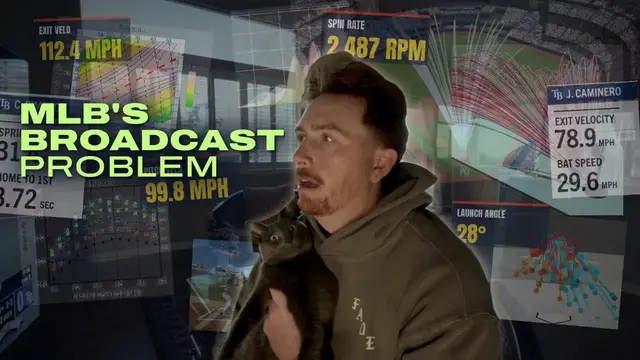
From megaphone play-by-plays to sensory-overload Statcast graphics, baseball on screen has evolved into pure visual chaos.
Show More Show Less View Video Transcript
0:00
How the f*** did we get here
0:02
We got umpcams. We are changing shots every couple seconds. There are over 40 different camera angles
0:08
Clocks are ticking down everywhere I look. I can see information about pitch speeds, exit velocities, spin rates, launch angles
0:15
multiple ads physically and digitally plastered everywhere. Then the game ended. Go Brewers
0:21
And my brain had a second to breathe. Is this actually a better experience for a fan than it used to be
0:27
So, I went back through the archives of Major League Baseball history and took a look at the tech involved in creating these experiences for fans
0:35
Starting from the very beginning, the very first World Series. So put on your favorite Boston Americans or Pittsburgh Pirates hat because we are going to dash back into the first ever World Series game in 1903
0:47
I know it sounds crazy, how did a Pirates team make a World Series? But they did, I swear
0:52
And if that offended you and you were a Pirates fan watching this, I have even worse news
0:56
you're actually going to get heckled out of winning this series by some
0:59
quote, escaped patients from an insane asylum, end quote. It's good to see some things never change, even if they are called Red Sox fans now
1:09
The story is actually pretty awesome. I'll link it down below in the description if you're interested. But if you actually wanted to watch this game
1:14
you would have had to travel to the grounds to watch. Or you would just have to check the newspaper the next day to see the scores and what had happened
1:21
Or there was a third option for diehard fans, of which there were many, you could go out and brave the October weather conditions to listen
1:30
to the predecessor of modern broadcast booths. That's right, the Megaphone Man. This beautiful
1:36
loud man was backed by the technology of Morse code. A telegraph operator would send reports of
1:42
every pitch to which the Megaphone Man would announce to the crowd. Reportedly, they even
1:47
developed their own unique and dramatic styles to keep crowds entertained between the action
1:51
I just quickly also want to shout out the Playograph here. When I first read about it, I thought, oh, that's kind of cool. And the more I think about it, it was actually really cool. So
1:58
it was an electro mechanical scoreboard that was usually put up at a newspaper building or somewhere
2:03
that was already equipped with telegraph equipment because they would get the telegraph and then two
2:07
operators behind the scoreboard would mechanically move those little pieces around to show you who's
2:12
on base, how many outs, strikes, balls, et cetera. And it would be a huge social gathering. So you
2:18
would go with your family and friends over to this building to watch the game basically live on the
2:22
first version of Gamecast. If only there was a way to not have to stand outside to hear this
2:27
What if I could listen to the game while I comfortably sit on my couch and eat snacks? Did they even have snacks back then? Well bud, it would be just a short 18 years before this was
2:37
the reality. I call this Land Before Picture Time. The radio baby! It's here and it's so f***ing
2:45
cool Sound can travel through the air dude How is that possible How did these bros figure that out over 100 years ago The first baseball game on the air happened on August 5th 1921 Guess what Games are still being broadcasted on the radio today
3:00
That's over 100 years of baseball broadcasts via the same technology. The megaphone man walked so radio could run
3:08
A 25-year-old man named Harold Arlen did the first ever play-by-play of a Major League Baseball game
3:12
He sat in a box seat behind home plate at Forbes Field with a converted telephone used as a makeshift microphone
3:20
But the equipment didn't matter. It's the voice, the stories, the action, and making the game accessible to anyone who could listen prove that radio was the future
3:29
Well, at least it was the future until a new technology took over. And you already know what I'm talking about
3:36
Lights, cameras, action. It's August 26, 1939, and it's this day that the first ever televised Major League Baseball game is broadcasted
3:45
Red Barber is on the microphone, calling the game between the Cincinnati Reds and the Brooklyn Dodgers
3:50
However, there is one big problem. Television is a brand new technology
3:55
Regular programming did not exist yet, and why would it? It's estimated there are only about 400 television sets in the entire New York area
4:03
It would be another seven years until regular network broadcasting was getting popular
4:08
TV sets weren't the norm for every American household until well into the 50s and even early 60s
4:13
So what gives? Why was this regular season matchup broadcasted on TV at all
4:17
Well, it's because the 1939 World's Fair was being held in New York at that time
4:22
which absolutely ripped, by the way. The television was one of the World's Fair's main exhibits
4:36
and what better way to show it off than with a ball game? Don't get too excited, though
4:41
As you can imagine, it was still nothing like today's broadcasts. There were only two stationary camera angles
4:46
The main angle was placed high above home plate with a wide-angle lens to show the entire field
4:51
The other was positioned in foul territory on the third base side, pointed at the infield to show the throws across the diamond
4:57
The ball was basically invisible, but regardless, it was a complete and utter success
5:03
pushing television technology to go further and further. Fans wanted more. And by 1947, they had more
5:10
Game one of the World Series between my New York Yankees and the Brooklyn Dodgers
5:13
was broadcasted on NBC network. This was the first ever televised World Series game
5:19
According to the Sports Broadcast Journal, there were about 44,000 television sets in the United States at this time
5:26
Coverage was limited to select northeastern markets. But even so, Billboard estimates nearly 4 million fans watch the games on television, either at home or at public venues like bars
5:35
By contrast, even more millions of fans followed along on the radio
5:40
Our next major leap forward would be in 1951 when CBS televised the first MLB game in color But even more interesting to me is what happened at the end of the 50s At this point in time networks really found their stride But there are two more major innovations that happened that have redefined how we watch baseball today
5:56
First off, the center field camera. This may seem obvious to us now, but it wasn't until the 1957 World Series between the Yankees and Milwaukee Braves that this angle was used
6:06
It didn't become the standard angle until the 1960s. This angle puts the viewer inside one of the most intense duels in sports
6:13
That's 60 feet and 6 inches between pitcher and batter. And number two
6:18
Emma Bee first showed a sports instant replay on a television broadcast in 1959
6:23
Yankees announcer Mel Allen asked the local WPIX station director to replay the ninth inning single
6:28
that had broken up Ralph Terry's no-hitter. Mel Allen knew that the videotape was being saved for the post-game show
6:34
but had asked director Jim Murphy if they could somehow replay the moment. They were able to show the audience at home the first ever replay in a game
6:42
even though it wasn't exactly instant. The next few decades improved on the systems, camera angles, replays, and more
6:50
And it's not until the 1990s that we have our next giant advancement in our modern day viewing
6:56
That's what I am calling the revolution of information. By the 1990s, baseball's broadcasting had somewhat of a major problem
7:03
If you stopped paying attention for a bit or stepped away to get another round and then came back to the game
7:08
you wouldn't know what had just happened, or if anything had happened at all. That's right, there wasn't a constant score graphic until the Fox box debuted in 1996
7:17
The Fox box not only gave the viewers a constant score display, it also tracked important real-time details, like the inning and outs
7:23
This was actually first used for the NFL by Fox in 1994. Even more interesting to me is when this first debuted
7:30
baseball purists hated it, saying it was distracting and that it cluttered the screen
7:35
However, it didn't take long at all until the audience attitude shifted. Suddenly everyone loved the bug because it meant they didn't have to wait for the score to be talked about
7:43
or the announcer to tell you how many outs there were to know what was going on in the game
7:47
Just a couple years later, every single major sports network was forced to copy Fox and build their own version
7:54
That brings me to today, the modern super broadcast. Well, speaking of information, welcome to today
8:04
The center field camera is still the mainstay at least. But besides that, broadcasts have changed dramatically
8:09
There are now more than 40 cameras capturing the World Series today
8:13
Oomps have cameras. There's mini cameras that are hidden in the bags. And other parts of the infield too
8:18
There are cameras in the dugouts, cameras in the stands, camera on the foul pulls, and more
8:23
Oh, of course, there's drones now too, both inside and outside the stadium
8:28
Then there are handheld setups and rigs on wires. and don't forget the high frame rate, super slow motion cameras too
8:35
These can be used to track real bat speed attack angle of a swing pitch movement spin rate exit velocity and launch angle All metrics that we really need to know at home We can use these metrics like
8:47
that though to estimate how far a home run would have gone. Maybe most importantly, we have that
8:52
built-in K zone. We can see a strike zone for every pitch, knowing better than the hitter
8:57
the pitcher, and the umpire if the pitch was a strike or a ball, which is now even more crucial
9:01
than ever since challenging balls and strikes are finally allowed in the sport. At home we basically
9:06
have a greater real-time understanding of the game than anyone on the field could ever have
9:11
It's a very interesting time and I'm not saying it's a bad thing. I like the K-Zone and I do like
9:15
seeing the metrics too. The camera angles are beautiful and watching a game can feel very immersive and futuristic. You can feel like you're on the field, in the crowd, or above the stadium
9:24
all in a matter of seconds. But there are times that it just feels like too much. Sometimes it
9:30
feels more about the stats and the metrics than it does about the game. Like broadcasts are doing
9:35
everything they can to keep my eyes on the screen rather than letting it breathe and letting me
9:39
enjoy the moment and the sport for what it is. I don't know. Overall, I think broadcasts are in a
9:44
great place, but sometimes if you're a big fan of the sport like me, it is nice to step back a bit
9:49
I listened to a handful of Yankee games on the radio this year and it was really great. There
9:52
still truly is something magical about that. I do think we could strike a better balance on these
9:57
broadcasts with old and new. In fact, I think NBC actually hit a sweet spot earlier in the playoffs
10:02
by having local booths call the games together. For example, Joe Girardi from Yes Network and
10:07
Lou Merloni from NESN called the Wild Card Series together, two familiar voices for fans who have
10:13
been watching and listening all year. For me, hearing stories about the Red Sox season this
10:17
year from a guy who watched every one of their games can just provide such a deeper insight
10:21
that you can't get from these national broadcast booths. And this is one of the things, too
10:25
It's not just the great catches that this outfield does, but it prevents guys from going first to third
10:29
It takes doubles away, turns them into singles. And he gets a fastball middle in, and he's ready for it
10:34
I think during the course of the season, at times, he's been late on the heater
10:38
But you look at his last 60 games, his OPS has really ticked up
10:42
However, I know many fans just come to watch the postseason. They may not even know who is in their local booths
10:48
And I think that national broadcasts still do a fantastic job, even if it is just a little more surface level
10:54
However, if these metrics and camera angles and all this new technology is helping to get more people interested and watching this sport that I love, then hey, I love it
11:02
Keep doing it. This game is great. Many of the relationships in my life have come from this game one way or another, whether playing it through college or watching it at a bar or playing an adult league or playing catch with my dad growing up
11:12
I have baseball to thank for so many of the beautiful things in my life. So here's the past, present, and the future of this sport
11:18
Now let's enjoy one of these teams, hopefully the Brewers. win their franchise's first ever World Series
11:25
I'll see you guys in the next one
Celebrities & Entertainment News
Entertainment Industry
TV & Video