0:00
You know that feeling when your computer
0:01
just completely freezes? Like you've got
0:03
40 tabs open, the fan is screaming, and
0:06
the cursor is just Well, that spinning
0:09
>> Oh, yeah. And no matter what you click,
0:11
absolutely nothing happens.
0:12
>> Right. Exactly. And lately, I feel like
0:14
that's what a lot of our nervous systems
0:16
feel like. We're just stuck in this
0:18
endless uh spinning wheel survival mode
0:21
of burnout and bad news and
0:24
>> which is exactly why we are doing this
0:26
deep dive today. We're looking at an
0:28
article and our mission is to unpack the
0:31
hard neuroscience behind why that old
0:33
cliche, you know, laughter is the best
0:36
medicine is actually a biological
0:39
>> It's like the ultimate temporary escape
0:40
hatch for you, the listener, when modern
0:42
life just hits hard. But let's get into
0:45
the mechanics of this because when
0:46
you're stressed, your body is locked in
0:49
that sympathetic nervous system
0:50
response, right? Like that classic fight
0:53
>> So, how does laughing actually disrupt
0:56
that? Because I mean it can't just be a
0:57
psychological distraction.
0:59
>> Oh, it's far from it. When you genuinely
1:02
laugh, you are physically forcing your
1:04
body out of fight or flight. Like just
1:06
think about the mechanics of a real
1:08
>> Your stomach hurts,
1:09
>> right? Because your diaphragm is heavily
1:11
spasming and that spasmotic movement
1:13
actually stimulates the vagus nerve
1:16
which is uh the major communication
1:18
highway between your gut and your brain.
1:20
>> Okay? So by stimulating the vagus nerve,
1:23
you're manually triggering the
1:25
parasympathetic nervous system like the
1:27
rest and digest mode.
1:28
>> You got it. You are sending this
1:29
unavoidable physical signal to your
1:31
brain that the immediate environmental
1:35
>> And that is what halts the cortisol
1:37
production. It triggers the endorphine
1:39
release and the muscle relaxation that
1:42
follows can actually last for up to 45
1:44
minutes simply because you've
1:45
biologically flipped the switch. That
1:47
really is a force quit command for a
1:49
frozen brain. I mean, you literally
1:51
cannot sustain a biological panic loop
1:54
while your diaphragm is spasming in a
1:56
>> You really can't. And that naturally
1:58
creates crucial psychological distance.
2:01
Like once the biological alarm bells
2:03
stop ringing, your mind finally has the
2:05
capacity to step back from whatever
2:07
overwhelming stimulus is right in front
2:10
>> which makes sense.
2:11
>> Yeah. And you see this vividly in really
2:14
high stakes environments, you know,
2:15
emergency rooms, military deployments.
2:18
>> Okay, wait. Let me challenge that for a
2:20
>> Because when people use dark humor in a
2:23
crisis or say they crack a joke at a
2:26
>> doesn't that just mean they're avoiding
2:29
>> Because to anyone watching, it usually
2:30
just looks like flatout denial or blunt
2:33
insensitivity? I mean, yeah, it totally
2:35
looks that way from the outside, but
2:37
neurologically it's actually a highly
2:39
sophisticated coping mechanism.
2:41
>> Yeah. When you reframe a tragedy into a
2:44
joke, you are forcing your prefrontal
2:46
cortex, which is the logical pattern
2:48
recognizing part of your brain to
2:50
override the amygdala's raw panic
2:54
>> Oh, I see. So, you aren't ignoring the
2:56
tragedy. You're just putting like a
2:58
cognitive buffer around it so you can
2:59
actually look at it without completely
3:02
>> Exactly. The human mind is constantly
3:05
searching for a way to tolerate
3:06
emotional weight that would otherwise
3:08
just be paralyzing. The joke is the
3:11
buffer. It lets people mentally approach
3:14
painful realities without being
3:16
completely consumed by them.
3:17
>> That's wild. And think about how that
3:19
scales down to just everyday stress,
3:21
like dealing with an aggressive driver.
3:24
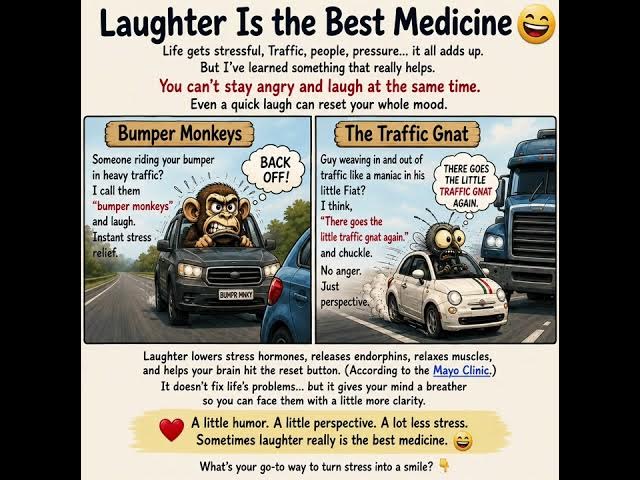
>> The article actually mentions a trick
3:25
where the author renames tailgators
3:27
really ridiculous things like bumper
3:29
monkeys or freeway nats.
3:31
>> Bumper monkeys. I love that. And it's
3:33
the exact same cognitive buffering at
3:35
play, right? By assigning this absurd
3:37
label, you completely change the
3:39
narrative from a personal attack like,
3:41
"Oh, this person hates me." to a
3:43
cartoonish scenario. It strips the
3:46
>> And I guess it prevents you from
3:47
reacting with your own rage, which is so
3:49
critical because we rarely know what's
3:52
actually fueling that other Percy's
3:55
>> Like the author shares this profound
3:56
story about driving down a gravel road
3:58
intentionally going slow to avoid rock
4:01
>> And this guy behind him is riding his
4:03
bumper, just honking and totally
4:06
>> Right. And when they finally pull over
4:07
to confront each other, it turns out the
4:09
aggressive driver is a coworker.
4:11
>> Yes. A coworker who was rushing home
4:14
because his daughter was having severe
4:16
>> It is such a gut punch of a story.
4:18
>> It really is. What looks like hostility
4:20
to us is just so often someone else's
4:23
pure emotional overload.
4:24
>> Yeah. And when we use humor to regulate
4:27
our own stress response, you know,
4:29
laughing at the bumper monkey instead of
4:31
screaming at them, we maintain the
4:33
emotional bandwidth to show compassion
4:35
when the reality of a situation actually
4:38
>> which is so important. Now, to be clear,
4:41
laughter is not a replacement for real
4:43
therapy. It's not going to magically pay
4:45
your bills or cure a chronic illness,
4:47
>> right? Unfortunately, not.
4:48
>> But our nervous systems simply weren't
4:49
built to sustain the constant pressure
4:51
of modern life. Laughter provides this
4:54
essential biological breathing room.
4:55
>> It really is your internal circuit
4:58
>> Well, I want to leave you with this to
5:01
If a single genuine laugh can hit force
5:03
quit on your own biological stress loop,
5:06
how might intentionally making someone
5:07
else laugh today alter the trajectory of
5:10
their invisible burdens?