0:00
All right, let's talk about one of the
0:02
most common and honestly one of the most
0:04
frustrating headaches for any pool
0:06
owner. But I promise you, by the end of
0:08
this quick explainer, you'll have a
0:10
super simple, clear solution to get that
0:12
perfect sparkling water you've been
0:14
dreaming of. Does this look a little too
0:17
familiar? You walk out to your pool,
0:19
you're all ready for a swim, but the
0:20
water just looks blah. You know, it's
0:23
cloudy, maybe a little murky, and it is
0:26
definitely lost that crystal clear
0:27
sparkle. Or maybe this is your reality.
0:30
Friends and family get out of the pool
0:32
and they mention that their eyes are
0:33
stinging or their skin feels kind of
0:35
itchy. It is so easy to just blame the
0:37
chlorine, right? But here's the thing.
0:39
Both that cloudy water and the
0:41
irritation, they often point to the
0:43
exact same hidden cause. And that
0:46
culprit, nine times out of 10, is an
0:48
unbalanced pH level. Seriously, you can
0:51
think of it as the invisible force
0:52
behind most of the common pool problems.
0:54
Getting a handle on it is absolutely the
0:57
key to clean, safe, and beautiful water
0:59
all season long. So, let's pull back the
1:01
curtain. What even is pool pH? Before we
1:05
can fix the problem, we've got to
1:06
understand what we're actually dealing
1:08
with. And don't worry, I promise this
1:09
isn't going to be some boring high
1:11
school chemistry lesson. Just the simple
1:13
need to know stuff. At its core, pH is
1:16
just a simple scale from 0 to 14 that
1:19
tells you if your water is more on the
1:21
acidic side or the basic side. Zero is
1:23
highly acidic, 14 is highly basic, and
1:26
seven, right in the middle, is perfectly
1:28
neutral. Now, getting this number right,
1:31
is crucial because if it's off, your
1:33
chlorine basically can't do its job of
1:35
sanitizing, and the water itself can
1:37
start to damage your pool's surfaces and
1:39
equipment. Ouch. And this this right
1:42
here is the magic number. Well, the
1:45
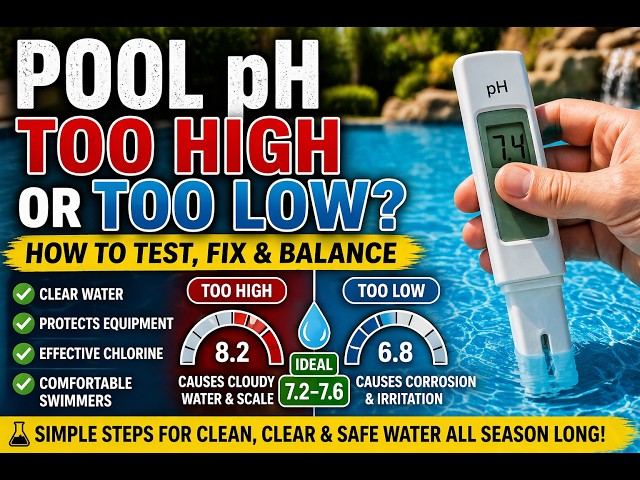
magic range, I should say, 7.2 to 7.6.
1:49
You're going to want to burn this into
1:50
your memory. This is the absolute sweet
1:52
spot. In this range, the water feels
1:55
comfortable for swimmers and your
1:56
chlorine is at peak power, ready to zap
1:58
any bacteria or algae that dares to show
2:01
up. Okay, so we know what pH is and we
2:03
have our target range. Now, it's time to
2:05
do a little detective work and figure
2:07
out if your pool's pH is too high or too
2:09
low. And believe it or not, the symptoms
2:10
are actually pretty different. Let's
2:12
break this down. If you're seeing that
2:14
cloudy water or maybe you've noticed a
2:16
chalky white scale building up on your
2:18
tiles, you're almost certainly dealing
2:20
with high pH. On the other hand, if the
2:22
main complaint is burning eyes or you're
2:24
actually seeing corrosion on metal parts
2:26
like your ladder, your problem is likely
2:28
low pH. Diagnosis complete. Now that
2:32
you've probably figured out which camp
2:34
you're in, let's get to the fun part,
2:36
the fix. These are the simple,
2:37
actionable steps to bring your water
2:39
right back into that perfect range. If
2:42
your pH is too high, you need to add an
2:44
acid to bring it down. The process is
2:46
super simple. Test your water first so
2:49
you know your starting point. Then
2:51
carefully add either muratic acid or dry
2:53
acid. And listen, this stuff is potent,
2:56
so always follow the safety directions
2:57
on the label. We're talking gloves and
2:59
eye protection for sure. The real key
3:02
here is to add it in small amounts. You
3:04
can always add more, but you can't take
3:06
it out. Let your pump circulate the
3:08
water for a few hours, then test again.
3:10
And if your pH is too low, well, it's
3:13
pretty much the same dance, just with a
3:15
different chemical. In this case, you'll
3:17
use soda ash. Test first, add the soda
3:20
ash gradually around the edges of the
3:22
pool, let it circulate for a while, and
3:24
then retest to check your progress. See,
3:26
simple. This brings us to the
3:29
milliondoll question, doesn't it? We
3:31
know what to add, but how much is a
3:34
small amount? You definitely don't want
3:36
to overshoot your target and
3:37
accidentally create a whole new problem.
3:40
Here's a great starting point. For a
3:42
pretty typical 15,000galon pool, about 9
3:45
ounces of soda ash will raise your pH by
3:47
roughly 0.2. But, and this is really
3:50
important, think of these as
3:51
approximations. Every pool has its own
3:54
unique chemistry. So, use this as a
3:56
guide to get you in the ballpark. But
3:58
always, always retest after you make an
3:59
adjustment. Getting your pH back in
4:02
range is a huge win, but the real goal
4:04
is to keep it there, right? So, why does
4:07
it seem to wander off all the time in
4:09
the first place? You know, your pool's
4:11
pH is in a constant state of flux. Every
4:13
time it rains, that adds acidic water.
4:16
Every person who swims brings in oils
4:17
and lotions. Even features like
4:19
waterfalls can cause irration that makes
4:21
the pH rise. And one of the biggest
4:23
factors is your alkalinity level. Think
4:25
of alkalinity as the buffer that helps
4:27
keep your pH stable. So, the goal isn't
4:30
to stop it from changing. It's to be
4:32
aware of these things so you can
4:33
anticipate them. So, let's just recap
4:35
the fundamentals real quick. Your target
4:37
7.2 to 7.6. High pH means lazy chlorine
4:42
and scale. Low pH means corrosion and
4:45
irritation. Use acid to lower pH, soda
4:48
ash to raise it. And the master key to
4:50
all of this, test your water two to
4:52
three times a week. That is the real
4:54
secret to staying ahead of any problems.
4:57
With this knowledge, you're no longer
4:59
just reacting to pool problems. You are
5:01
in control. You understand the why
5:04
behind the what, and you've got the
5:05
tools to keep your water perfect.