Up next in 10


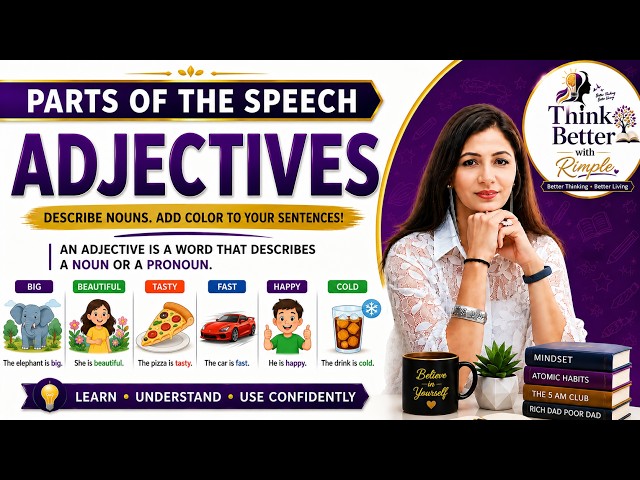
📘 PARTS OF SPEECH – ADJECTIVES | Easy English Grammar Lesson
Welcome to Think Better with Rimple! 🌟
In this video, you will learn about ADJECTIVES in a simple, fun, and easy way. Adjectives are describing words that make sentences more interesting and meaningful.
✨ In this lesson, you will learn:
✔ What are adjectives?
✔ How adjectives describe nouns and pronouns
✔ Types of adjectives
✔ Easy examples with sentences
✔ Daily-use grammar practice
✔ Common mistakes to avoid
📚 Examples included:
👉 Beautiful flower
👉 Tall boy
👉 Happy child
👉 Clever student
🎯 This video is perfect for:
Show More Show Less View Video Transcript
0:00
Good morning everyone. So, today I'm
0:02
going to make you understand the next
0:04
parts of the speech, that is adjectives.
0:07
So students, what are adjectives?
0:11
Adjectives are the words that describe a
0:13
noun, a noun phrase, or a pronoun.
0:17
Adjectives give us more information
0:19
about the noun. They tell the features
0:22
or the characteristics of the noun. And
0:25
mostly adjectives appear before the
0:27
noun.
0:28
So, in simple words, if you have to
0:30
understand what an adjective is, then
0:33
adjectives are the words which give us
0:35
more information about the noun.
0:38
Let's try to understand with help of
0:40
some examples.
0:42
Ayan is a tall boy. Boy is a noun. Tall
0:46
is an adjective. There are 10 students
0:50
in the class. Students is a noun. 10 is
0:53
an adjective. Now, let's understand
0:57
various types of adjectives. The first
0:59
type of adjective that we are going to
1:01
understand is the qualitative or the
1:04
descriptive adjectives. We also call
1:07
them adjectives of quality.
1:10
So, what are adjectives of quality? They
1:12
are the words which tell about the
1:15
quality of a noun.
1:17
These words can describe the size, age,
1:21
shape, color, material, origin, and
1:25
purpose of the noun. Just check some
1:28
examples. We ate some delicious food.
1:32
Delicious is the adjective. She has a
1:35
beautiful face. Beautiful is an
1:38
adjective. She is a clever student. Give
1:42
me that green notebook. He bought a
1:45
diamond ring. So, the words clever,
1:49
green, and diamond, all these are
1:52
adjectives.
1:53
Now, next type of adjectives are
1:56
quantitative adjectives or adjectives of
1:59
quantity.
2:01
As the word is telling, these words
2:04
indicate the number or the amount of the
2:07
things. Here both the things would come.
2:10
Apply the question statement
2:11
classification like how much or how many
2:14
to the noun. Now, let's try to
2:17
understand first with the number. If I
2:20
say, "There are 30 students. There are
2:24
several books." So here 30 students or
2:27
several books, both of them are
2:29
countable.
2:31
So these are adjective of number. We can
2:34
count them.
2:35
Now let's check the next examples. He
2:38
brought some cheese. They ate half of
2:42
the pizza. So here some cheese and half
2:45
of the pizza can't be counted. It's a
2:48
quantity which can be measured. So these
2:51
are the things which also come under
2:54
quantitative adjectives. So here the
2:56
answer would be either how many like 10,
2:59
20, several or it can be how much 10 kg,
3:04
some, a little, etc. Now the third type
3:07
of adjectives which we are going to
3:09
understand are the demonstrative
3:11
adjectives. These words point out the
3:14
nouns. They describe the position of the
3:17
noun in space or time.
3:20
If you remember in the last video about
3:22
pronouns, we had done demonstrative
3:24
pronouns also. And I told you that under
3:27
demonstrative four words always comes.
3:30
This, that, these and those.
3:33
There we used this, that, these, those
3:36
to replace the nouns. But here we are
3:39
going to use them to give more
3:41
information about the noun. Let's take
3:44
some examples. This time I'll pass the
3:47
exam.
3:48
This
3:49
I I
3:50
that bag more. So here if you see this,
3:54
that, these, those are coming before a
3:56
noun. So, whenever we have to use this,
3:59
that, these, those as demonstrative
4:02
adjectives, you have to use them before
4:05
the noun. This time, that bag, that
4:09
notebook, these apples, those books. So,
4:13
here this, that, these, those, all the
4:17
four words are coming before the noun.
4:20
It's giving us more information about
4:22
the noun. They are describing the
4:25
position or they are pointing out the
4:27
noun. So, here they are demonstrative
4:30
adjectives. Now, the next type of
4:33
adjectives are interrogative adjectives.
4:37
We know very well interrogation means
4:39
asking a question.
4:41
So, these words modify a noun by asking
4:44
questions.
4:46
And they are also known as interrogative
4:49
determiners.
4:51
Let's check some examples.
4:53
Which subject do you like more?
4:55
What kind of movies do you love? Whose
4:58
bike is this? Which dress is more
5:01
expensive? Whose pen did you borrow? So,
5:05
like demonstrative adjectives, even the
5:07
interrogative adjectives when you have
5:09
to use the words like which, what,
5:12
whose, which will always come before a
5:16
noun in order to use them as
5:19
interrogative adjectives.
5:22
Now, after this, the next type of
5:24
adjective that we are going to
5:26
understand are the possessive
5:28
adjectives. What are possessive
5:30
adjectives? Possessive adjectives are
5:32
the words which express who owns
5:36
something. They indicate the possession.
5:40
They indicate the belongingness.
5:43
Ownership. Check the examples. My phone
5:47
is not working.
5:49
Her hair is longer than mine.
5:53
She is our favorite teacher.
5:56
All students finished their books.
6:00
He lost his glasses again. So, just
6:03
check it out. The words like my, her,
6:07
our, their, his are all being used
6:11
before a noun. They are not used in
6:14
place of noun. We are using them before
6:17
the noun. So, here they are acting as
6:20
possessive adjectives.
6:23
The next type of adjectives are
6:25
distributive adjectives. What does the
6:28
word distribute means? To distribute the
6:31
things.
6:32
So, it means these words show the things
6:35
counted collectively as individuals.
6:39
The words like each, every, either,
6:43
neither, any, one, or both are all used
6:48
as distributive adjectives.
6:51
Check the examples.
6:53
Each student has a pen.
6:56
He runs every morning.
6:58
Is there any cheese?
7:01
Both of them are here.
7:03
She doesn't like it, neither am I.
7:06
So, here each, every, any, both, neither
7:12
are all the distributive adjectives.
7:16
So, now one more type of adjectives we
7:19
need to understand.
7:21
They are the compound adjectives.
7:23
Compound means made up of two or three
7:26
words.
7:28
So, they are the compound words which
7:31
actually act as adjectives.
7:33
As I told you just now, they contain two
7:36
or more words which are having a hyphen
7:40
in between.
7:41
Check the example, students.
7:43
She is a well-known artist. So, see,
7:47
well-known
7:49
is a word which has been separated by a
7:51
hyphen. It's a compound word.
7:54
I have a 10-page assignment. 10 {hyphen}
7:59
page.
8:00
They gave 10-minute break time.
8:03
He took a five-week course.
8:07
We use cruelty-free products. So, here
8:10
well-known, 10-page, five-week,
8:14
cruelty-free are all compound words, and
8:17
they are used as compound adjectives.
8:20
So, I hope, students, I have made you
8:22
understand all the type of adjectives.
8:25
If you have any doubt, you can just drop
8:28
me a message. I'll just give you more
8:30
clarity. Thank you so much. Follow and
8:33
subscribe Think Better with Rimple.
#People & Society