Up next in 10


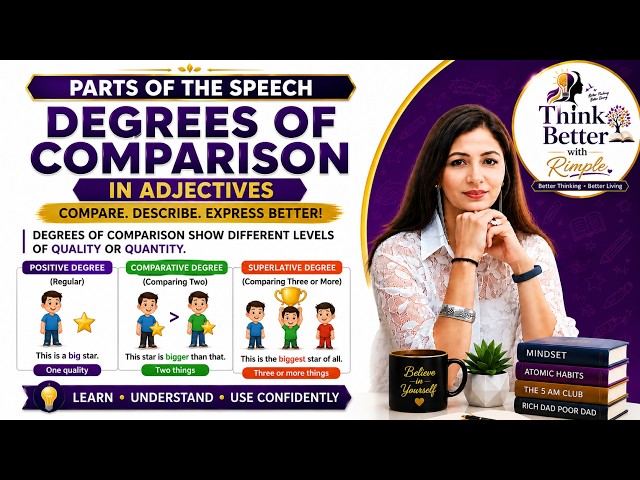
📚 DEGREES OF COMPARISON IN ADJECTIVES | Easy English Grammar Lesson
Welcome to Think Better with Rimple! 🌟
In this video, you will learn Degrees of Comparison in Adjectives in the easiest and most interesting way. This lesson will help you understand how adjectives change when we compare people, places, animals, or things.
✨ In this lesson, you will learn:
✔ Positive Degree
✔ Comparative Degree
✔ Superlative Degree
✔ Easy grammar rules
✔ Daily-use examples
✔ Sentence practice
📘 Examples:
👉 Tall – Taller – Tallest
👉 Big – Bigger – Biggest
👉 Good – Better – Best
🎯 Perfect for:
✅ School students
Show More Show Less View Video Transcript
0:04
Good morning students. Hope you all are
0:06
doing fine. I have already discussed
0:09
various parts of the speech with you all
0:11
which includes nouns, pronouns, verbs,
0:15
adverbs and adjectives and I hope I have
0:18
made you understand those very well.
0:21
Today I'm going to discuss one more
0:23
aspect of adjectives with you that is
0:26
degrees of comparison in adjectives. It
0:29
is one of the important part which we
0:31
all need to understand because it plays
0:33
a very important role when we are making
0:35
sentence formation. So let's start with
0:38
it guys.
0:40
So what are the various things which we
0:42
are going to cover in degrees of
0:45
comparison in this particular video.
0:47
Number one understanding the meaning of
0:49
degrees of comparison. Number two
0:52
identify three degrees of comparison.
0:55
Three, use comparative and superlative
0:58
forms correctly. Apply comparison in
1:01
simple sentences and avoid some common
1:05
mistakes that we make while we are doing
1:08
comparison. Let's first of all
1:10
understand what is the definition of
1:13
degrees of comparison. Degrees of
1:16
comparison. Compare means to compare one
1:18
thing with the another or one thing with
1:21
more other things. So degrees of
1:24
comparison is mainly used to compare the
1:27
qualities of the people, animals or
1:30
things. It shows whether something has
1:34
more, less or the most of a quality.
1:39
For example, a cat is small. Here we are
1:43
just talking about a cat. Next sentence,
1:46
a dog is bigger than a cat. Now here I'm
1:51
comparing a dog with another cat and
1:54
what I'm saying a dog is bigger than a
1:58
cat.
2:00
Now let's understand what are the types
2:04
of degrees of comparison. Particularly
2:07
there are three types of degrees of
2:09
comparison. First is the positive
2:12
degree, comparative degree and the
2:16
superlative degree. Let's move on to the
2:18
next slide.
2:20
First of all, I'm going to start with
2:22
the positive degree with you. Now, let's
2:26
start with the positive degree. The
2:29
positive degree always describes one
2:31
thing without comparing it to the
2:34
others. It is always subject plus
2:37
adjective. For example, if I talk about
2:40
a house, the house is big.
2:44
She is tall.
2:46
This book is interesting. So if you see
2:50
all the three examples in the video,
2:52
they are just discussing one thing at a
2:54
time. So when we have to tell the
2:57
quality of one thing without comparing
3:00
it with the others, we always use the
3:04
positive degree. Let's move on to the
3:07
comparative degree. The comparative
3:10
degree is always used to compare two
3:14
things.
3:15
The pattern is the adjective plus eer
3:19
plus than if in case there is a shorter
3:21
adjective. The more plus long adjective
3:26
plus than. I'll explain you these things
3:28
in the further slides. For example, if I
3:31
have to compare a cat and a dog, what I
3:34
would say a cat is smaller than a dog.
3:40
English and maths. English is more
3:44
interesting than maths. So whenever we
3:48
are going to compare two things, we are
3:51
always going to use the word than.
3:56
Now let's move on to the third type of
3:59
degree in comparisons in adjective and
4:01
that is your superlative degree. What is
4:04
the superlative degree? The superlative
4:07
degree is always used to compare more
4:09
than two things. Always remember one
4:12
important thing whenever we are going to
4:15
use the superlative degree t the is
4:19
always going to come. What is the
4:22
pattern? The plus adjective plus est or
4:27
the most plus long adjective.
4:31
Let's see first example. She is the
4:35
tallest student in the class. It means
4:37
here we are comparing one girl with all
4:42
the other students of the class.
4:45
This is the most interesting movie. So
4:49
here again out of all the movies we are
4:52
telling that this is the one which is
4:54
the most interesting movie. So when we
4:58
talk about just one thing there we use
5:00
the positive degree. When we compare two
5:03
things, we use the comparative degree.
5:06
And when we have to compare one thing
5:09
with many other things, we use the
5:13
superlative degree.
5:15
Now I told you students that there are
5:17
some short adjectives, there are some
5:19
long adjectives. Let's understand what
5:21
does it mean. Now let's understand what
5:25
are short adjectives. Short adjectives
5:28
usually have one or two syllables.
5:31
Mostly when we are going to change the
5:33
degrees these shorter adjectives in
5:36
comparative they are going to put eer
5:39
and for the superlative degree we are
5:41
going to put est at the end bigger
5:45
biggest fast faster fastest smaller
5:51
smallest. So these are the short
5:53
adjectives behind whom we simply put eer
5:57
for comparative and est for superlative
6:00
degrees.
6:02
However, if we talk about long
6:04
adjectives, they usually have two or
6:08
more syllables. For example, beautiful.
6:12
Now when you have to write their
6:13
degrees, we are going to add more and
6:17
the most before them. Beautiful. more
6:21
beautiful, the most beautiful,
6:24
expensive, more expensive, the most
6:28
expensive.
6:31
And third, there are irregular
6:33
adjectives.
6:35
For them to change their degrees, they
6:37
don't follow a rule. We have to learn
6:39
them by heart. For example, good,
6:42
better, best, bad, worse, worst, far,
6:47
farther, farthest. So there are going to
6:50
be shorter adjectives behind whom you're
6:53
going to put eer or est. The long
6:56
adjectives for which we are going to add
6:58
more or the most and there are irregular
7:01
adjectives which we have to learn by
7:04
heart.
7:05
Now I already told you that when we are
7:08
going to use the comparative degree we
7:11
always use than after the comparative
7:14
degree. If I'm comparing my house with
7:16
the house of other person, what I would
7:18
say my house is bigger than yours. So
7:23
see with bigger I have used the word
7:26
than. A bicycle is cheaper than a
7:30
motorcycle. So I have used the
7:33
comparative degree of cheap that is
7:35
cheaper and I have used than after that.
7:40
However, there are some common mistakes
7:42
which students usually do. Let's check
7:46
those examples. You will never say she
7:49
is more taller than me. For tall, the
7:52
three degrees are tall, taller, tallest.
7:55
Now, with taller, you will not put more.
7:58
You'll simply say she is taller than me.
8:02
Similarly, cheap, cheaper, cheapest.
8:06
Some students they add most with
8:08
cheapest
8:10
cheap. This is the most cheapest bag.
8:12
No, this is totally wrong. For cheap the
8:15
superlative degree is cheapest. This is
8:18
the cheapest bag.
8:21
He is the better student. No, I told you
8:24
th the will be used only in the
8:27
superlative degree. He is the best
8:30
student in the class.
8:34
Let's some check some more examples for
8:36
your better understanding.
8:38
My school is bigger than my old school.
8:41
So here we are comparing two schools.
8:44
This test is easier than the last one.
8:47
Here again we are comparing two. So I'm
8:50
using the comparative degree. She is the
8:53
smartest student in the class. So here
8:55
I'm comparing one girl with all the
8:58
other students in the class. So I have
9:00
used the superlative degree.
9:03
In this slide, I have given you
9:06
different words which have different
9:08
degrees of comparison. So you can just
9:10
go through them for your better
9:11
understanding. Small, smaller, smallest,
9:14
fast, faster, fastest, hot, hotter,
9:17
hottest. So these are the short
9:19
adjectives. But if you see the long
9:21
adjectives, famous, more famous, most
9:25
famous, careful, more careful, most
9:28
careful. And third I told you some
9:30
irregular adjectives like good, better,
9:34
best, bad, worse, worst, little, less,
9:39
least. So these are the examples of
9:42
irregular adjectives. So I hope I have
9:44
made you understand very well. Different
9:47
degrees of comparison. Two most
9:49
important things which you always need
9:51
to keep in your mind is that in
9:53
comparative degree we always compare two
9:55
things and we are going to use than. And
9:58
in superlative degree we find one in
10:02
comparison to the all. So we are going
10:04
to use th the always when we are using
10:07
the superlative degree. So that's all
10:10
for today. I hope you all have
10:12
understood what I have tried to explain
10:14
you. Thank you so much. Please follow
10:16
and subscribe. Think better with Rimple.
#People & Society