Up next in 10



Make Golf Easy With This Simple Approach To Practice.
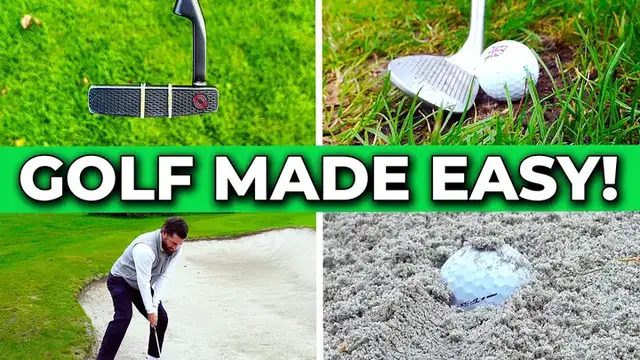
In this video, Joe 'the pro' Ferguson demonstrates a simple but effective approach to practice that should help the game of golf feel and seem easier out on the course. Give it a try next time you're working on your game as we're confident it will have almost instantly positive results on your performance.
Show More Show Less View Video Transcript
0:00
Are you fed up of putting work into your game and not seeing that effort reflected in your scores
0:05
Well, I've got a little hunch as to why that might be, and I've come to the beautiful Parkston Golf Club to tell you why
0:10
The number one thing I see with poor practices is people not making their practice difficult enough
0:16
Now, what I mean by that is taking it easy on yourself in practice and giving yourself lovely fluffy lies and not really challenging yourself might be good fun
0:23
but I don't think you're going to see the benefits on the other end. Think about it, if you're trying to get fit, you don't go to the gym and put the treadmill on the slowest setting with no incline whatsoever
0:34
You challenge yourself, you make that more difficult and you see the benefits in your cardiovascular fitness
0:39
The same principle should apply to your goal. So I've got some practice tips all the way from driver, irons, down to your short game and your putter
0:47
So let's get to it, let's get on that driving range. Starting with driver, how do we make driving practice more difficult
0:52
well one of the things I see all the time down at the driving range is people just picking out
0:56
say a marker post on this range and hitting balls towards it and whilst that's not a bad use of your
1:02
time I think we can be a little bit more focused. A fairly average sized fairway here in the UK at
1:07
least would be about 35 yards wide so one of the things I love to do on the range is go ahead and
1:13
pick out a target that is significantly smaller than that. So for example on this range here at
1:18
at Parkston Golf Club, I've got some markers out here that are really, really useful. So I'm picking
1:23
out an area that's about 20 yards in width, in my opinion, between the black marker up in the
1:28
distance there and the yellow marker. So that's a significantly smaller target than I would see on
1:33
the golf course. So when I'm practicing towards that, it will fine tune my feels and my perception
1:38
what a fairway is. So when I get back out onto the golf course, all of a sudden that 35 yard fairway
1:44
feels absolutely massive. Now, you don't just have to stop there. You can also challenge yourself and
1:49
make it more measurable. So a lot of things I like to do, hit 10 balls in a row and see how many of
1:55
those balls I can keep between those two parameters. If you've got a bit more time, you can keep going
2:00
and hit ball after ball after ball and not stop until you hit your target number, which might be
2:05
20 fairways. It might take you a few to get there, but like I said, once you get out onto the golf
2:09
course and get to that 35 yard fairway you'll really feel the benefits from a confidence point
2:14
of view. A little tip for you that I would use either bring a notepad or use the notes section
2:18
on your phone note down what you've done in terms of a score so you can track it and see if you can
2:22
beat it next time. While we're on the driving range you can use the same principles in your iron play
2:28
as we've just spoken about there with driver you can create small greens and smaller targets
2:32
to sharpen your focus but one thing that I really like to do with the iron side of things is to me strike is absolutely key So your front to back dispersion is equally as important as your left to right dispersion And to achieve good front to back dispersion with iron play
2:47
you need precise striking. And one thing that I've picked up recently
2:54
to help me with that strike is this clever little training aid, the Butterblade
2:58
So the Butterblade is essentially a little training aid iron that has been through the honey I shrunk the kids machine
3:03
It is tiny. of my normal Gamer 7 iron. So what this does is puts a real premium on strike. If you miss the
3:12
middle, you really, really know about it. There's not much margin for error here. So as much as you
3:16
might think that might affect your confidence, it's actually going to really, really dial you in
3:21
You don't need to be confident here. The point of this is we're making it far more difficult to find
3:25
a strike in practice. So when you get out onto the golf course and you see your normal iron in front
3:30
of you, it feels enormous and it feels like you cannot miss. So what I've been doing over late
3:34
I've been incorporating at least half a dozen shots in all of my warm-ups and practice sessions
3:39
with this Butterblade. Just making it that much more difficult for myself in practice
3:43
makes it so much easier when I get to the golf course, and it's one less thing to think about
3:48
knowing I've already dialed in my strike. Another good option if you don't want to spend the money on a training aid like the Butterblade
3:57
is head to your pro shop or somewhere like Golf Clubs for cash and find the oldest, smallest
4:01
bladed iron you can and hit a few shots with that before you play or in your practice sessions
4:06
it'll essentially do the same thing for you. So how many of you practice like this? You've just
4:14
hit a nice chip shot, you give yourself a nice fluffy low, plenty of grass underneath the ball
4:19
you drag another ball and you just do the same and you repeat, repeat, repeat thinking you're
4:24
getting better at chipping. Well I would argue that you're probably not. That was really good
4:29
nearly went in. If you think about it, how many times do you get that lie out on the golf course
4:33
Unless you're significantly luckier than me, it's not very many. We're quite often sat down in the
4:38
rough, we've got a tight bear lie. So all you're doing by treating yourself well in this practice
4:43
area is setting yourself up for failure on the golf course. So what I like to do is quite the
4:48
opposite. I like to flick the switch and make it as difficult as possible. And I like to find
4:52
some of the tightest, muddiest, most compact and scruffy lies possible to really fine-tune my
4:58
my strike and my feel. Now this is something that a lot of tour pros do
5:02
and have done very successfully. Nick Faldo is one who very rarely would play his good shots
5:08
in a practice round. He would go and find the most awkward lie or stance possible
5:13
So when it became tournament time, he was prepared for anything Padraig Harrington has also been known with his short game practice to find those sort of railway sleeper steps that you get going into bunkers and clip chips off that because it the ultimate firm tight surface Now that might be a little bit extreme but like I say especially in
5:31
the winter you might be able to find some less than optimal lies and if you can drag your ball
5:36
onto those lies and it's a little tricky at first but if you can learn to find strike from some of
5:41
these really tough scruffy lies, all of a sudden, every time you get out onto that golf course
5:47
let's go again here, let's give it even worse. Every time you go out onto that golf course after this
5:54
when the ball's even sat halfway reasonable, and that's a really good example, or not quite
5:59
it's gonna seem like an absolute delight compared to this. So once you've really fine tuned your strike here
6:04
in the tougher conditions, every time you get on that golf course, it'll be a nice surprise
6:08
So furthermore on the short game, it doesn't just stop with chipping, We're in the bunker now and there's loads of ways you can make bunker shots difficult
6:14
Again, what I generally see is people chucking them down on nice fluffy lies and just splashing away till their heart's content
6:20
But I like to make it progressively more difficult. So if you've got a line of, say, three or even more golf balls
6:26
try and make each one progressively worse in lie. The first one's good. I'm going to tap on the head of that one so it's a bit more buried
6:32
And we're really going to bury that last one. Almost half the ball is submerged beneath the ground there
6:38
Then when you're practicing the first one should be relatively easy to splash out
6:43
Now we know we've got a slightly more difficult one with the second shot so
6:47
I'm preparing myself for eventualities on the course. So my technique is here I
6:51
get a little bit more weight forward, stick the club in the ground and we're
6:56
getting the ball out of the bunker. Now this last one we have to go a little bit more extreme and we have to dig it a little bit more and we played that one
7:04
really really nicely but it's not just about the lie of the ball there's slopes in this bunker we
7:09
can use so i can come here and instead of a lovely perfectly flat lie which we rarely get
7:14
i can pop myself on this down slope here in a less than optimal lie in an awkward situation and these
7:20
are situations you face on the golf course so why would you not practice them i'm going to get my
7:24
my body level with that slope and i'm going to go digging for the ball and that would be a
7:29
perfectly acceptable result on the golf course i've got it to about 15 feet there how many times have
7:33
if you hit a wedge shot into a bunker and you've plugged it up the face here. So we're going to
7:38
on a heavy upslate, we're going to stand on that ball. I can barely see it. That's not an
7:43
uncommon occurrence for me, unfortunately. So again, how do we deal with it? If we haven't
7:48
practiced it, it's going to be a nasty surprise on the golf course. So all the difficult things
7:52
you do here that make it awkward will make it significantly easier on the golf course when you needing to escape from these very difficult situations The putting green is one of the easiest areas to make your practice more difficult We got plenty of holes here on this beautiful green
8:07
at Parkes and Golf Club, but I'm not gonna use those holes. I wanna use a smaller target
8:12
So I've got a tee peg with me. I'm just gonna try and hit some sort of four or five foot putts
8:17
And instead of aiming for that hole, which we know is plenty big enough to take a golf ball
8:22
I'm gonna be going at a smaller target of that tee peg. and if I can hit that tee peg that probably you know I've missed my target there but that probably
8:29
would have gone in so if I can start hitting putts where I'm consistently hitting that tee peg
8:35
then I can be very sure and very confident when I get out on that golf course I can hit the hole
8:41
and it's all about getting that confidence. Another way of narrowing your target particularly on these
8:46
very holeable short putts and I do this up to about six feet which I consider a really important
8:51
range for your scoring. Again, just narrowing your targets. What I've done here is up by the hole
8:56
instead of giving myself the entire hole to aim at, I've just made a small gate at the front with
9:01
the tees. It's obviously slightly bigger than the ball because I still want the ball to be able to
9:05
go through. But all of a sudden, instead of having the entire hole to aim at all of a sudden
9:11
I know that was just creeping in the right half. It's gone in, but it's only gone in
9:15
off that right-hand tee peg. So the idea of this exercise is to get yourself to a point where you
9:20
can get straight through that gate without hitting either of those tees. So we're just narrowing our
9:25
focus again. It makes the task more difficult in practice. So once again, on the golf course
9:30
it becomes a lot easier. One thing that we never think about enough in putting, in my opinion
9:35
is strike. We all take it for granted that we're going to hit the putt out the middle of the face
9:39
but I've played enough pro-ams to know that's not the case. And one way I like to make practice
9:43
difficult to ensure I do that is the use of two elastic bands. So if you've got a putter that
9:48
permits and some shapes do and some shapes don't but you can generally figure it out. I like to wrap
9:52
two elastic bands around the head like this and create a very small gap around a centimeter in
9:58
the middle of the putter face there for me to make contact with that golf ball. All of a sudden if you
10:04
miss the face, miss the center of the face slightly on the heel or the toe, the ball will shoot off
10:08
at a very funny angle and you'll get that instant feedback. So when you've got that elastic band on
10:13
there and you really need to meet the middle of the putter you get a real sense straight away of
10:19
whether you're hitting the middle of the face so when you take those elastic bands off you've done
10:23
your hard work you've done your training you've narrowed your focus and dialed in your strike so
10:27
again it's one less thing to think about on the golf course. So there's a few tips for you to help
10:31
make your practice more difficult and benefit your game and I've got a hunch if you're willing
10:35
to follow those practice tips 2025 could be your best golfing year ever
#sports
#Golf
#Sports Coaching & Training